Get Full Government Meeting Transcripts, Videos, & Alerts Forever!
Get email alerts on the Legislative Advocacy topic
No spam. Unsubscribe anytime.
Carlsbad officials outline legislative priorities, oppose state bill that would limit local control
Summary
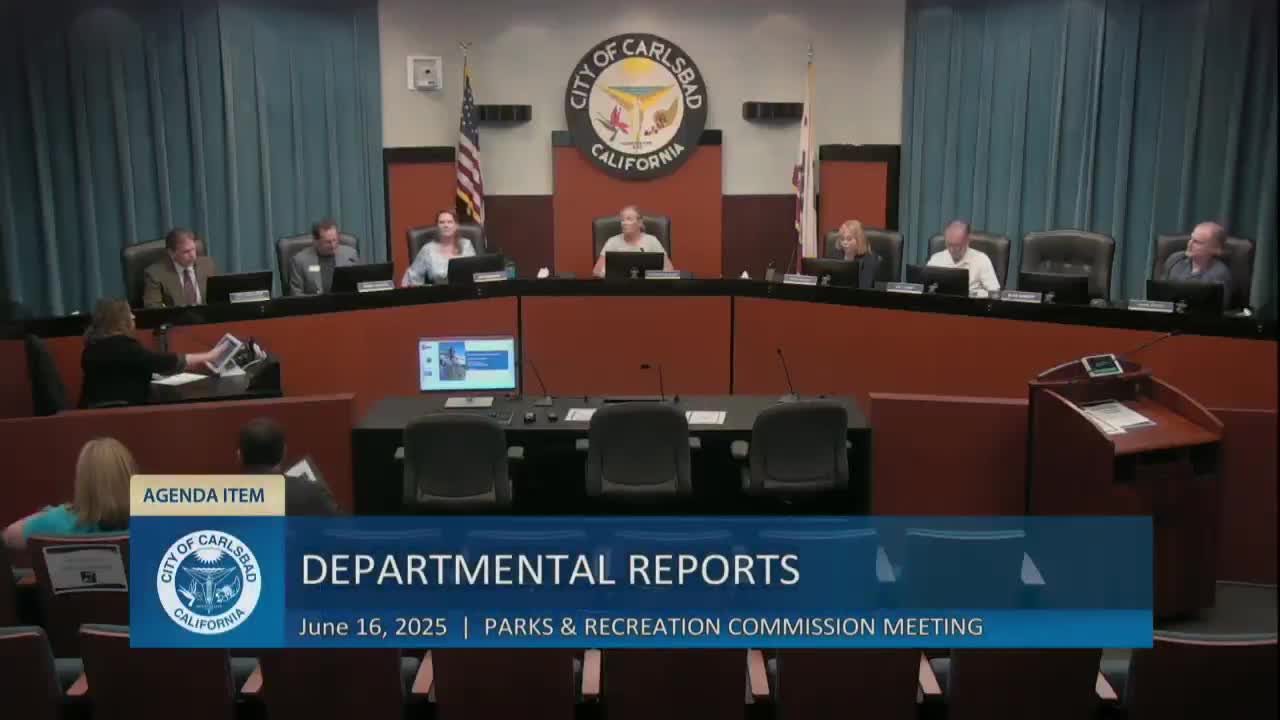
District 1 Councilmember Melanie Burkholder and Jason Haber, the city's intergovernmental affairs director, briefed the City of Carlsbad Parks and Recreation Commission on June 16 on the city's legislative advocacy program, platform and funding priorities.
District 1 Councilmember Melanie Burkholder and Jason Haber, the city's intergovernmental affairs director, briefed the City of Carlsbad Parks and Recreation Commission on June 16 on the city's legislative advocacy program, platform and funding priorities.
Burkholder said the legislative subcommittee's work centers on a city council policy and a council resolution that establish a legislative platform and direct the subcommittee's monthly work. She said the subcommittee coordinates departments, contract lobbyists and a contract grant writer to monitor state and federal proposals that could affect the city.
The presentation stressed preserving local control as a top principle. "SB 79 is coming through right now. It's a building and development bill that would actually take all the control away from cities and approve mid to high rise within a half mile of transit with ministerial approval," Burkholder said. "So I've definitely offered up going up to Sacramento to say absolutely not."
Why it matters: The subcommittee's platform is used to decide when the city should watch, support or oppose bills, seek amendments, sponsor legislation or pursue grants. That affects how the city can seek state and federal funds for parks, trails, ADA beach access and other projects the commission oversees.
Key points from the presentation
- Structure and tools: Haber described the subcommittee's process for assembling an annual legislative platform with input from departments and the League of California Cities and the National League of Cities. The city uses state and federal lobbyists and a contract grant writer to identify funding opportunities and to advocate in Sacramento and Washington, D.C.
- Recent sponsorships and outcomes: The city has successfully sponsored local bills that became law, including measures related to ocean and city pool lifeguards and a 2023 law allowing the city to file temporary restraining orders on behalf of employees facing workplace harassment. In 2024 the city sponsored an e-bike rider training and age-minimum bill that passed.
- Current priorities and tracked bills: Staff said the city is not sponsoring standalone bills in 2025 but is pursuing several concepts via omnibus vehicles or amendments. Two concepts the city continues to pursue are: allowing certain public-safety operators to use utility-terrain vehicles on city streets and enabling electronic filing and virtual appearances for individuals pursuing workplace harassment restraining orders. The city is tracking youth sports safety bills and other proposals.
- Specific bills: Staff flagged SB 79 (described above) as inconsistent with Carlsbad's emphasis on local control. The commission was also briefed on a Quimby Act-related proposal (SB 315) that would have limited park-mitigation requirements for developments near existing parks; the presenter said that bill was pulled by the author in April and that the city took an opposed position while it was active.
- Funding priorities: Staff listed targeted capital projects the city is seeking state or federal support for, including pickleball courts at Calavera and Stagecoach; ADA beach-access improvements (ramps at Pine Avenue and Tamarack were cited); Robertson Ranch Park; and the Avenida Encinas Coastal Rail Trail. Haber said staff coordinates the city's capital improvement program (CIP) needs with legislators' funding priorities when pursuing grants.
- Lobbying and partnerships: The presentation named the League of California Cities and the National League of Cities as informational partners and said the city uses state and federal lobbying firms and a contract grant writer. Commissioners asked whether the city's firms represent other municipal clients; staff replied the firms specialize in municipal work and will often coordinate coalition letters or joint approaches where appropriate.
Direct funding result noted: "In the last 5 years we've got about $8,000,000 between federal and state allocations that go to [Veterans Park]," Haber said, describing recent discretionary funds the city obtained for parks work.
What the commission did: Commissioners asked clarifying questions about how the city measures grant success and how projects are prioritized in the CIP. Staff described an ongoing, multi-year prioritization process and said current state budget constraints limit discretionary opportunities.
Next steps: Staff invited commissioners to submit bills or local policy ideas through Parks and Rec staff for possible inclusion in the legislative platform or future advocacy trips to Sacramento or Washington.
Ending note: Councilmember Burkholder and Haber encouraged collaboration with the commission on parks-related legislative issues and said the subcommittee meets monthly to advise on positions and advocacy.