Get Full Government Meeting Transcripts, Videos, & Alerts Forever!
Get email alerts on the Zoning Variance topic
No spam. Unsubscribe anytime.
Dorchester County Board of Appeals backs variance for 18x30 deck in critical-area buffer
Summary
The Dorchester County Board of Appeals recommended approval of a variance allowing an 18-by-30-foot open deck at 6213 Troy Pointe Cove in Cambridge, Md., with conditions including a 3:1 buffer mitigation plan and a restriction on converting the deck to lot coverage.
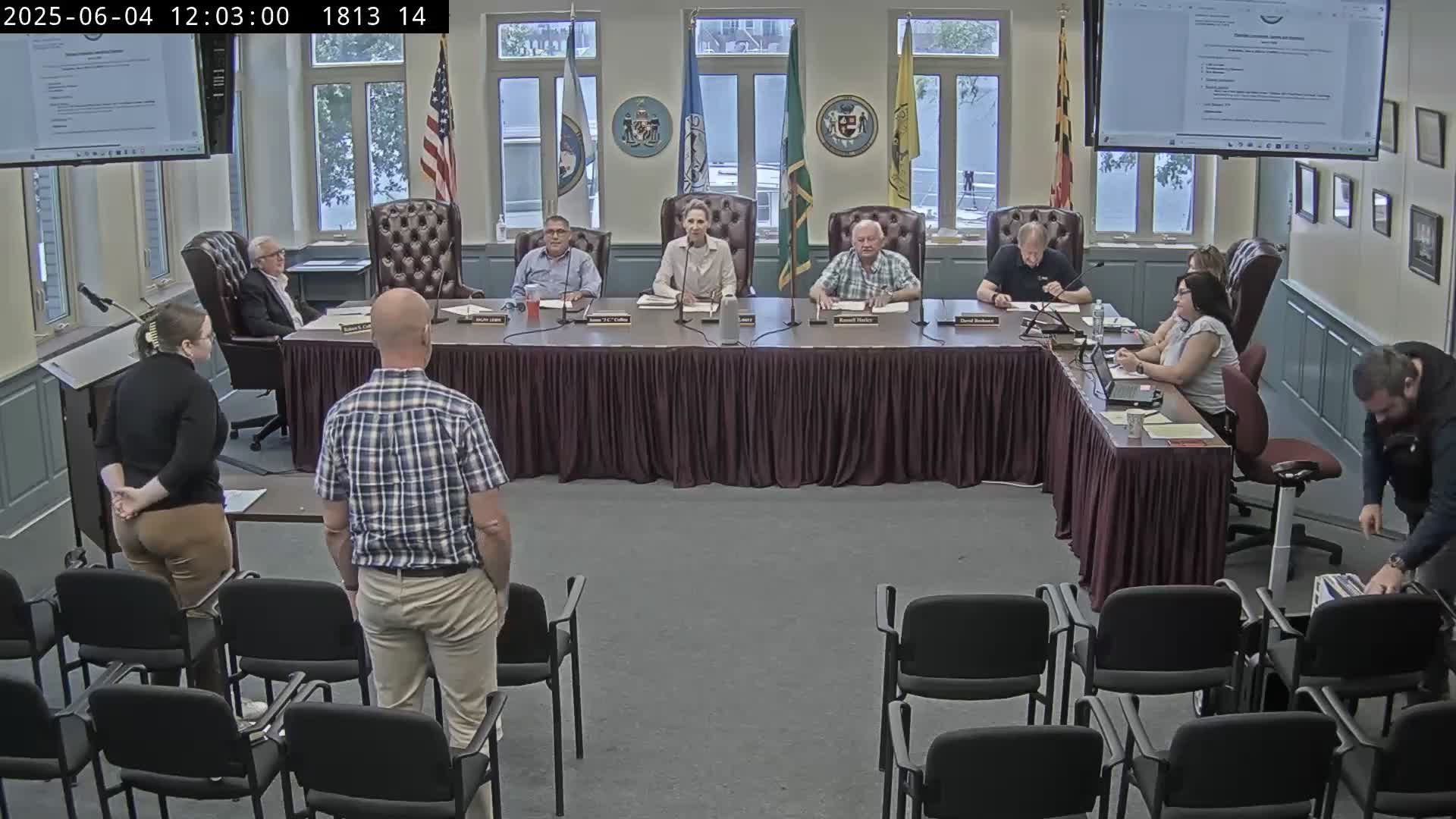
The Dorchester County Board of Appeals recommended approval of a variance allowing a homeowner to construct an 18-by-30-foot open deck at 6213 Troy Pointe Cove in Cambridge, Md., inside the county's mapped critical-area buffer.
The board's recommendation, made during a public meeting, included three conditions: the deck may not be converted to lot coverage in the future (including enclosure as a sunroom or placement of lot coverage beneath the deck), the applicant must provide a buffer management plan mitigating permanent disturbances at a 3:1 ratio, and the county's recommendation that a record note be placed in the property file or land records. The motion for a favorable recommendation passed on a voice vote without recorded opposition.
The variance request stems from the property's history and current site conditions. Planning and Zoning staff member Cassie Dyson told the board that the primary structure was built in 1981, before critical-area regulations applied, and that the lot is mapped as a modified buffer area with a majority of existing improvements inside the 100-foot buffer. Dyson said the proposed deck would not be closer than 43 feet, 9 inches from the water's edge and that an uncovered deck is not considered lot coverage under the county's critical-area rules.
"The applicant has proposed to construct an 18 by 30 open deck that's attached to the house," Dyson said. "As this is a modified buffer area, certain improvements are allowed by right beyond what is typically permitted in the critical-area standards. This would include new accessory structures within the 100-foot buffer, but no closer than 25 feet from the water's edge. The allowance includes cumulative total accessory structures to be limited to a thousand square foot total. The existing improvements exceed this limit, which is why any further development would require a variance."
The applicant, identified in the record as Mr. Grubb, described recent work on the shoreline and said the house's main living spaces (family room and kitchen) face the water, making the proposed deck a natural extension of those areas. "We've been solely repairing the shoreline and reestablishing the property that's still unkept for a number of years," Grubb said. "So we've got the shoreline work is done now, so this is the first step that we want to have the space." He acknowledged he intends to meet the 3:1 mitigation requirement but said he did not know the technical details.
Board members asked staff about alternatives for meeting the 3:1 mitigation if space is limited on the property. Dyson said mitigation could be accomplished on-site if room exists, off-site at an alternate property, or by paying a fee-in-lieu that the county could use for plantings elsewhere. The board also discussed how to make future buyers aware that enclosure of the deck would require another variance; some members favored recording a note in the land records, while county staff noted the case and its conditions would appear in the county's public permit and case layers online.
Several board members clarified how a future enclosure or conversion would be handled. Dyson said, "A deck is not considered lot coverage because it's uncovered as long as there's gaps between the boards. If he wanted to enclose it in the future, he would have to come back to get another variance." The board accepted that distinction and included the nonconversion language among the conditions.
A board member made a motion for a favorable recommendation with the stipulations read into the record; another member seconded the motion. The board then approved the recommendation by voice vote.
The recommendation moves the applicant next to the formal variance decision process under Dorchester County's appeal procedures and critical-area mitigation requirements. The applicant will be required to submit a buffer management plan and any documentation needed to meet the 3:1 mitigation standard or arrange an approved off-site mitigation or fee payment before final permits are issued.