Get Full Government Meeting Transcripts, Videos, & Alerts Forever!
Get email alerts on the Childcare Funding topic
No spam. Unsubscribe anytime.
Travis County outlines short‑term plan to start spending voter‑approved childcare fund while long‑term procurement proceeds
Summary
County health staff described a five‑track short‑term investment plan, a proposed 21‑member Community Advisory Council, and immediate steps to expand existing contracts and interlocal agreements to get childcare and out‑of‑school services into operation quickly.
Travis County Health and Human Services staff presented a roadmap for using the voter‑approved childcare and out‑of‑school‑time fund, saying short‑term contract expansions and interlocal agreements will put services in place while the county develops a competitive procurement for longer‑term investments.
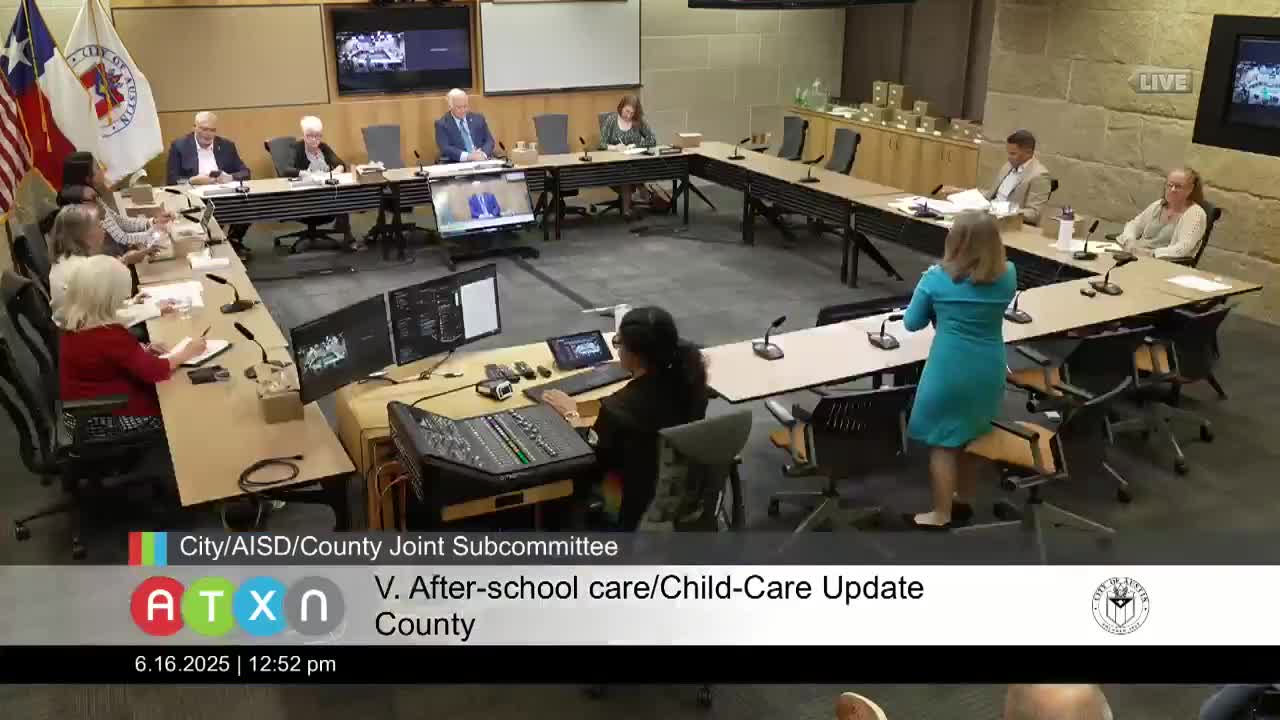
Corey Darling, research and planning director for Travis County HHS, told the joint subcommittee the county conducted community listening sessions, stakeholder meetings and an online survey that collected more than 200 responses to shape program design. The county has completed initial data analysis and will use that feedback to inform solicitations and program policies.
Darling described a recommended Community Advisory Council with 21 members that would advise county staff on program design, policy, evaluation and community engagement. Darling said the county presented the advisory council proposal to the Commissioners Court on June 10 and received approval to proceed with planning.
To accelerate services while the long‑term procurement proceeds, the county outlined a five‑track short‑term investment plan: expand child care and out‑of‑school‑time scholarships handled through Workforce Solutions; modify existing county early childhood and youth development contracts to add capacity; negotiate time‑limited interlocal agreements with four high‑need school districts (Austin ISD, Pflugerville ISD, Del Valle ISD and Manor ISD); explore interlocal agreements with the City of Austin; and design gap funding tied to the true cost of care for state‑funded child care scholarships.
Darling said the county will return to Commissioners Court in July with more detailed budgets and work statements to begin approval for some fall‑season expansions. “We are working as quickly as possible,” he said, acknowledging each track has a distinct timeline and compliance considerations.
Subcommittee members pressed for speed and clarity about whether the county could expand existing Workforce Solutions contracts and make money available to providers this summer. Darling said some contract modifications will be brought forward to court as soon as the summer and that interlocal agreements with school districts are being drafted for target approval this summer.
County and city officials also discussed program administration and documentation requirements tied to federal and state funding sources; Darling said the county’s auditor and federal audit rules affected timing and the structure of short‑term contracts. The county emphasized that short‑term investments must meet the ballot language for the voter‑approved fund and cannot simply replace existing baseline services in some cases.
The subcommittee requested continued updates; County HHS said it will return with more detailed recommendations to Commissioners Court and this joint body in July.