Get Full Government Meeting Transcripts, Videos, & Alerts Forever!
Get email alerts on the Economic Development Irb topic
No spam. Unsubscribe anytime.
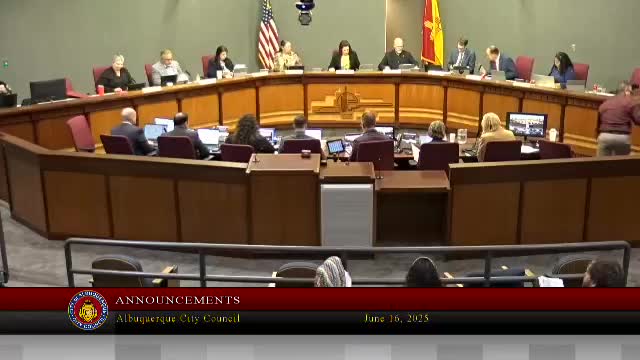
Council approves $227.5 million IRB for Sawmill District after adding prevailing‑wage condition
Summary
After extended public comment and union pushback, the Albuquerque City Council approved an industrial revenue bond package to finance three Sawmill District projects and added a floor amendment requiring compliance with the state prevailing-wage law.
The Albuquerque City Council voted Tuesday to approve an industrial revenue bond (IRB) package that clears the way for three private developments in the Sawmill District, approving the ordinance 9-0 after the council adopted a floor amendment that requires the developer to pay prevailing wages as defined by House Bill 6.
City staff presented the ordinance, O-87, as a consolidated IRB request to support three projects in the Sawmill District: a 115-room boutique Sawmill Hotel, an extended-stay Chaco Residence product, and a 140-unit mixed-use apartment building with retail. Deputy Director Monica Mitchell outlined the package and the staff analysis, and recommended approval. Mitchell said the consolidated IRB would support private investment in a designated metropolitan redevelopment area and federal opportunity zone and estimated the private investment at roughly $227.5 million, with an estimated 750 construction jobs and dozens of permanent positions when the projects are complete.
The developer, Jim Long, spoke to the council and framed the proposal as a chance to grow local small businesses and tourism. "We're very excited to create these beautiful buildings for our city," said Jim Long, owner and developer of the project. He told the council the project team intends to set aside funds to help small businesses secure retail and food opportunities in the new buildings.
Public commenters and union representatives pushed the council to attach worker protections and housing requirements to the public financing. Joan Baker, political affairs director for UA Local 412 (Plumbers & Pipefitters), urged delay until the state prevailing-wage law took effect: "This IRB, the way it is written or passing it before July 1, is a $227,000,000 giveaway with no worker protections and no affordable housing during our biggest crisis, which is a housing crisis," Baker said. Other speakers urged mandatory registered-apprenticeship language, requirements for local hires, and that some residential units be affordable to working families.
Council debate focused on whether to add a prevailing-wage requirement at the city level given an overlapping state law (House Bill 6) set to take effect in mid‑June. Councilor Pena proposed a floor amendment making approval of the IRB contingent on the developer paying prevailing wages as defined by HB 6. The amendment text, read into the record by the city attorney, stated: "The approval of these industrial revenue bonds is contingent on the developer paying prevailing wages as defined in HB 6 passed in the 2025 legislative session." The amendment passed 8-1.
After adoption of the prevailing-wage amendment, the council voted to approve O-87 as amended, 9-0. The final ordinance consolidates three IRB applications (labeled in staff materials as IRB 25-5) and includes a 30 percent payment-in-lieu-of-taxes arrangement (a 70% abatement on qualifying real and personal property for the IRB term), which staff said would leave a 30% PILOT contribution during the IRB period. Staff also noted a requested waiver of a Section E multifamily housing requirement; the waiver and other contract and document approvals will be handled in subsequent administrative actions once the ordinance is adopted.
Key numbers disclosed in the staff presentation included project cost estimates of roughly $76.3 million for the Sawmill Hotel, $70.4 million for the Chaco Residence extended-stay building, and $80.8 million for the mixed-use apartment project; an estimated 750 construction jobs overall; an estimated 75 new permanent full-time jobs and 40 part-time positions; and third-party fiscal verification by the University of New Mexico Bureau of Business and Economic Research. Staff predicted the projects would remain "fiscally positive" through the IRB term; staff materials also included projected tax revenue figures, which contained formatting and date anomalies in the packet that staff acknowledged would be cleaned up.
Councilors and the administration said they expect the administration and city attorneys to negotiate and execute the required bond documents, leases and related agreements. Councilors repeatedly told staff that, because public concern had focused on wages and housing, they expected the administration to use the citys contracting authority to secure enforceable local hire, apprenticeship, and reporting commitments where lawful and feasible.
The ordinance and the amendment will require follow-up administrative steps: final IRB documents, execution of lease and bond documents and, for the prevailing-wage requirement, verification tied to the statutory standard in HB 6 when construction permits are pulled and work begins. Staff said some project components may begin in phases and that timing of prevailing-wage applicability will depend on when each project starts construction.
Officials said the action aims to spur additional development nearby and to support the Sawmill Districts broader redevelopment momentum, but public speakers and several councilors emphasized the need for enforceable worker and equity protections going forward.