Get Full Government Meeting Transcripts, Videos, & Alerts Forever!
Get email alerts on the Traffic Safety topic
No spam. Unsubscribe anytime.
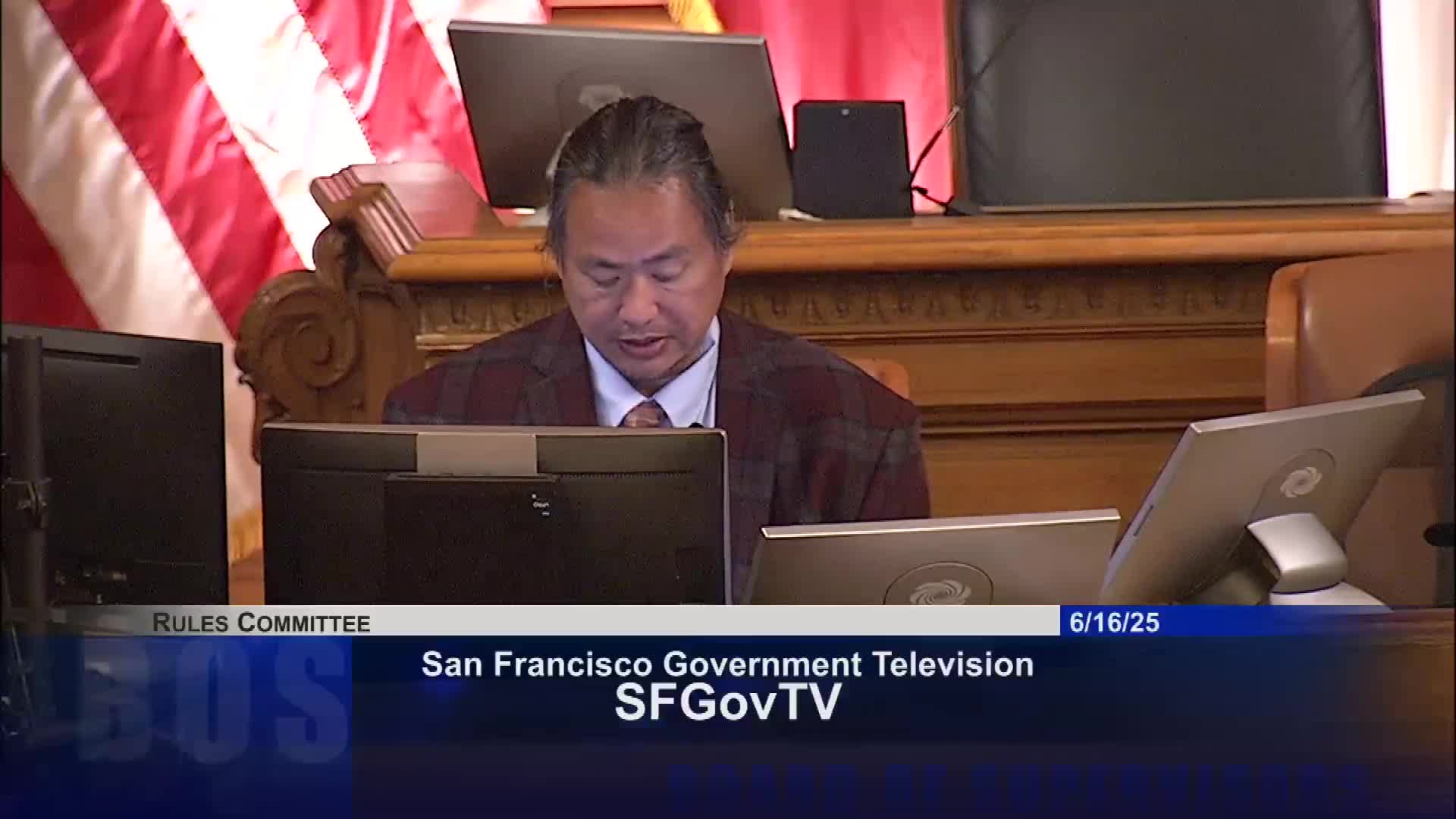
Rules Committee advances MTA surveillance policy for red-light and no-turn enforcement cameras
Summary
The Rules Committee voted to forward to the full Board an ordinance allowing the Municipal Transportation Agency to continue using automated red-light and no-turn enforcement cameras, with staff describing how the system detects violations, reviews footage and retains data.
The Rules Committee of the San Francisco Board of Supervisors voted to forward to the full board a municipal ordinance approving the Municipal Transportation Agency’s continued use of automated red-light and no-turn enforcement cameras, after a presentation from MTA staff and a brief round of questions from supervisors.
The program, first installed in 1996 and updated most recently in 2019, aims to reduce collisions and unsafe driving that occur when drivers run red lights or make illegal turns. Monica Giese, the program manager, told the committee the system uses 3D traffic radar and signal-state monitoring and “does not enter enforcement mode until the light changes from yellow to red.” When a potential violation is detected the system captures three still images, a 12‑second digital video and a separate driver photo; for illegal turns the system records a video stream of the turning movement.
The nut of the committee’s discussion concerned scope and data handling. Giese said the program issues roughly 800 to 1,000 citations per month — “so per year, it’s probably, like, 10, 11,000” — from 19 camera units at 13 intersections. Captured event data are first reviewed by a contractor, then reviewed by an SFPD officer before a citation is issued. Giese said footage “is stored on the cameras and devices for 30 days,” with non‑citation footage destroyed after 15 business days and citations retained 15 business days after final disposition; a contract amendment adds a maximum five‑year retention if final disposition is not reported.
The committee also discussed who receives data. Giese said the MTA shares footage and related data with SFPD, the Superior Court and the vendor (Vera Mobility); other third parties require a warrant or subpoena. Committee members pressed staff on how many detected events vs. issued citations are recorded and whether staffing limits cause events to “age out” before review. Giese said the contractor forwards potential violations to SFPD and that the department currently relies on 1 officer to perform the final review, which can create a backlog that leads to expiration of some events.
Supervisor Mandelmann asked about program costs and capacity; Giese estimated the 2019 construction cost for the current set of cameras at about $2,000,000 for the project as installed then. Mandelmann asked for a follow‑up report showing the number of events captured, the number that resulted in citations, and the stated reasons for non‑issuance; Giese agreed to provide a report with those categories.
The committee approved the motion to forward the ordinance with a positive recommendation. President Mandelmann made the motion; Vice Chair Sherrill and Chair Walton voted in favor. The motion passed without objection.
Background: MTA staff said the program is part of the city’s Vision Zero effort to reduce traffic deaths and severe collisions. The presentation noted the vendor relationship with Vera Mobility and that the system and proposed contract amendment were discussed by the Surveillance Advisory Board and related committees earlier in the year.