Get Full Government Meeting Transcripts, Videos, & Alerts Forever!
Get email alerts on the Education Funding topic
No spam. Unsubscribe anytime.
Austin ISD leaders say new state laws raise costs as district outlines $93M shortfall and staff reductions
Summary
Austin ISD legislative staff and district leaders told a joint city–county–school subcommittee that recently passed state school bills increase obligations while state funding and property value shifts leave the district with a multi‑million dollar deficit and planned forced reductions.
Austin Independent School District officials told a joint subcommittee of the Austin City Council and Travis County Commissioners Court that new state education laws will increase district obligations even as AISD closes fiscal 2024–25 with a projected deficit in the tens of millions.
The district’s legislative staff described House Bill 2 as a large, statewide school funding package that appropriated $8.5 billion and created new allotments — including an “allotment for basic costs,” a teacher retention allotment and a support‑staff allotment — but said the changes do not eliminate a sizable budget shortfall for AISD.
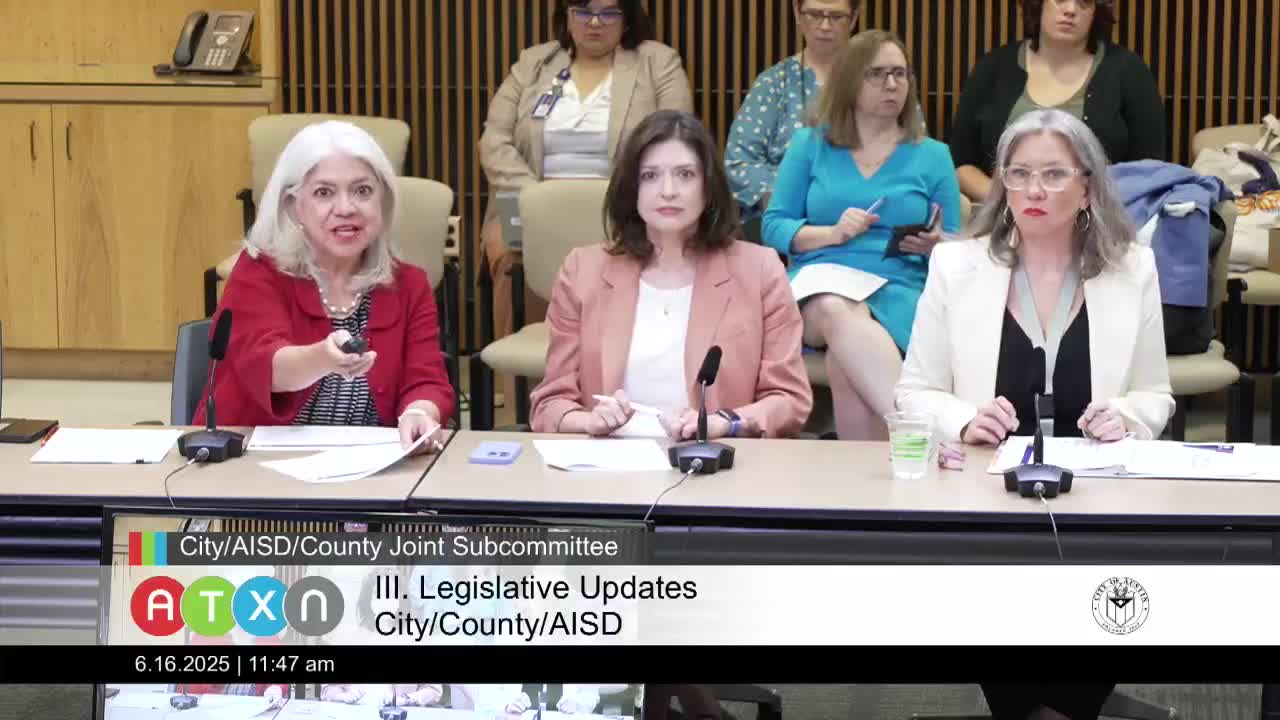
Edna Butts, representing AISD legislative staff, summarized HB 2’s key elements: “They increased the basic allotment by $55, and they tied increases in the future to property values. They have two new allotments, the allotment for basic costs, and the teacher retention allotment.”
Butts detailed other changes that will affect district operations, including a doubling of the school safety allotment from $10 to $20 per student and higher per‑campus minimums. The district executives said the safety allotment is still insufficient to cover the district’s model for campus safety.
“For our model, one that aligns with our values, it does not meet or come close to even meeting the costs associated with it,” Superintendent Segura said, referring to AISD’s expectation that armed campus responders would be AISD employees trained for school settings.
Butts and Superintendent Segura also summarized other passed measures affecting discipline and school choice. They said HB 6 expands teacher authority to remove students from classrooms, caps out‑of‑school suspensions at three days in most cases, allows virtual disciplinary alternative education programs (DAEP), and permits expulsions for certain off‑campus conduct. They also described a new education savings account (voucher) program that appropriated $1 billion for the first biennium, with voucher amounts specified at $10,000 per student and higher amounts for students with disabilities.
Katrina Montgomery, AISD interim chief financial officer, walked the subcommittee through the district’s fiscal close‑out for 2024–25 and proposed budget for 2025–26. Montgomery said the district adopted a budget last June showing a $78 million deficit; subsequent changes in property valuation and federal/state program reimbursements widened the gap before the district’s internal reductions narrowed it again.
“Between January and March, we did a hiring freeze on all positions excluding special education, and we did reductions in p‑card spending,” Montgomery said. “As of May, it’s showing that we have a projected $93 million deficit.” She said the district projects the deficit will fall to about $90 million when June closes and that the FY 2025–26 proposed budget would aim for a 15% fund balance.
Montgomery outlined planned strategies to reduce the deficit in FY 2025–26, including vacancy savings, master schedule efficiency, PEIMS data improvements, land sales identified as excess property, and a targeted $15 million line for forced reductions. The district also includes a central office realignment intended to deliver roughly $10 million in ongoing savings through position eliminations, reassignments, and new reporting structures. Montgomery said employment change notices would be issued in mid‑June with changes effective Aug. 1.
Members of the subcommittee pressed the district on how cuts would be prioritized and how the district would document impacts by neighborhood and student population. Montgomery said the district is using a Support and Resource Index to target resources toward higher‑need campuses and that the aim is to shield classroom‑level services where possible.
Superintendent Segura and AISD leaders repeatedly emphasized implementation complexity, noting that several new state requirements will require TEA rulemaking, local policy updates and multistep operational plans. “Many of these will have to be operationalized by AISD and require multiple steps,” Butts said.
The subcommittee did not take formal action on the district’s budget at the meeting; AISD’s board is scheduled to vote on adoption of the FY 2025–26 budget on June 26, according to district presenters.
The meeting closed with members from city and county government acknowledging the fiscal pressures facing AISD and the need to coordinate locally on implementation and advocacy at the state level.