Get Full Government Meeting Transcripts, Videos, & Alerts Forever!
Get email alerts on the Land Use topic
No spam. Unsubscribe anytime.
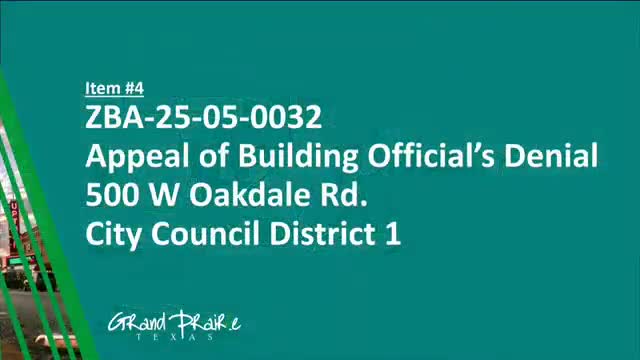
Zoning board upholds building official on Oakdale storage appeal after 6-3 vote; 7 votes required to overturn
Summary
The Zoning Board of Adjustment and Appeals denied an appeal that sought to overturn a building official's denial of a certificate of occupancy for outside storage and truck/equipment parking at an Oakdale Road property. The board voted 6-3; city rules require seven concurring votes to overturn a building official's decision, so the denial stands.
The Zoning Board of Adjustment and Appeals on June 16 denied an appeal seeking a certificate of occupancy for outside storage and heavy truck/equipment parking at a narrow, long property identified in filings as 475/500 West Oakdale Road.
The board heard a legal presentation from Tiffany Bull, deputy city attorney, who represented the city and explained that outside storage and heavy truck/equipment parking are allowed in the Light Industrial (LI) district only by specific use permit (SUP) in the corridor overlay and that the applicant had no prior certificate of occupancy (CO) establishing a lawful, nonconforming use. Bull said the property lies largely in the 100-year and 500-year floodplains and that the applicant's recent CO application had been denied because the proposed uses require an SUP. Bull told the board those denials are subject to review by council via an SUP application or by the courts if the board's decision is appealed further.
The appellant's representatives, including attorney Stephen Darling and owner Eli (Eli Amzalag), argued the property had been used historically for outdoor storage and truck/equipment parking for decades and that city records are incomplete. They submitted historic aerial photos, a special warranty deed with deed restrictions permitting warehousing and light wholesaling, and email correspondence they said created reasonable expectations that the prior activity established nonconforming-use rights. The appellant said they purchased the property in 2021 relying on a zoning verification email and that the land has been used for similar activities by prior owners for many years.
Bull told the board that a lawful nonconforming use requires that a use was lawfully established (for example, supported by a CO) before a code change; she said extended or undocumented illegal activity does not create legal nonconforming rights. City staff recorded an earlier CO application denial; Bull said the record does not show a previously issued CO for this parcel and that the applicant was advised to pursue an SUP if they wished to operate the property for the proposed uses.
Board members discussed whether earlier informal emails from city planning staff could reasonably have led the purchasers to rely on the property's legality. Several members said staff guidance that directed the prospective buyer back to the code without producing a definitive record was insufficient; others stressed that the legal test is whether the use was lawfully established. A motion to grant the appeal (thereby overturning the building official) failed to reach the seven-vote threshold required to overturn the official: the board voted 6 in favor, 3 opposed. Because the board requires seven concurring votes to overturn a building official, the building official's denial stands.
The city attorney reiterated that the applicant retains the option to (1) seek a specific use permit from City Council to legalize the use with any operational or mitigation conditions council requires; (2) pursue judicial review in district court; or (3) discontinue the requested use. The board record shows the decision does not itself grant an SUP or any other development entitlement.
The decision leaves the property without the CO the owner sought; staff and counsel advised that any future CO or SUP application will be evaluated under current floodplain, paving and other development standards.