Get Full Government Meeting Transcripts, Videos, & Alerts Forever!
Get email alerts on the Pesticides In Parks topic
No spam. Unsubscribe anytime.
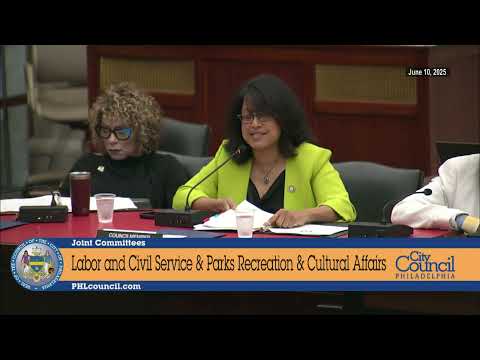
Council hearing examines enforcement of HOPS law and pesticide use in Philadelphia parks
Summary
A joint City Council committee held a public hearing to review why the 2020 Healthy Outdoor Public Spaces (HOPS) law has not been fully enforced, focusing on health risks from synthetic herbicides, pilots of organic alternatives, worker protections and the department's plan for transition.
A joint committee of the Philadelphia City Council convened a public hearing to examine enforcement of the 2020 Healthy Outdoor Public Spaces bill (HOPS) and the city's use of synthetic herbicides, including glyphosate and 2,4‑D. The hearing, authorized by Resolution 250397, brought council members, Parks and Recreation officials, medical experts, public advocates and residents to testify on health, environmental and operational issues.
The hearing focused on two questions: why the HOPS law passed in 2020 has not been fully implemented, and what immediate and longer-term steps the Department of Parks and Recreation (PPR) and the administration will take to protect park users and workers. Council members repeatedly pressed PPR to explain pilot results and alternatives and asked for a timetable and regular reporting.
PPR Commissioner Susan Slauson told the committee that the administration adopted four commitments after the council passed Bill 200425‑A: advance signage for herbicide applications that remains up until herbicides dry; a 50‑foot buffer from play equipment; a pilot program to evaluate organic products; and ongoing record keeping and reporting. "PPR manages as you know over 10,000 acres of land and only uses herbicides that have been approved by the US Environmental Protection Agency," Slauson said. She added that PPR staff and contractors are licensed applicators and follow label instructions and state and federal law.
Committee members and witnesses challenged parts of that account. Physician Linda Stern testified that PPR continues to apply 2,4‑D and glyphosate and summarized studies linking those chemicals to cancer, neurologic disease and other harms. "There are no established safe levels of herbicides and children are uniquely vulnerable to the health effects of that exposure," Stern said. Other witnesses — including a childhood leukemia survivor, community volunteers and a veterinarian — urged strict enforcement and immediate action to stop spraying in places where children play.
PPR described specific trial work. Deputy staff said PPR began organic herbicide trials in May 2022 at Fern Hill Park and partnered with the U.S. Forest Service on an experiment that tracked 36 sample plots and tested mechanical removal, synthetic treatments and non‑synthetic treatments. PPR reported that para‑hydroxyacetic‑acid (described as paragonic in testimony) organic treatments burned some above‑ground vegetation but did not kill roots; plants resprouted, requiring roughly four times more product and twice the labor compared with synthetic treatments, producing unsatisfactory control in several cases.
Aylin Compton, environmental restoration crew chief for PPR, described the department's integrated pest management approach and the operational limits they face. "There are some species that I've discovered that we cannot control through those means alone," Compton said, explaining that some vines and woody invasives resprout after mechanical or organic treatment and that restoration goals for tree canopy and sight lines drive certain management choices.
Council members pressed on worker safety and protective equipment. Testimony detailed available personal protective equipment (PPE) and safety data sheets; PPR witnesses said staff are provided PPE that meets label requirements and that, "the label is the law." Committee members and some witnesses urged stricter respirator and hazardous‑materials training for applicators and stronger subcontractor oversight.
Community advocates and volunteer groups presented data they said show continued pesticide applications in violation of the HOPS law. Toxic Free Philly representatives said city records produced through right‑to‑know requests show multiple tons of prohibited herbicides applied to parks since 2020 and provided an interactive map of sites and dates. Student and institutional witnesses described pilots elsewhere and on university campuses that shifted to organic land‑care by improving soil health and longer‑term management practices.
Council members repeatedly asked for an actionable plan and timeline. Commissioner Slauson said the administration is collecting best practices from other cities, identifying pilot sites and will draft a plan for phased implementation because "we can't tackle 10,000 acres at one time." She also described some policies used elsewhere, including targeted exceptions for athletic fields and golf courses, and the need for budget and staffing adjustments to scale nonchemical approaches.
The hearing closed with committee members asking PPR to return with a concrete plan and more frequent updates; chairs proposed quarterly tracking so work does not lapse. No formal vote or change in city policy was taken at the hearing itself.
The hearing record includes medical testimony about potential long‑term harms from exposure, PPR operational details about pilot results and limitations, and repeated calls from council members and advocates for enforcement, clearer reporting and accelerated transition planning. The committee will continue oversight, and PPR said it intends to work with council, public‑health experts and community partners to refine and implement a pilot‑to‑plan pathway.