Get Full Government Meeting Transcripts, Videos, & Alerts Forever!
Get email alerts on the Trails Naming topic
No spam. Unsubscribe anytime.
Council asks trails committee to propose new names after Forest Service rejects several choices
Summary
Bountiful City Council staff and the Forest Service reviewed naming criteria after the agency rejected several proposed trail names; council directed the trails committee and staff to develop alternate, landscape‑based names and to consult families for two sensitive existing memorial names.
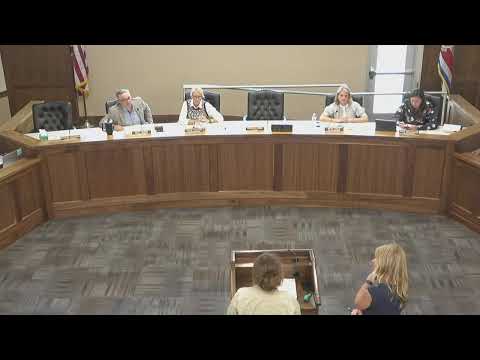
BOUNTIFUL — At a Bountiful City Council work session, council members and staff discussed naming criteria the Forest Service requires for trails on Forest Service land and directed the trails committee to submit alternate names for several existing and proposed routes.
Council staff said the Forest Service’s responses listed in the meeting packet require trail names to be associated with natural landscape or geographic features, prohibit names specific to a user group and generally do not permit names associated with a person. Amber (staff member) summarized those criteria: “the trails need to be associated with natural landscape or geographical feature. Also, the name cannot be specific to a user group. And finally, names associated with a person will not be considered.”
The clarification followed staff’s report on roughly 11 trails that intersect Forest Service property and that the city has identified for naming or renaming. Staff listed trails and current or proposed names: Trail 20201 (Sunset); Trail 30301 (Mahogany Ridge); Trail 307 and 406 (Peregrine); Trail 404 (Maple Syrup); Trails 402 and 403 (Hornet); Trail 405 (no final name yet); Trail 409 (no final name yet); Trail 501 (King Green, Holbrook access); Trail 502B (Encore); and 304/305 (formerly proposed as Bell & Co.).
Staff said some proposed names were approved by the Forest Service and others were not. Examples discussed in the meeting: - “Maple Syrup” was not acceptable because the trees in the area do not produce maple syrup and the Forest Service found that misleading; staff noted that “maple” as a landscape descriptor might be acceptable but “syrup” was rejected as playful/misleading. - “Peregrine” (intended to reference a local founder) was flagged as unlikely to pass because naming a trail after a person requires a multi-level approval that typically requires federal or national significance and could take a long time. As a Forest Service representative put it, “I’m not the one that gets to decide the names. This had to go up through our public affairs officer, and this was her explanation for these trail names.” - “King Green” was identified as a name tied to a person and staff said an alternate name would be needed; staff noted the city has already memorial elements such as a bridge and plaque near that access. - “Hornet” and “Mahogany Ridge” were described in the meeting as acceptable under the criteria.
Council members and staff discussed practical constraints: many of the trails are already open and the council wants signage and mapping to match names in use. A councilmember said time is “of the essence” for naming so signage and mapping can be completed; staff replied there is no fixed deadline from the Forest Service but that the agency’s public affairs staff want names pushed through quickly and that acceptable lists generally move faster through the process.
The council asked the trails committee to provide a short list of candidate names for each trail. Staff and committee members said the committee has already brainstormed possible alternatives (examples offered during the meeting included “Peregrine” spelled to emphasize the bird of prey, “Goshawk,” “Holbrook Hills,” “Big Rock” and “Elephant Down”), but several needed reworking to match the Forest Service criteria. Council members also asked staff to consult with two families connected to trails that had been previously proposed to be named for residents; staff said they had already contacted one family (the Bells) and would reach out to the other family for a similar conversation.
Council and staff agreed on a short timetable for next steps: staff said the trails committee could provide recommendations within about a week, staff would vet those with the Forest Service and with families where appropriate, and the council would review submitted candidate names at the next available meeting or work session.
The discussion closed with staff confirming they would compile and forward a list of candidate names from the trails committee and that staff would reach out to families tied to memorial names to discuss alternate ways to recognize those contributors.
Two direct quotes from the meeting capture the constraints and next steps. Amber (staff member) summarized the Forest Service rules: “the name cannot be specific to a user group.” The Forest Service representative cautioned on timelines and approvals for personal names: “it has to go through our forest, then to the region, then to the Washington office,” and noted that that process can be lengthy.
The council did not take a formal vote on names; members instructed staff and the trails committee to prepare vetted lists of alternative, landscape‑based names and to consult families for the two sensitive memorial names before returning the proposals to the council.