Get Full Government Meeting Transcripts, Videos, & Alerts Forever!
Get email alerts on the Public Art Program topic
No spam. Unsubscribe anytime.
GCAC presents Art in Public Places strategy recommending percent-for-art, seed funding and new governance
Summary
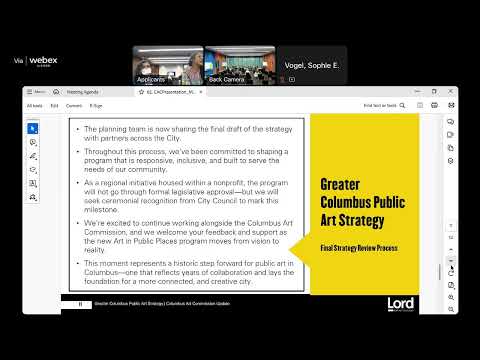
Representatives of GCAC and city planning staff presented a proposed Art in Public Places strategy on June 18, 2025, asking the Columbus Art Commission to align approval criteria and public engagement while GCAC seeds a new program with $500,000 a year for five years and a paid AIPP director position.
Representatives of GCAC and city planning staff presented a proposed Art in Public Places (AIPP) strategy to the Columbus Art Commission on June 18, 2025, recommending a GCAC-led program funded initially with $500,000 a year for five years and a paid AIPP director position. GCAC representatives described a program that would use public and private sources and asked the commission to help align approval criteria and public engagement processes across city and county partners.
Why it matters: the plan would create a standing program and governance structure to commission and manage public art in Columbus, establish project-level selection teams and an AIPP advisory committee, and recommend options such as a percent-for-art ordinance tied to capital projects. GCAC representatives and city staff said the plan is intended to increase public art across neighborhoods while building processes for selection, maintenance planning and community engagement.
GCAC presenters said the nonprofit has committed seed funding that would cover an AIPP director salary and initial project funds. Maria Rivera of the strategy team said GCAC has committed $500,000 a year for five years and will pay the AIPP director salary from that allocation. Rivera said the nonprofit's role is to house and operate the program in partnership with the City of Columbus and Franklin County and to convene project-specific selection teams that include local community members, artists and technical experts.
The strategy recommends a dedicated, restricted AIPP fund with sustainable revenue drawn from public and private sources. Presenters described percent-for-art models, in which roughly 0.5% to 2.5% of capital project budgets are set aside for public art, as the most common model nationally. GCAC materials provided to the commission state that 82% of U.S. cities with public art programs use percent-for-art ordinances; presenters said Ohio state-level percent-for-art programs have existed since 1990.
City staff described how the AIPP program would interact with existing city authorities. Sophie (city staff) told commissioners the city would retain budgetary control over existing maintenance funds for the municipal public art collection. Mark Trevillis (city planning/public art staff) said the city currently budgets about $75,000 a year for maintenance of the city's public art collection; that funding and contract administration would remain under city purview. Rivera said projects proposed through AIPP would be required to include maintenance plans as part of project design.
Staffing and governance were central topics. GCAC and the strategy team recommended an AIPP advisory committee housed under the GCAC board, a paid AIPP director at GCAC, and, eventually, a dedicated public art position within city government to coordinate across departments. Rivera and other presenters described project-based selection teams that would include CAC members, community representatives (with stipends), artists and technical experts.
Commissioners raised questions about authority, collection stewardship and the relationship between AIPP projects and the city's existing collection. Several commissioners emphasized that projects placed on city property will continue to require review and final approval by the Columbus Art Commission (CAC). Rivera said the AIPP annual plan and project-level selection processes would be shared with the CAC for site approval and alignment of review criteria. Presenters said not every project that results from the AIPP program would become part of the City of Columbus's permanent collection; some projects could be GCAC- or county-administered and remain separate collections.
Commissioners asked how private developers and property owners would be expected to engage with the new process. Presenters said the AIPP program could not legally compel private property owners without funding to participate but that the strategy includes toolkits and educational materials to encourage voluntary participation, best-practice selection, and community engagement. GCAC presenters said the plan will include public-facing guidance, a toolkit and outreach to developers, artists and community groups.
The presenters said the program aims to launch in the fall pending approvals and coordinated agreements; they noted that the AIPP program, as a regional initiative housed at a nonprofit, does not require formal legislation but that ceremonial recognition and further city-level approvals are planned. Rivera said GCAC will continue outreach with the CAC and city staff and return at the next commission meeting for follow-up.
Ending: commissioners welcomed continued collaboration and asked staff and GCAC to return with clarifications on process details, stakeholder definitions, and proposed criteria alignment. GCAC and city staff committed to additional one-on-one briefings with commissioners before the next hearing.