Get Full Government Meeting Transcripts, Videos, & Alerts Forever!
Get email alerts on the Gun Violence Response topic
No spam. Unsubscribe anytime.
Richmond trauma-response network outlines supports for families after firearm injury
Summary
The Trauma Healing Response Network told the Education and Human Services Committee it provided emergency funds, housing and case management to families affected by firearm incidents and is formalizing a coordinated response with Richmond Police, VCU and health districts.
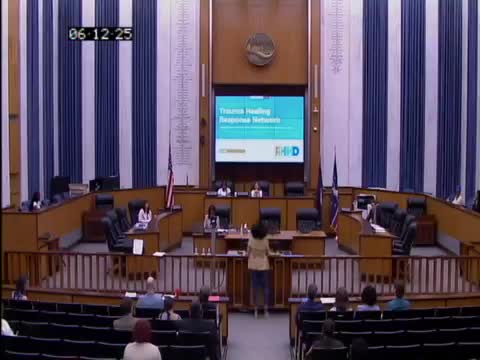
Lorraine Wright, violence prevention program manager for the Richmond and Henrico health districts, told the Education and Human Services Standing Committee that the Trauma Healing Response Network engages families in the immediate aftermath of firearm injury or death and connects them to short-term case management and long-term resources.
Wright said the network, formed in 2021 in partnership with Richmond City Council, the Richmond and Henrico health districts and the Richmond Behavioral Health Foundation, convenes 53 community partners to address housing, food access, mental health and education needs. "We engage impacted families in the immediate aftermath of a firearm injury or death," Wright said.
The network reported more than 3,400 community wellness checks this fiscal year, reached nearly 9,000 residents through mentoring and outreach, and dispersed more than $36,000 in emergency funds to impacted families. Wright said the program provided emergency housing to 16 families, including four permanent relocations, and engaged 37 high-risk cases to prevent retaliation-related violence.
Wright described an "incident response protocol" formalized in February 2025 with the Richmond Police Department, Virginia Commonwealth University (VCU) and the Richmond and Henrico health districts to integrate medical, public safety and victim-assistance responses. She said Richmond community mediators, VCU and other partners coordinate a handoff to avoid compromising investigations while still providing support to families.
Council members thanked Wright and asked for additional detail on the locations of the network's work. "I'd love to know all of the numbers that you presented. I'd love to know where you are working with those families, what parts of the city," Councilmember Jones said, asking the program to provide district- or neighborhood-level data to help deploy resources. Councilwoman Lynch said the program "means to us as council and to me personally." Staff noted an action item to follow up with the Trauma Healing Response Network on the locations of its work.
Wright described other recent activities including a Stop the Bleed campaign, partnership with the Richmond Association of Black Social Workers to expand mental-health services, and work with Richmond Public Schools at sites such as MLK and Huguenot. She said the network also provided support to families in connection with the Commonwealth's attorney's office and cited a recent double homicide in which the network arranged housing for an impacted person.
The presentation closed with committee members encouraging continued collaboration and asking the network to supply the requested geographic and numeric detail to the committee at a future meeting. A committee staff member recorded a follow-up action: the committee will request more information from the Trauma Healing Response Network about the locations where it is working.
Two council members asked questions during the presentation and committee staff noted that the matter will be revisited; no formal committee action or funding decision was taken during the meeting.