Get Full Government Meeting Transcripts, Videos, & Alerts Forever!
Get email alerts on the Seawalls And Shoreline Permitting topic
No spam. Unsubscribe anytime.
Miami-Dade commissioners approve faster permitting for seawalls, allow living seawall technology
Summary
The County Commission voted unanimously to approve ordinance item 1 G 1 as amended, creating a short-form permit path for many seawall and bulkhead replacements, adding a 90-day review timeline and provisions to accommodate new "living seawall" products while preserving some public-hearing rights.
Miami-Dade County commissioners on a voice vote approved an amended ordinance (item 1 G 1) to streamline permitting for seawalls and bulkheads, add a 90-day review timeline for certain class 1 permits and create a short-form permitting option intended to speed replacement and adoption of so-called "living seawall" technologies.
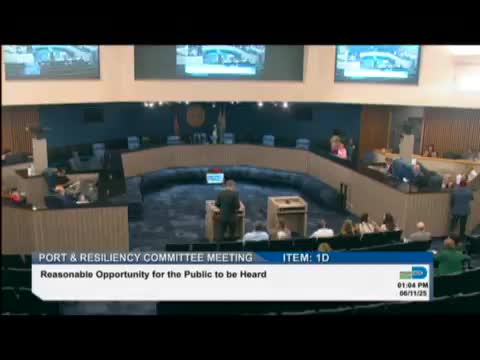
The change, moved by Commissioner Higgins and seconded by Commissioner Hardiman, passed unanimously. Commissioners said the measure balances permitting speed with environmental safeguards; public speakers representing builders, marine contractors and environmental groups addressed the commission during the item’s public hearing.
Supporters said long permitting times leave homeowners and shoreline infrastructure at risk and slow adoption of newer, habitat-friendly seawall materials. "This amendment limits public hearing and speeds up permitting applications only for seawalls and bulkheads, which we support," said Scott Polowitz of Friends of Biscayne Bay. Several contractors described multi‑month or multi‑year delays and urged the county to align local requirements with state and federal practice to avoid project failures and environmental damage.
Private residents and contractors also described impacts on construction schedules and property safety. "This has had a material impact on the construction of my project, while I've had to make adjustments to the start of construction because I am still waiting to replace my seawall," said Peter Mazzeo, a property owner who said he had waited months for a modification to a permit for living-seawall panels.
The ordinance as approved includes five amendments offered by Commissioner Higgins. Key provisions in the amendments add recital language acknowledging potential federal or state permitting authority in some cases; allow seawall or bulkhead replacement to qualify for a short-form permit where primary structural piles extend no more than 14 inches waterward provided the reconstructed face is no more than 18 inches waterward of the existing primary support piles; require that a public hearing before the Board of County Commissioners be available for any short-form application other than seawalls and bulkheads upon written request; and set the new permitting timeline to take effect upon full implementation of the county's Gold Key software for class 1 permits or on Jan. 1, 2026, whichever is earlier.
Marine biologist Bree Kocas of Ocean Consulting, who said she has worked in Biscayne Bay for more than two decades, told the commission she supports the riprap restriction and the short-form approach while raising biological concerns about invasive sponge species and habitat trends. "No one knows current...coastal habitat within Biscayne Bay better than me," Kocas said, and added support for the riprap restriction requirement.
Environmental groups asked the commission to preserve public review for applications with potentially larger impacts. Maria (last name not specified) of Miami Waterkeeper thanked Commissioner Higgins for adding a public-hearing possibility for the short form, but cautioned that some language could limit hearings for other standard permits and flagged a provision discussed during public comment that would allow piles up to 40 inches in some cases, which she said could effectively authorize incremental filling in the Biscayne Bay Aquatic Preserve and raise water-quality and navigation concerns.
Commissioner Higgins said the ordinance is intended to open a path for new living-seawall technologies and to bring riprap standards into alignment with state and county comprehensive development rules while providing transparency on missed deadlines: "There'll be a 90 day shot clock to approve these. There's only a reporting mechanism if Durham misses that," Higgins said, describing the measure as a way to speed resiliency work without eliminating oversight.
The motion was recorded as moved by Commissioner Higgins and seconded by Commissioner Hardiman and passed unanimously. The commission noted a loss of quorum was imminent; the item will take effect per the amendment timetable tied to the Gold Key software implementation or Jan. 1, 2026, whichever comes first.
Votes at a glance: item 1 G 1 — motion to approve as amended; mover Commissioner Higgins; second Commissioner Hardiman; outcome: approved unanimously.
The commission also scheduled one related administrative item (appointments to the Watershed Board) to be expedited to the June 26 meeting; no other formal actions on seawall policy were taken at this meeting.