Get Full Government Meeting Transcripts, Videos, & Alerts Forever!
Get email alerts on the Tax Increment Financing topic
No spam. Unsubscribe anytime.
Dallas TIF board reviews Grand Park South finances; home‑repair payouts likely delayed until vendor is procured
Summary
City of Dallas Office of Economic Development staff gave the Grand Park South TIF Board an overview of the district’s finances and projects and said TIF‑funded home‑repair dollars will likely not be deployed until a third‑party vendor is procured in the fall to help process applications.
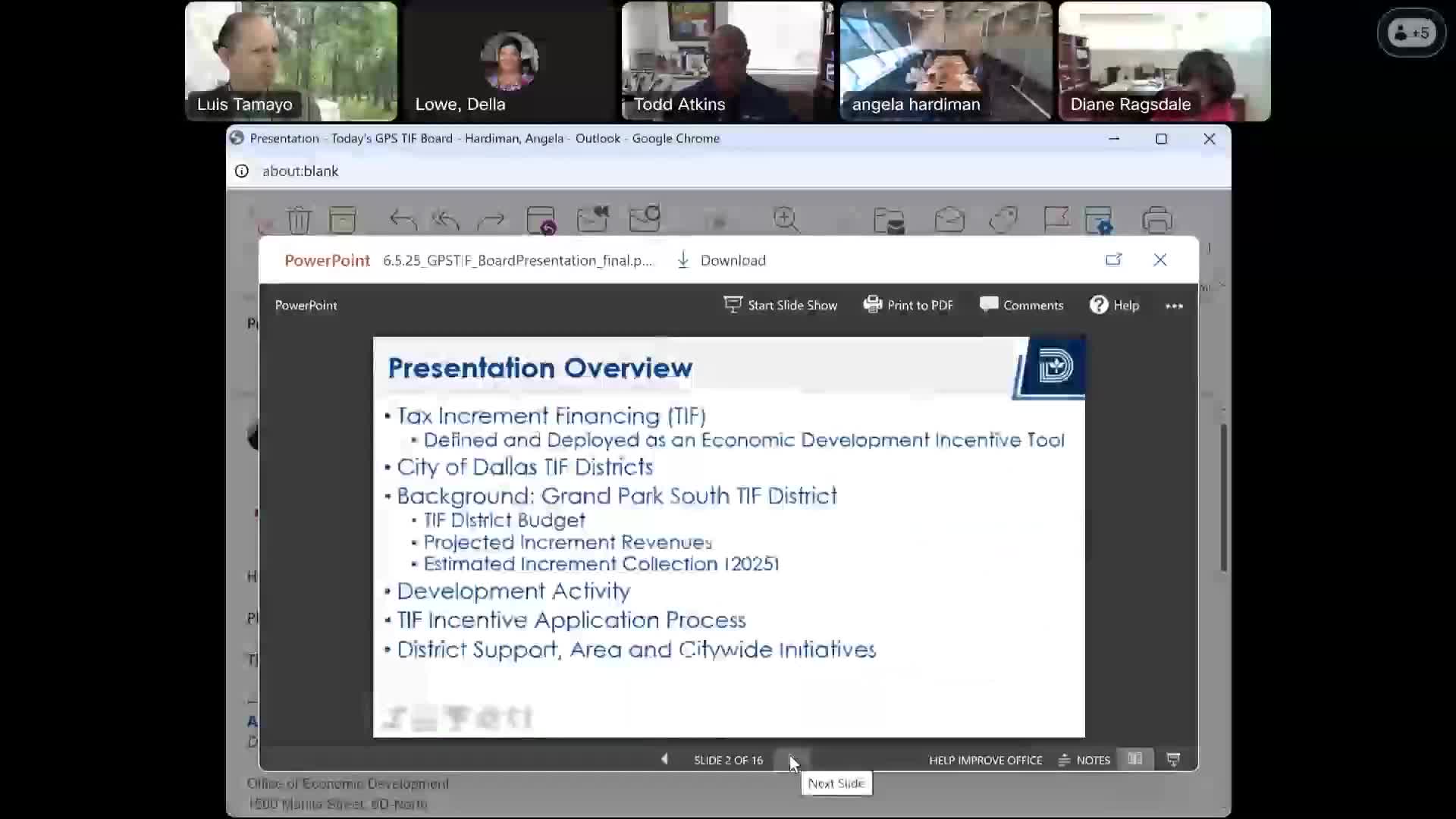
City of Dallas Office of Economic Development staff gave the Grand Park South Tax Increment Financing (TIF) Board an overview of the district’s finances, recent and planned projects, and the process for future incentives at a board meeting. Staff reported an estimated increment collection for tax year 2024 (payable summer 2025) of about $843,630 and said the district’s cash balance, after a funding allocation to the Legacy of Hope redevelopment, is approximately $176,392.
The briefing matters because the Grand Park South TIF District is one of the city’s targeted redevelopment tools aimed at spurring investment around the MLK light‑rail station and other South Dallas locations. The district, created in February 2005, covers roughly 389 acres and is scheduled to expire in February 2035; staff emphasized the board has about a decade left to use remaining TIF capacity.
Angela, a City of Dallas economic development staff member, described tax increment financing as a “value capture” tool that uses increases in property tax revenues above a base year to reimburse eligible public improvements. She said the city operates 18 active TIF districts and that eligible TIF expenditures typically include public infrastructure, open space, environmental remediation and historic façade work. Angela told the board that development agreements are generally negotiated as “pay as you go” reimbursements and that projects usually must layer other funding sources to be feasible.
On recent and upcoming projects, staff said the district funded roughly $500,000 for public lighting improvements in response to a mayoral task force recommendation on safety; that TIF‑funded lighting work began in 2021 and completed in 2022. Staff also listed non‑TIF investments in the area, including the South Dallas Cloud Kitchen (a community market and commercial kitchen), a retail building at 1632 MLK that includes Ruthie’s restaurant, confirmation that Baylor has committed a presence in that retail development, Malcolm’s Point retail (in predevelopment), and the Forest Theater (under construction).
The board discussed Legacy of Hope, a redevelopment of a former hospital property that staff said remains in predevelopment. Staff reported a City TIF allocation for that project of about $2.3 million and said the project must pull a building permit by Dec. 30, 2025, with an anticipated completion in 2027. Staff said they are assisting the developer with financing connections and predevelopment tasks but that the developer must satisfy senior lending requirements to meet the deadline.
Board members pressed staff for the amount of cash immediately available for incentives; staff reiterated the difference between the TIF plan budget (a net present value projection over the life of the district) and actual cash on hand. Angela said the plan budget and net present value estimate show substantial theoretical capacity but actual cash is far smaller and depends on realized development.
Several board members pressed for specifics about home‑repair funds the board had prioritized. Staff said the dollars for homeowner repair and homebuyer assistance remain allocated but that the Department of Housing has been prioritizing disbursement of federal funds and is procuring a third‑party vendor to help process applicants. Tamara Leek, assistant director (interim) for the Office of Economic Development, told the board staff will coordinate a small meeting with board members and Department of Housing staff to avoid creating a quorum and will report back to the full board. Staff said they expect the vendor procurement to conclude in the fall and that material disbursements of the TIF home‑repair funds are likely to begin after that vendor is on board.
Board members asked for a written report with clearer numbers on cash available and timing; staff agreed to send the meeting PowerPoint and to follow up with details on the 2024 certified taxable value, captured value, and the anticipated summer 2025 increment. Staff also said they will continue meeting monthly or as needed with Legacy of Hope developers to track progress toward the building‑permit deadline.
No ordinance or contract vote recorded in this meeting altered these items; the board approved the meeting minutes at the start and later moved to adjourn. Staff recommended that interested board members coordinate follow‑up conversations through OED staff to avoid quorum issues and to ensure public‑meeting rules are followed.