Get Full Government Meeting Transcripts, Videos, & Alerts Forever!
Get email alerts on the Instructional Time Model topic
No spam. Unsubscribe anytime.
Kyrene holds required public hearing on instructional time model for remote learners
Summary
Director Amy Gingell described the district’s Instructional Time Model covering Kyrene Online Learning and asynchronous options; the model requires two public meetings by statute and will be submitted to the state Department of Education after board adoption.
The Kyrene Elementary District held a public hearing June 10 on its Instructional Time Model, required of Arizona school districts to document how remote instructional minutes equate to in‑person minutes and to provide flexibility for students who are learning outside the physical classroom.
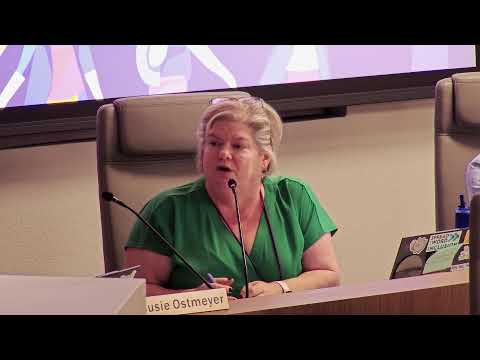
Director of Academic Equity and Excellence Amy Gingell told the governing board the model applies districtwide and was prepared to cover students who participate in the Kyrene Online Learning program and students with extended absences. Gingell said the model is being submitted pursuant to state law (transcript reference: “ARS 15,808”) and that all districts must adopt an instructional time model to allow some remote instruction while maintaining equivalence to in‑person instructional minutes.
Gingell outlined several options the model allows: daily teacher‑led online instruction (students are marked present when they log into the teacher‑led session); asynchronous module completion (students are marked present once a teacher documents the completed learning activity); participation in Kyrene’s online program (which combines live, teacher‑led sessions and asynchronous modules); and temporary schoolwide remote instruction when a school building must close for safety or health reasons. She said districts in 2022–23 were permitted to deliver up to 40% of in‑person instructional time in a remote setting, and she clarified that the 40% limit applies at the district level rather than to an individual school or subgroup.
Attendance rules in the proposed policy were described in detail: students who complete asynchronous work must submit it in a timely manner to be credited with attendance; work submitted later than 10 school days after the assignment will result in an absence for the corresponding days. Gingell also clarified that students physically present in a Kyrene school building remain classified as in‑person students even if they take an online course in that building; the Instructional Time Model applies to students who are outside district facilities. Gingell noted that one of the district’s online programs uses Centennial Middle School as a registration hub for online learners.
Gingell invited questions and public comment; no members of the public spoke. The board noted that this public hearing is the first of two required meetings; the district will hold a second public hearing at the next board meeting before formally asking the board to adopt the model and submit it to the Arizona Department of Education.
Why it matters: the instructional time model creates the local rules that determine when remote learning counts as attendance and under what conditions students may participate in online or asynchronous instruction. Adoption will affect students who are homebound, temporarily absent for extended reasons, or enrolled in district online programs.