Get Full Government Meeting Transcripts, Videos, & Alerts Forever!
Get email alerts on the County Budget topic
No spam. Unsubscribe anytime.
Commissioners debate rising mid‑year budget amendments as court approves multiple transfers 3–2
Summary
Guadalupe County commissioners discussed frequency and scale of budget amendments and voted 3–2 to approve a package of mid‑year transfers and amendments after debate about planning, transparency and whether large projects should be advanced in the regular budget process.
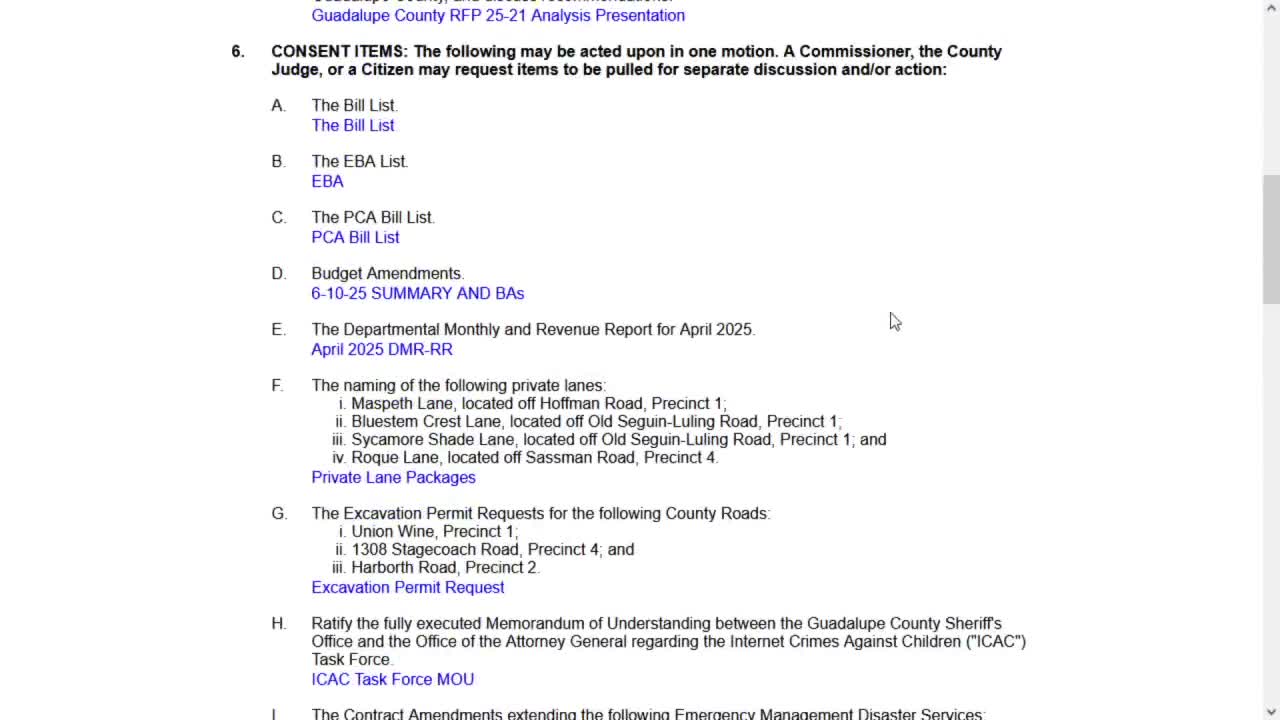
The Guadalupe County Commissioners Court extensively debated the frequency and size of mid‑year budget amendments on June 10, ultimately approving a set of amendments by a 3–2 vote.
Judge Kutcher led a lengthy policy review during which he described an increase in the number and size of budget amendments in recent months, and expressed concern that the county was authorizing projects and moving millions in unbudgeted dollars outside the regular annual budget process. He asked whether budget amendments should be an action item rather than a consent item to allow departments to present more context and allow commissioners to ask detailed questions.
Commissioners’ concerns and examples: Court members who opposed the trend said projects are often being executed without sufficient lead time, vendor vetting, or public transparency, and that shifting large sums in June to complete projects that should have been planned in the budget risks compounding amendments in September. Examples cited by commissioners included large road‑work commitments, vehicle outfitting for additional sheriff’s vehicles that arrived unexpectedly, jail commissary upgrades, and purchases for other county projects.
Counterpoints: Other commissioners acknowledged the concern but noted some mid‑year moves were unavoidable — for example, when unanticipated vehicles arrive and must be outfitted so they can be used. Purchasing staff and department heads said some items were time sensitive and could be more expensive if delayed.
Vote and outcome: After debate, the court took a voice vote to approve the listed budget amendments. The motion passed 3 ayes to 2 nays. The court instructed staff that going forward, larger and more frequent budget amendments should be individually reviewed and put on the action-calendar so department heads could present details and answer questions.
Ending: Commissioners directed staff and departments to coordinate so that major capital or recurring needs are identified during the annual budget process when possible; the court’s members signaled they will apply greater scrutiny to large mid‑year amendments in the future.