Get Full Government Meeting Transcripts, Videos, & Alerts Forever!
Get email alerts on the Implementation Report topic
No spam. Unsubscribe anytime.
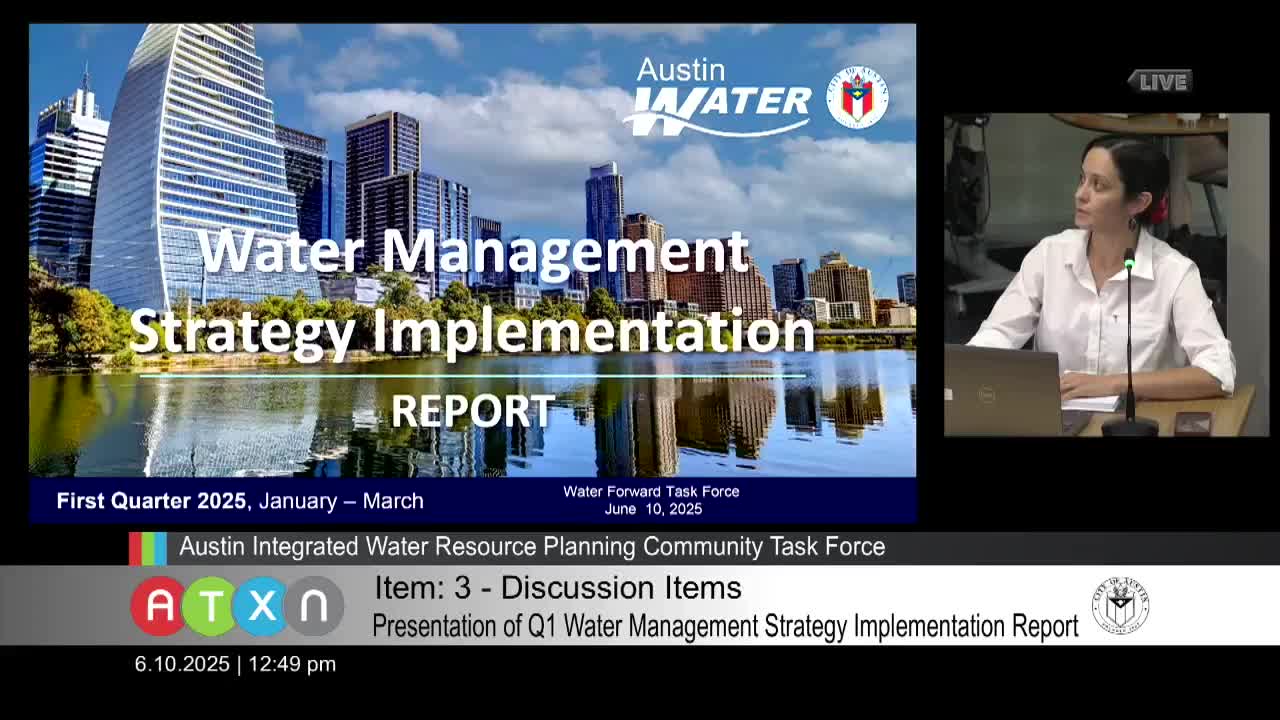
Austin Water presents Q1 implementation report: smart meters, rebates, reclaimed water and regional engagement on ASR
Summary
Austin Water presented a Q1 implementation report showing higher rebate applications and smart‑meter leak alerts in early 2025, progress on reclaimed-water connections and ongoing stakeholder engagement for ASR field testing and regulatory steps.
Austin Water staff presented the first-quarter (Q1) implementation report for Water Forward and the updated water conservation plan, summarizing progress on conservation programs, smart-meter rollout, reclaimed water expansion, water-loss reduction and regional engagement on aquifer storage and recovery (ASR).
Kevin Kluge (Water Conservation Division manager, Austin Water) said the quarterly report will cover five categories: water conservation, water loss, reclaimed and on-site reuse, conservation outreach and water-supply projects, plus quarterly water-use metrics. Kluge said Q1 metrics were preliminary and that staff intend the report to evolve with stakeholder feedback.
Conservation and rebates: staff reported an uptick in rebate applications in Q1 2025 compared with historical averages. Residential programs and digital customer tools (MiTX Water/MyATX portal) are being used to detect leaks; staff reported more leak alerts in Q1 2025 than Q1 2024. Commercial programs such as the Bucks for Business performance-based rebate program contributed savings in 2024; Q1 2025 included several submittals but less pipeline throughput than the banner year of 2024.
Smart meters and customer tools: staff said Austin’s MiTX smart-meter system is largely built out for residential customers and is generating higher volumes of leak-alert notifications; the utility is piloting customer notifications and irrigation-schedule alerts as part of council-directed work on customer outreach.
Water loss: staff said they are implementing recommendations from a Black & Veatch water-loss audit and are increasing funds for service-line replacement. Kluge noted that the infrastructure-leakage index (ILI) recorded for 2024 rose versus 2023, a change staff attributed to improved data, higher real loss from elevated use and higher temperatures.
Reclaimed water and on-site reuse: Austin Water reported two newly metered reclaimed-water connections in Q1 and work underway on multiple reclaimed system extensions. The Go Purple on-site reuse pilot was described as approved by City Council (April 2025 was cited in the meeting record) and staff said the ordinance adopted in February allows on-site reuse to be accounted for when calculating wastewater volumes. Kluge said Go Purple projects were in the pipeline but incentives finalized after the quarter; staff were approving construction permits for on-site reuse.
Fee‑in‑lieu and dual-plumb requirement: staff said the Go Purple program includes a fee-in-lieu option in limited circumstances but that the program requires dual plumbing (future-ready plumbing) to facilitate future connections; staff and task force members flagged the need to monitor whether fee-in-lieu will reduce on-site reuse installation versus expanding system capacity where feasible.
Water-supply projects and ASR engagement: staff summarized planning and consultant work for supply strategies such as ASR, indirect potable reuse (IPR), Lake Walter E. Long feasibility and brackish groundwater options. Staff said ASR field testing and eventual pilot work would require regulatory approvals (TCEQ authorizations and a Class V injection-well permitting sequence for injection), and described ongoing stakeholder engagement with Bastrop County-area representatives (Bastrop County Commissioners Court, City of Bastrop, City of Smithville, Aqua WSC, Bastrop WCID No. 2, community advocacy groups). Staff reported regular meetings with Bastrop stakeholders since April and said they are developing a memorandum of understanding (MOU) to outline commitments including information-sharing, potential community benefits, not using eminent domain in Bastrop County for the project and exploring wholesale‑supply options.
Why this matters: the Q1 report aggregates operational metrics that council asked Austin Water to publish, including gallons-per-capita daily (GPCD), rebate uptake, leak-detection activity and reclaimed-water progress. The ASR stakeholder work is material because it addresses regulatory and community confidence needs for a project that would store and recover water outside the city’s immediate boundaries.
What staff will provide next: staff said they will refine quarterly metrics, provide additional supporting data (including details on capital-recovery fee methodology and reclaimed‑system capacity), and continue stakeholder engagement. Task force members asked staff to include GPCD or gallons-per-connection metrics and to provide clearer historical comparisons for service-line replacement funding; staff acknowledged those requests for future reports.