Get Full Government Meeting Transcripts, Videos, & Alerts Forever!
Get email alerts on the Community Cats Tnr topic
No spam. Unsubscribe anytime.
CommunityCats volunteers ask commission for consistent protocol, voucher review and field support role
Summary
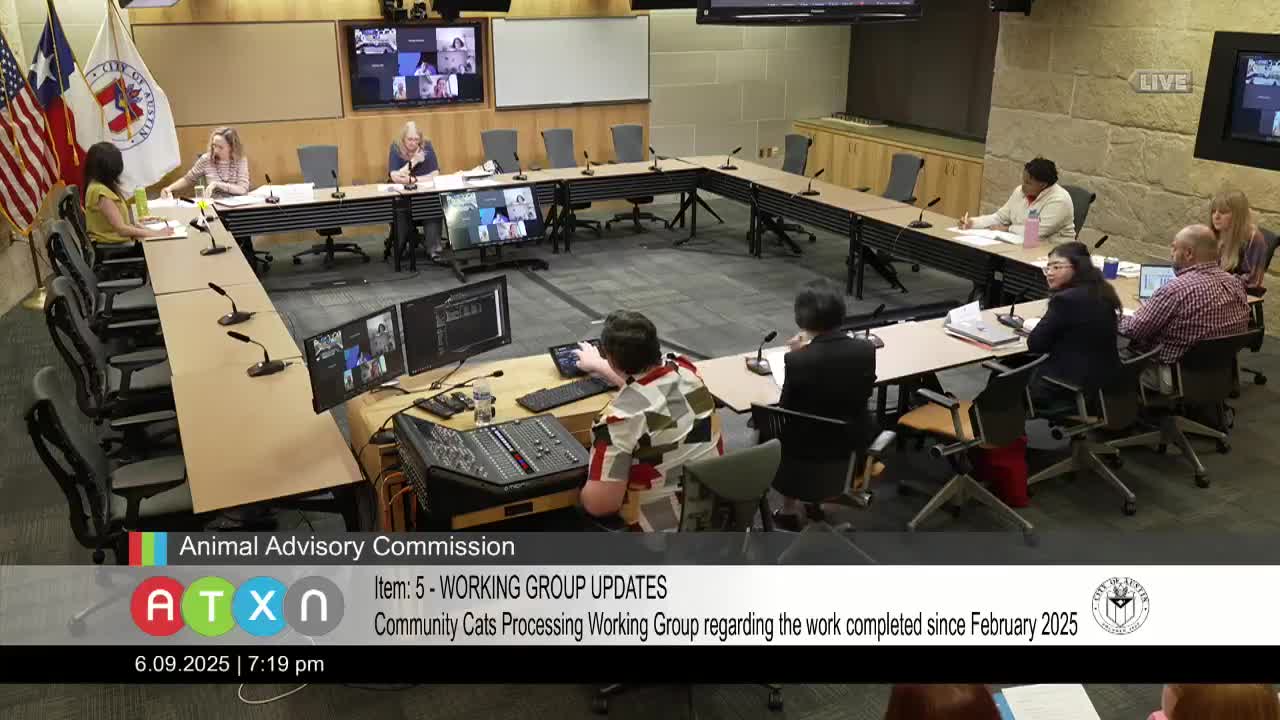
Members of the CommunityCats working group presented preliminary recommendations to the commission asking for a single coordinated protocol for community cat intake and return, a fiscal review of the $250 medical voucher cap, restored or designated trapping/field support staff, and more appropriate volunteer identification materials.
Volunteers who run trap-neuter-return (TNR) operations across Travis County told the Austin Animal Advisory Commission on June 16 that program problems are eroding public trust, increasing volunteer burnout and reducing effectiveness.
Deborah Rowe, representing the CommunityCats Working Group, said volunteers encounter inconsistent treatment depending on which staff member is on duty, that colony cats promised to caregivers were sometimes adopted without notice, and that 3-1-1 staff had outdated guidance. Rowe asked the commission to adopt five formal recommendations (to be submitted in writing) including a single shared protocol for handling community cats, clearer coordination among PRC (public reclaim), SNR and community-cats teams, and a fiscal reassessment of the medical voucher program.
Rowe: “We need a single shared protocol that is used consistently across public-facing teams.”
The group told commissioners that the current medical voucher cap of $250 (the amount volunteers and advocates said is in effect) has not kept pace with veterinary costs and that volunteers often pay the balance out of pocket. Another recommendation asked staff to explore restoring a dedicated field or trapper support position — a staff role that previously coordinated trapping logistics and reduced volunteer burnout.
Jacoby Alvarez, a volunteer, said a staff trapper or designated field support person would improve responsiveness, help triage urgent requests and reduce the operational risk tied to an entirely volunteer-run scheduling spreadsheet. Laura Nesmith, another volunteer, asked the commission to require more collaborative development of volunteer-facing materials and identification: she said a city-issued shirt designed without volunteer input failed to meet field visibility and safety needs.
Commissioner Holt and Commissioner Huddleston (who have been leading commission engagement with the working group) said they plan a one-on-one meeting with ASO community-cats staff to finalize the recommendations and asked staff to schedule the group’s written proposals for the next meeting packet.
Clarification at the meeting: volunteers and commissioners discussed the voucher amount; speakers and commissioners stated $250 as the current cap and recommended a fiscal evaluation — they did not adopt a new cap during the meeting.
Why it matters: TNR volunteers operate across the county and are critical to community-cat management and public-health outcomes; inconsistent practice or insufficient funding could reduce volunteer retention and program effectiveness.
What’s next: The CommunityCats working group plans to submit written recommendations next month; commissioners signaled they will review the proposals and consider formal action.