Get Full Government Meeting Transcripts, Videos, & Alerts Forever!
Get email alerts on the Comprehensive Plan topic
No spam. Unsubscribe anytime.
Nassau County reviews Vision 2050 draft, planners stress conservation and corridor-focused growth
Summary
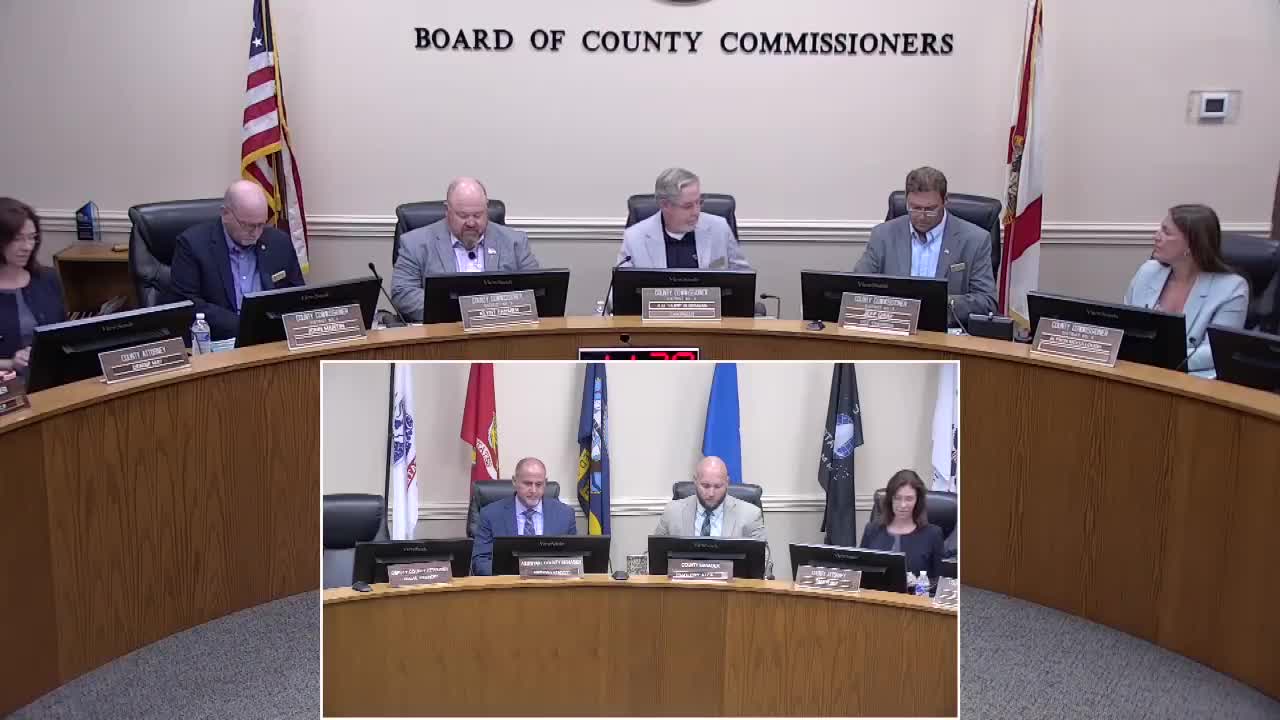
Nassau County commissioners on Monday reviewed the draft Vision 2050 plan, a countywide growth-and-land-use framework that county planning staff and consultants said would guide the comprehensive plan and later land-development regulations.
Nassau County commissioners on Monday reviewed the draft Vision 2050 plan, a countywide growth-and-land-use framework that county planning staff and consultants said would guide the comprehensive plan and later land-development regulations.
Elizabeth, a planning-department staff member, opened the workshop and said the project has reached the end of an 18-month engagement process and is setting up for potential adoption later this month. Melissa, a consultant with Half Associates, presented the preferred growth scenario that planners developed after testing three alternatives: a trend scenario, an incremental scenario and a so-called "think big" scenario.
The presentation emphasized placing more land into conservation, concentrating employment centers along the I-95 corridor and supporting those centers with suburban and mixed-use areas rather than unchecked sprawl. "The idea was to utilize the existing planning after the mobility plan and also understand where those future corridors could also be included," Melissa said while showing maps of employment centers, conservation areas and potential mobility corridors.
Why it matters: County officials said the preferred scenario is meant to inform the county's 2050 comprehensive-plan update and subsequent land-development regulations. Planning staff and consultants described the vision as high-level guidance that will be translated into statutory comprehensive-plan elements and then into enforceable code changes, small-area plans and, where appropriate, master plans for specific nodes.
What the draft contains: Presenters said the Vision 2050 process produced a community assessment, a growth framework, place types and character areas, and an implementation work program. Engagement metrics presented to the board included more than 1,000 participants in the open community survey, a statistically valid survey of more than 400 respondents, and roughly 99 formal comments in the final six-week comment period plus about 40 map-point comments. The consultants also noted multiple public events across the county and a story map on ArcGIS to let residents compare scenarios with an interactive slider.
Commission discussion: Commissioners asked for clarification about the difference between the "think big" scenario and the preferred scenario. Commissioner Martin asked, "What's the biggest difference between scenario 3, think big, and the preferred growth scenario?" Melissa and staff said the preferred map increases conservation land and refines employment-center locations compared with the broader think-big concept. Commissioners and staff emphasized that the phrase "think big" had led to misperceptions on social media and that the intent was innovation and containment of sprawl rather than encouragement of large-scale unchecked development.
Next steps and implementation timeline: Planning staff and a presenter identified the next formal steps: converting the vision into a 2050 comprehensive plan (a statutory document), updating land-development regulations, and preparing small-area or master plans for specific places such as Amelia City, Kings Ferry and the 179/95 interchange. Mr. Pope, a county staff member, described the sequence and timeframe in practical terms: the vision will inform the comprehensive-plan update, which then sets the foundation for local legislation and code changes. "This vision is that step in getting community feedback to create the comprehensive plan," he said, and added that the comprehensive-plan and land-development-code updates will require additional staff time and board direction.
Public comments: Two residents spoke during general public comment after the presentation.
Nancy Gladfelter, a resident of 24 Waxpriddle Road on Amelia Island, praised the process and asked how the county will "put teeth" into the document so the vision becomes enforceable policy. She asked whether the county would create a single master plan or multiple master plans and urged commissioners to ensure the vision is followed through into law and appointments. "How do you put teeth into this and make it become, a master plan?" Gladfelter asked.
Staff responses noted that the vision itself is a guiding document and that enforceable measures come when the county adopts the comprehensive-plan map and updates land-development regulations. Mr. Pope and other staff offered to follow up with Gladfelter individually.
Myra Jones of Callahan urged the county to protect headwaters, wetlands and existing conservation areas near the Crawford Diamond project area. Jones said Tupelo Plantation's PUD and more than 1,000 acres of wetland conservation were not shown on the presented map and urged creating large buffers and protecting Thomas Creek. "Anything that is south of the Norfolk Southern line doesn't need to be included in the industrial park. Let's protect that headwater," she said.
Staff and consultants acknowledged those site-specific concerns and said the mapping and future small-area plans would need to account for wetlands, utilities and mobility constraints. Melissa noted that existing entitled units and planned areas were included in the analysis and that the mobility plan and utility availability were key considerations when locating employment centers.
Clarifying details from the workshop: The consultants said the project produced a 148-page draft document with eight "building blocks" (for example, governance, connectivity, livability and resilience), each with objectives, outcomes and actions. The team reported more than 1,000 respondents to the open survey, a statistically valid survey of more than 400 residents, 99 public comments in the most recent six weeks and roughly 40 additional map-point comments. The consultants said those materials and all engagement inputs will be included in the final plan appendix.
No formal vote: The workshop was informational. No motions or formal board actions were recorded on the Vision 2050 item at this meeting.
Looking ahead: Staff said they can return for an additional workshop if the board wants more time before finalizing text and supporting materials for adoption. The planning department and consultants also offered to provide participants with further data on website impressions and engagement metrics.
Sources: Presentation and discussion at the Nassau County Board of County Commissioners workshop; public comments by Nancy Gladfelter and Myra Jones; presentation by consultants from Half Associates and planning-department staff.