Get Full Government Meeting Transcripts, Videos, & Alerts Forever!
Get email alerts on the Animal Shelter Euthanasia Notifications topic
No spam. Unsubscribe anytime.
Volunteers and residents urge Austin Animal Center to halt short-notice euthanasia notices and improve transparency
Summary
Volunteers, frequent shelter visitors and residents told the Austin Animal Advisory Commission that four dogs received euthanasia notices with limited rescue time, arguing the actions reflect a space crisis rather than public-safety needs and calling for clearer criteria, more transparency and improved shelter conditions.
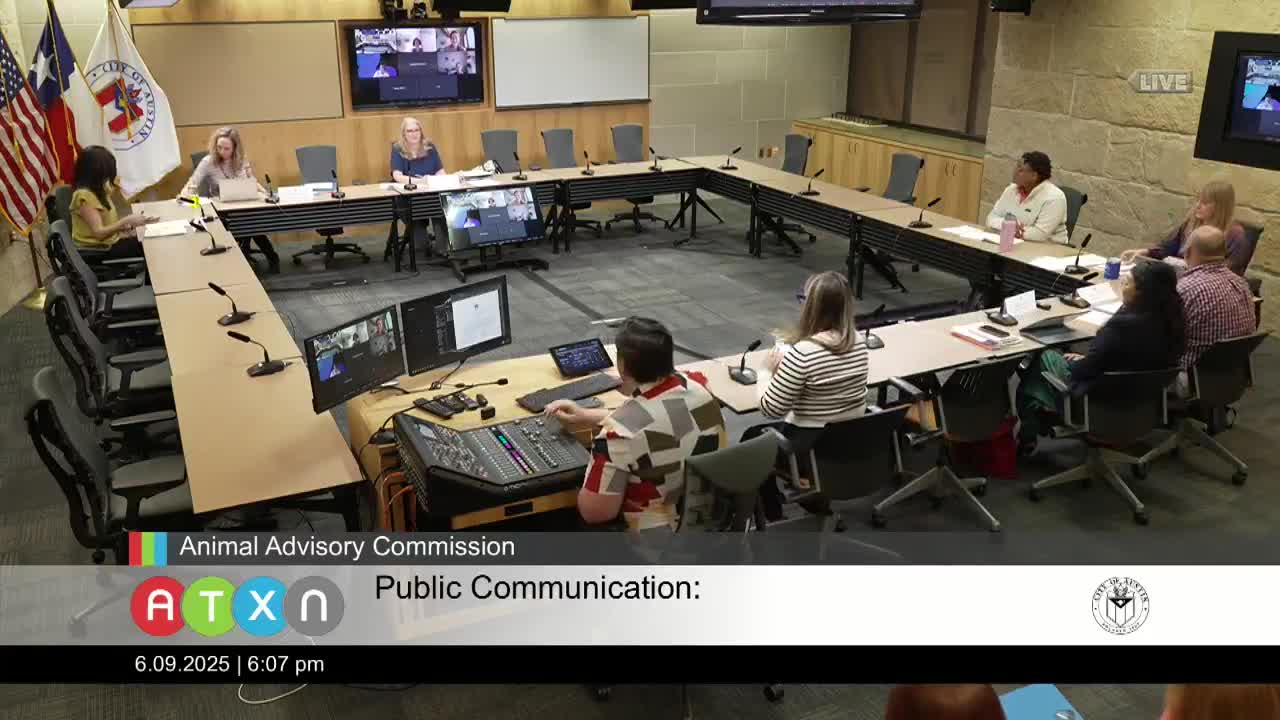
Volunteers and community members told the Austin Animal Advisory Commission on June 16 that Austin Animal Center (AAC) issued four euthanasia notices earlier that day and that the notices gave too little time and too little behavior context for rescue partners to respond.
The most direct comments came from Heather Myers, an attorney and AAC volunteer, who said AAC’s buildings were struggling to stay cool and that the shelter’s “urgent placement list” transparency commitment has not been fulfilled. Myers said at least four euthanasia notices were issued that day and that two of the dogs singled out — Sage and “Billy Girl” — were on the list as public-safety risks despite single-bite records that, she said, occurred while volunteers or staff were breaking up dog fights.
Myers: “We need more time, more transparency, and more humane decision making based on actual facts and common sense.”
Several other volunteers described the same concern. Julie Oliver, who said she volunteers about 20 hours a week at AAC, named the four dogs receiving notices as Fondue, Billy Girl, Sage and Dudley and said the dogs’ bite histories were months old and that, since those incidents, the dogs had continued safe interactions with volunteers and the public. She said staff had not provided consistent behavior reporting and raised several operational concerns, including lack of safety equipment for staff, insufficient daily walks for many dogs and an incident she said involved alleged taunting of a fearful dog by veterinary staff.
Julie Oliver: “This is about space and we are a no-kill shelter yet public safety is now being used to justify killing dogs that have shown no recent incidents.”
Max Oliver, a volunteer and mentor for new volunteers, told commissioners that Dudley — one of the dogs named in the notices — regularly meets new volunteers and has shown no aggression, and said the euthanasia notice felt driven by space constraints.
Jason Garza, who presented the monthly staff report for Animal Services during the meeting, confirmed the shelter has been transitioning software (from Chameleon to Shelter Buddy), reported May intake of roughly 1,300 animals and said the live outcome rate for the month was about 90.13 percent. Garza said veterinary services saw many emergencies and that a “good portion” of euthanasia counts in recent months consisted of very young kittens or cats that were not viable.
Garza also described space-management measures: playgroups to increase kennel capacity, double-housing compatible dogs, and incentives for rescue partners to pull animals (he said the department was offering up to $750 in reimbursement to rescues to free kennel space).
Interim Animal Services Officer Rolando Fernandez, who spoke later in the meeting, said the department is drafting a marketing/outreach plan, adding staff support for communications and working on short-term and long-term facility improvements. Fernandez also said leadership is reviewing procedures around criteria used when euthanasia is considered and offered to return with a written memo and a future presentation about those criteria.
Fernandez: “We want to make sure that as a department we are doing those things the right way… If we are doing the right thing and still having challenges meeting performance measures, then that becomes a matter of more resources.”
Commissioners and several volunteers asked for a formal agenda item or a working group to review urgent placement list policy, euthanasia-notice procedure and related transparency. Commissioner Del Zayde said she would add the topic as a future agenda item; Commissioner Linder and others said the commission could create a working group to follow up.
The public speakers also raised other operational concerns: problems with national adoption listing feeds, animals in foster not appearing online, and that animals under veterinary care are sometimes not visible to potential fosters even when they could be eligible.
Why it matters: Volunteers who know individual animals firsthand told commissioners that dogs on euthanasia notice had continued safe interactions and that the notices are being used to manage overcrowding. Commissioners asked staff to bring the euthanasia criteria and notification procedures back to the commission in a format that allows public scrutiny.
What’s next: Several commissioners suggested adding a formal agenda item or establishing a working group to review the urgent placement list, euthanasia-notice procedures, and the shelter’s transparency commitments. Staff said they would prepare memos and could present the euthanasia/behavior criteria to the commission at a future meeting.