Get Full Government Meeting Transcripts, Videos, & Alerts Forever!
Get email alerts on the Agritourism topic
No spam. Unsubscribe anytime.
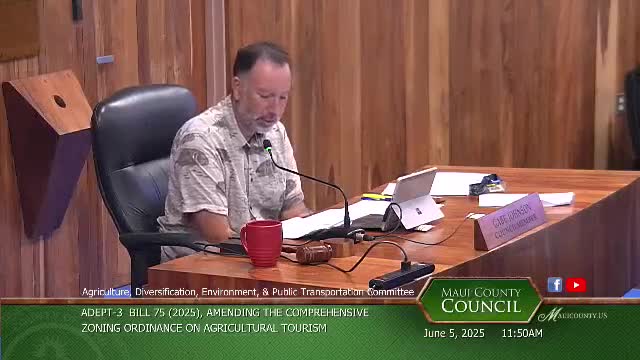
Council committee advances ordinance to allow on-farm agricultural tourism with new safeguards
Summary
After public testimony from numerous farmers and residents, the ADEPT committee voted to recommend first-reading passage of Bill 75 (CD1), which would add a defined agricultural-tourism accessory use for working farms and create a registration process and safety reviews before operations begin.
The Agriculture, Diversification, Environment and Public Transportation Committee on June 5 recommended first reading of Bill 75 (CD1), which would amend the county's zoning code to explicitly allow agricultural tourism as an accessory use on working farms.
The measure addresses state law (HRS chapter 205) requirements that allow counties to permit ag-tourism on working farms if the counties adopt rules. Planning staff worked with the bill sponsors and the Planning Commissions to craft language the committee advanced. The ordinance would add a new accessory category for agricultural tourism and list allowable activities, require legal access and off-street parking, and create a registration process so farmers confirm compliance with the standards before operating.
Why it matters: Farmers and ranchers told the committee they rely on on-farm offerings to supplement income, hire employees and keep land in agricultural use. Testimony included long-run farming operations in Hana, Maui's east side and other districts. Proponents said the change will bring county policy in line with HRS 205 and help farms recover lost income. Opponents and several Hana-area commentators asked the committee for stronger safeguards for neighbors, protections for easements, fire access and a pathway for the Hana Advisory Committee to review impacts.
What the bill does: The CD1 draft incorporates Planning Commission recommendations and includes: - A detailed description of permitted ag-tourism activities (educational tours, farm-to-table demonstrations, cultural activities, on-site retail of farm products), with a requirement that activities be accessory to a working farm. - A registration process with planning so county staff can confirm an active farm operation, legal access to a public highway, and basic parking; registration is not a permit fee-based process but a checklist and acknowledgment. - A requirement that activities cease if the farming operation stops for 60 days or longer. - A clause encouraging respect for indigenous cultural practices; the committee added language requiring consultation with the Department of O'iwi Resources on cultural-knowledge matters.
Public safety and access: The committee amended the bill to clarify that where a farm's main point of ingress/egress is under 20 feet, "consultation with Fire and Public Safety must occur" and that planners and fire would work with applicants to confirm safe access without prescribing onerous surveying requirements. Planning and the department of fire said they will review site plans at registration and work with applicants to reach feasible solutions.
Committee action and next steps: The committee voted to substitute the CD1 text and then recommended first reading, carrying revisions agreed in committee. The recorded committee vote on the final motion was 6 in favor, 0 opposed, 1 member excused. The bill will be posted for first reading on the full council agenda; the sponsor and staff said they would hold additional outreach (including a meeting in Hana) before first reading to address local concerns.
Ending: Supporters said the ordinance clarifies long-standing ambiguity, offers a structured registration and safeguards, and makes on-farm educational and retail activities legally available without forcing every farmer into a multi-month special-use permit process.