Get Full Government Meeting Transcripts, Videos, & Alerts Forever!
Get email alerts on the Urban Forestry topic
No spam. Unsubscribe anytime.
Maui committee hears plan to build an urban-forest program, seeks local input and funding
Summary
Maui County officials and nonprofit leaders presented an 18–21 month plan to inventory the island's trees, expand urban-forestry capacity and propose code changes to boost canopy cover. Presenters urged county backing for staffing and budget to implement the plan.
Maui County planning staff, nonprofit volunteers and consultants told the County Council's ADEPT committee on June 5 that a new Urban Forest Management Plan could reverse decades of canopy loss, cool built areas and support cultural uses of native species.
The county's long-range planning manager, Karen Komkiewicz, and lead consultant Kim Thayer of SR Partners described an outreach-driven project that will map existing tree canopy using LIDAR and other tools, recommend policy and code changes and identify three pilot planting projects. Komkiewicz said the plan will also recommend staffing and budget needs to treat trees as public infrastructure. "By merging local knowledge with expert advice, we can create a robust strategy that benefits everyone," Komkiewicz said.
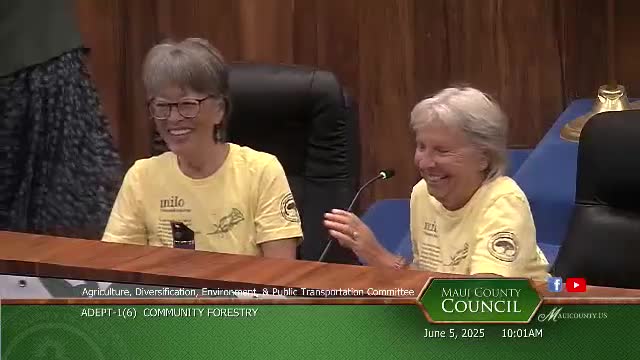
Why it matters: Committee members and presenters linked trees to public health, energy savings, stormwater management and cultural practices. Maui Green & Beautiful, a longtime nonprofit presenter, told the committee it has begun citizen-forester training and collaborative programs with schools and hopes the county plan will back stronger parking-lot shade requirements and limit harmful topping practices.
Key details: Consultants said the project timeline runs about 21 months, beginning with community outreach this summer and continuing through a draft plan and public review, with a final plan expected in 2026. Presenters described tools they will use: LIDAR canopy modeling, a story-map interface for community reports and a citizen-forester tree-mapping program modelled on Honolulu's Tree Plotter work. Kim Thayer said the plan will identify "optimal areas for planting" and recommend the "right tree in the right place." Maui Green & Beautiful said it has five citizen foresters certified so far and has secured a Kaulunani grant to support public events.
Questions and concerns: Committee members repeatedly asked about enforcement and standards: who will be responsible for pruning standards, how the county would require or incentivize shade in parking lots, and where funding and new arborist positions would sit inside county government. Komkiewicz said the plan will identify code and policy changes and recommended a budget submission so staff can implement the recommendations. Fire and emergency access, invasive species removal and coordination with utility corridors were raised as operational items the plan must address.
Public input and next steps: Dozens of residents and community organizations gave testimony supporting canopy protection, neighborhood planting and native species programs. Several speakers sought stronger public engagement in rural communities (including Hana) and recommended practical steps such as rain gardens, porous pavement and a county planting plan tied to development review. The committee asked staff to schedule community outreach across the island and to return with a draft plan and a budget request for implementation.
Ending: Committee members signaled broad support for the plan'and for drafting code and budget recommendations that would let the county expand tree care, preserve exceptional trees and fund citizen-forester training. "We need this to help our communities adapt and recover," one member said as the presentations concluded.