Get Full Government Meeting Transcripts, Videos, & Alerts Forever!
Get email alerts on the Wildfire Insurance topic
No spam. Unsubscribe anytime.
Coconino County hears experts on wildfire-driven insurance losses; board resolves to convene as flood control district
Summary
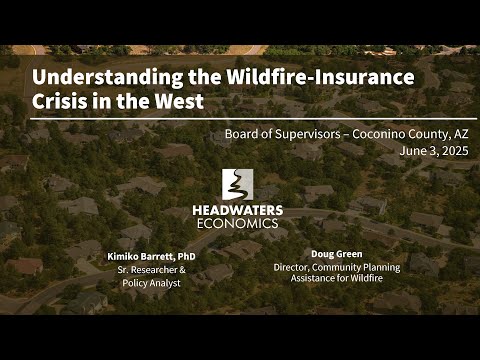
The Coconino County Board of Supervisors, meeting as the Flood Control District Board of Directors for agenda item 31, heard a presentation on the growing “wildfire insurance crisis” from Headwaters Economics experts and agreed to continue a series of work sessions on the topic.
The Coconino County Board of Supervisors, meeting as the Flood Control District Board of Directors for agenda item 31, heard a presentation on the growing “wildfire insurance crisis” from Headwaters Economics experts and agreed to continue a series of work sessions on the topic.
The Flood Control District director, Lucinda Andriani, opened the session by saying the board lacks regulatory authority over insurance but intends to “be part of a partnership and part of a discussion” with state, federal, municipal and insurance-sector partners. Andriani introduced Dr. Kimiko Barrett and Doug Green of Headwaters Economics to provide foundational information for county leaders and the public.
Why it matters: presenters said wildfire losses and post‑fire recovery costs are increasing nationwide and are reshaping the private insurance market—leading insurers to raise rates, issue nonrenewals or withdraw from high‑risk areas. Panelists warned those market shifts can push costs onto homeowners and local governments and can hinder municipal financing.
Headwaters Economics’ Barrett framed insurance as pooled risk and a price signal: when expected losses rise, insurers will adjust policies and pricing to remain solvent. Barrett said wildfire claims and recovery costs are growing, and that local governments shoulder a substantial share of those costs. She noted a state Department of Insurance and Financial Institutions (referred to in the meeting as “DiFi”) has a resiliency/mitigation council that will report recommendations to the governor later this year.
Doug Green described the mechanics of how homes are lost in wildfires and emphasized embers as the dominant source of structure loss in large conflagrations. “By far, the most common way we lose community is through embers,” Green said, explaining that embers can be lofted miles ahead of a fire front, ignite dozens of separate ignition sources and trigger structure‑to‑structure spread that overwhelms firefighting capacity.
Green and Barrett presented a five‑ingredient mitigation “toolbox” they said insurers look for: staffing and capacity for parcel‑level inspections and neighborhood planning; accurate, up‑to‑date parcel and neighborhood risk data; proactive communications and community engagement; collaborative public‑private partnerships (including insurers and regulators); and funding or incentives to help homeowners and communities carry out measures.
Examples cited: Barrett pointed to Boulder County’s Wildfire Partners home‑certification program and wildfire prepared‑home certification pilots from the Insurance Institute for Business & Home Safety (IBHS). In those programs, homeowners complete mitigation checklists and—where insurers participate—can receive continued coverage or recognition if they meet standards. She and Green emphasized that insurers generally want to see mitigation at a neighborhood scale rather than only at isolated parcels.
Board reaction and next steps: supervisors thanked the presenters and described county activity that intersects with the issue—forest restoration, fuel reduction, Firewise outreach, updates to building codes and Community Wildfire Protection Plan (CWPP) work. Andriani and presenters said the county will continue this educational series and coordinate with City of Flagstaff, state regulators and insurers. Barrett and Green offered ongoing technical support.
Votes at a glance: Before the presentation began, the board moved and seconded a procedural motion to resolve as the Flood Control District Board of Directors. The motion was approved unanimously.
Ending: Presenters said future sessions will drill into data alignment, certification models and funding mechanisms; staff and supervisors indicated follow‑up work on mapping county risk, refining building‑code strategy and pursuing partnerships with insurers and state regulators.