Get Full Government Meeting Transcripts, Videos, & Alerts Forever!
Get email alerts on the Unemployment Insurance Overpayments topic
No spam. Unsubscribe anytime.
Audit: Michigan UIA paid billions in possible overpayments and relaxed fraud controls during COVID-19
Summary
The state auditor general told a legislative oversight committee that two reports — issued January 2023 and December 2023 — identified systemic problems at the Unemployment Insurance Agency, including an inability to apply fraud controls, programming limits in the Midas claims system and billions in estimated overpayments.
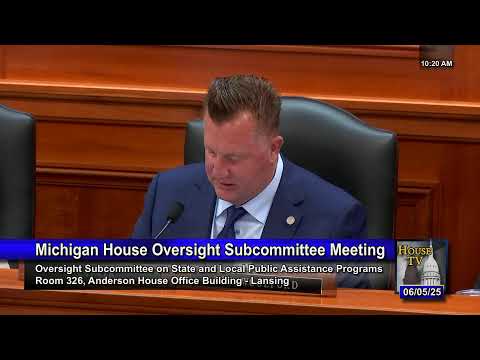
The Oversight Committee on State and Local Public Assistance Programs heard testimony that Michigan’s Unemployment Insurance Agency (UIA) issued billions of dollars in potential overpayments during the COVID-19 pandemic and weakened fraud controls while processing pandemic-era claims.
Auditor Brian Wyler, Audit Division Administrator for the Michigan Office of the Auditor General, told the committee the office issued two reports — January 2023 and December 2023 — that examined UIA claims processing and fraud investigations during the pandemic. “We concluded that UIA’s efforts were not effective,” Wyler said in prepared testimony to the panel.
The findings matter to taxpayers and employers because the reports show major federal and state funds were at risk. Auditors projected multiple overlapping estimates of overpayments rather than a single definitive total, but Wyler cited UIA’s own estimate that it had identified about $10,200,000,000 in overpayments and said the overall federal- and state-funded payments processed during the period totaled about $40,000,000,000.
Auditors described several specific control failures. Brian Wyler said UIA disabled a fraud-prevention prescreening tool known as “fraud manager” in mid-April 2020 to avoid slowing payments; auditors recorded the shutdown date as April 13, 2020. Wyler said the agency also lacked Midas programming logic to flag certain pandemic-related claims for nonmonetary review, which impeded later attempts to determine whether overpayments were the result of fraud or eligibility errors.
Chad Munger, an audit supervisor who accompanied Wyler, told the committee the audits identified material and reportable conditions across multiple objectives, including claims-processing controls, claimant communications and fraud investigations. The December 2023 audit, Munger said, concluded UIA’s efforts to identify and investigate potential claimant fraud “were not sufficient” and cited, among other items, under-assessed fraud penalties and limited law-enforcement referrals.
The auditors also discussed how UIA applied waivers. Wyler said the agency granted a large number of overpayment waivers — in many instances without first reviewing files — because it concluded that claimants were not at fault when the agency’s application and eligibility logic had been incorrect. That approach, Wyler said, increased the risk that individuals who committed identity theft or intentional misrepresentation received waivers.
The reports and committee discussion quantified some categories of problematic payments. Auditors cited Deloitte’s contemporaneous estimate that about $8,400,000,000 in pandemic payments were fraudulent; Wyler and Munger told the committee their work was independent but referenced Deloitte’s figure. The auditors’ work also identified portions of the paid amounts directed to specific groups during January 2020–October 2022: roughly $35,600,000 to incarcerated individuals, $19,800,000 to deceased individuals, about $6,500,000 to residents of long-term care facilities and more than $5,000,000 paid to UIA or LEO employees or contractors. Auditors said payments to claimants age 15 and younger or age 80 and older amounted to more than $177,000,000.
Committee members pressed auditors on causes and responsibility. Auditors told legislators the system failures reflected a combination of factors: the volume surge in claims, rapid stand-up of CARES Act programs, temporarily waived or relaxed requirements such as active work-search and the decision to prioritize speed of payment. Wyler said federal guidance early in the pandemic urged states to expedite payments and that the agency’s leadership, including a then‑director identified in committee discussion as Steve Gray, made operational calls to speed processing; Wyler said he could not definitively attribute all decisions to a single office or individual beyond noting director-level authority for some changes.
The auditors noted time limits on recovery. Wyler said Michigan law and applicable federal rules limit the period for redeterminations of intentional misrepresentation (the audit cites a three-year redetermination window under the referenced MES Act), and that for many claims those deadlines have already passed, which reduces the state’s ability to recoup some payments.
The committee adopted the minutes of its May 22 meeting by unanimous consent after a motion by Representative Brooke; no recorded roll-call tally was provided in the transcript.
Wyler and Munger told the committee they issued the two reports in January 2023 and December 2023 and that their office’s work covered claims through Dec. 31, 2022, for the fraud audit and through June 30, 2022, for the claims-processing audit. They said they were not aware of what steps UIA or the executive branch may have taken since those reports were released.
The committee concluded its hearing after extended questioning by multiple members. The auditors said their findings focused on internal controls and recommended steps to reduce the risk of similar problems in the future.