Get Full Government Meeting Transcripts, Videos, & Alerts Forever!
Get email alerts on the Water topic
No spam. Unsubscribe anytime.
Santa Cruz water department details $48 million in capital work, warns of funding and revenue headwinds
Summary
Water Director Heidi Luckenbach told the City Council the water enterprise will deliver roughly $48 million in capital projects next year but faces rising construction costs, falling demand-driven revenue and loan limits that complicate financing for large projects.
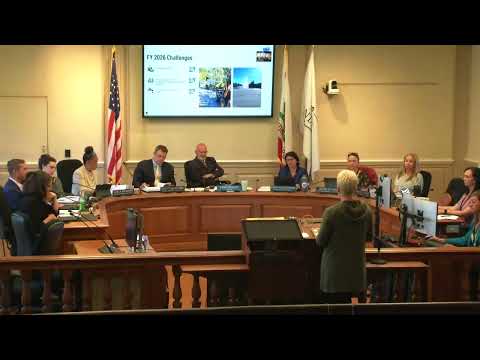
Heidi Luckenbach, the city’s water director, told the Santa Cruz City Council during a budget overview that the water enterprise will pursue about $48 million in capital work in fiscal 2025–26 while running a roughly $56 million operating budget.
Luckenbach said the department serves about 100,000 people and collects about $46 million in water rate revenue annually. She described major funding secured to date — including State Revolving Fund (SRF) loans, WIFIA loans and other grants — and outlined projects planned for the coming year, including replacement concrete tanks at the Graham Hill Water Treatment Plant, two aquifer storage and recovery (ASR) wells in Live Oak and an intertie with Scotts Valley Water District.
The water director said the department expects to ask the council in June to approve two contracts tied to a 30‑year Habitat Conservation Plan that will fund watershed and fisheries restoration and mitigation monitoring. Luckenbach also described a customer assistance program (UCAP) the council approved in November 2024; she said roughly 182 single‑family customers were enrolled and the city intends to expand a multifamily component in 2026.
Council members pressed Luckenbach on how the department will pay for long‑lived, high‑cost projects. Luckenbach and other staff described the department’s five‑year cost‑of‑service and rate planning process, noted increases in debt service tied to principal payments on a Newell Creek Dam replacement loan, and said the department is packaging projects and pursuing grants and partnerships to improve funding competitiveness.
Luckenbach warned of specific constraints. She said the SRF has imposed a $50 million loan cap that leaves some projects short of that source, and she reported one FEMA‑funded pipeline project in San Lorenzo Valley lost FEMA support after construction bids came in well above estimates. She also said construction and labor costs are rising while conservation reduces volumetric sales, creating a squeeze on revenue. “We do a great job in conservation, and that means we’re not selling water. It means we’re not making revenue,” Luckenbach said.
Staff described options the city is using to respond: (1) continuing the five‑year rate and cost‑of‑service cycle and starting the next study early; (2) packaging projects to pursue Prop 4 and Bureau of Reclamation funding and to increase multi‑benefit grant competitiveness; and (3) using debt financing where appropriate for long‑lived assets. Luckenbach said the department had secured about $190 million in SRF and roughly $100 million in WIFIA commitments overall (staff emphasized these figures as part of multi‑project programs, not a single loan), and that the Graham Hill intertie should be complete in March 2026.
Council members asked for comparative rate data and how water rates in Santa Cruz compare with neighboring districts; Luckenbach said the department has not recently completed an updated comparative analysis but the water commission has requested that comparison in the upcoming rate study. She also confirmed the department is exploring partnerships with Soquel Creek and Scotts Valley water districts to lower cost and expand reliability.
Looking ahead, staff said some large projects will likely require a mix of grants and debt and that the city will bring future policy choices to council as long‑term capital needs continue to outpace available revenues.