Get Full Government Meeting Transcripts, Videos, & Alerts Forever!
Get email alerts on the Wildfire Debris Transfer topic
No spam. Unsubscribe anytime.
Officials describe plan to move Lahaina wildfire debris from Olowalu to Central Maui Landfill; committee accepts experts and defers for follow-up
Summary
Federal, state and county officials briefed the Maui County Water and Infrastructure Committee on June 4 about the planned mid‑June start of debris transfer operations that will move nonhazardous Lahaina wildfire debris from the temporary disposal site in Olowalu to a new permanent disposal site at the Central Maui Landfill.
Federal, state and county officials briefed the Maui County Council Water and Infrastructure Committee on June 4 about the planned mid‑June start of debris transfer operations that will move nonhazardous Lahaina wildfire debris from the temporary disposal site in Olowalu to a new permanent disposal site (PDS) at the Central Maui Landfill in Central Maui.
County and federal presenters described a multiagency effort led operationally by the U.S. Army Corps of Engineers, with environmental monitoring and public‑health oversight from the Hawai‘i State Department of Health (DOH) and the U.S. Environmental Protection Agency (EPA), and facility operations handled by Maui County Department of Environmental Management (DEM) and Solid Waste Division staff. Committee members accepted designated resource personnel from the Army Corps, DOH and State DOT, heard two rounds of detailed questions, and ultimately deferred the item to allow agencies to provide further written information and clarifications.
On the record, USACE representatives said the transfer will begin June 16, with an estimated 400,000 tons of debris to be moved using a planned fleet of up to 50 trucks making up to four round trips per day (200 truckloads daily maximum). USACE said each load will be handled under a sequence intended to reduce dust and spillage: industrial‑grade plastic liners in truck beds, wetting the debris to control dust, wrapping loads and applying additional tarps, and weighing vehicles to meet Department of Transportation requirements before leaving the temporary site.
Nancy Conrad of the Hawai‘i Department of Health summarized environmental monitoring done to date during debris removal and at the temporary disposal site: thousands of samples for asbestos and heavy metals have shown no positive asbestos results and no ambient public‑health air quality exceedances tied to the TDS operations. DOH said it will continue ambient and personnel monitoring at Olowalu and will review conditions near the PDS; DEM said the county will add perimeter air monitors at the Central Maui Landfill cell accepting debris.
DEM director Shane Agawa described how the Central Maui Landfill was selected after a scoring process that included logistical, regulatory and community input. The county acquired parcels and constructed a lined containment cell: earthwork completed in earlier months and a liner installation underway. Agawa said the liner system is being built to Subtitle D landfill standards and the liner/cover system for the PDS structural elements totals about 5 feet in cross section. DEM reported roughly $5.2 million for the earthwork phase and about $14.4 million for the liner portion—roughly $20 million for PDS construction to date.
USACE and county presenters said operations will use three routes (one primary and two alternates). Presenters emphasized that trucks will be identifiable by placards (about 12x16 inches) and a contractor hotline will be available. Agencies said they will wet and wrap loads, and that routine dust control and ambient monitoring procedures are in place; DOH noted monitors in Olowalu and Kihei downwind from the PDS and said it would add monitoring as needed.
Committee members asked in detail about traffic impacts, public communication, contingency plans for weather (the hauling window overlaps part of Hawai‘i’s typical hurricane season), whether the contractor protocols and safety plans could be made public, and what would trigger operational shutdowns for wind or rain. Agencies said operational shutdown thresholds included sustained high winds (presenters cited approximately 25 mph sustained winds as a planning threshold for suspension in some operations) and that contractors and county staff would decide shutdowns for safety; the committee asked that those specific trigger thresholds and contractor safety protocols be provided in writing.
Members also asked whether the transported debris is truly nonhazardous. Department of Health staff explained the regulatory distinction: material that requires Subtitle C hazardous‑waste handling under federal and state hazardous‑waste law has already been removed during earlier phases; the material moving from the Olowalu temporary site is classified as nonhazardous solid waste under Subtitle D but can still present health risks if persons come into direct contact with ash or debris. DOH and EPA officers said workers use PPE and monitoring; they advised the public not to handle debris and said that monitoring results have not shown levels of concern for ambient air at community monitoring locations.
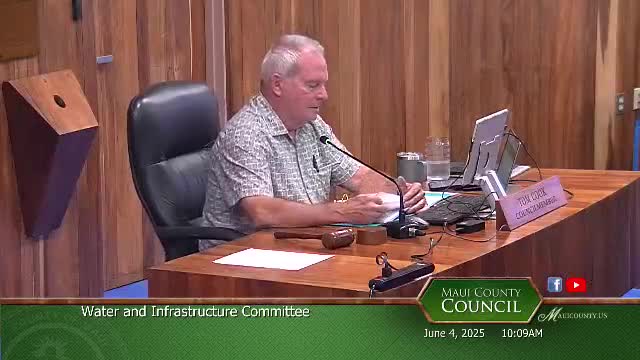
Several council members requested written answers and additional materials: contractor safety protocols, wind‑ and weather‑shutdown thresholds in writing, more detailed traffic and communications plans (including outreach to hotels, rental car companies and event organizers), and clarification on how heavy rain or storm events would be handled. Committee chair Tom Cook closed the public testimony portion (no oral public testimony was offered) and the committee agreed to defer the item so agencies could compile the requested clarifications.
Presenters said FEMA will fund certain tipping fees for debris disposal; DEM indicated the county would have additional costs for construction and operations and provided the roughly $20 million estimate for PDS construction; USACE said total transport and operations cost estimates were still being finalized but would be in the millions. No formal vote was taken; the committee accepted the agencies as resource personnel and deferred the item for follow‑up.