Get Full Government Meeting Transcripts, Videos, & Alerts Forever!
Get email alerts on the Water topic
No spam. Unsubscribe anytime.
North Ogden planning commissioners receive training on new state-required water-use element; staff cite storage, metering and secondary-water constraints
Summary
At a June 4 Planning Commission training, city staff reviewed a draft "water use and preservation" element planners must add to the general plan by the end of 2025 under state law, discussed water storage and metering upgrades and flagged limits on the city's ability to enforce secondary-water use.
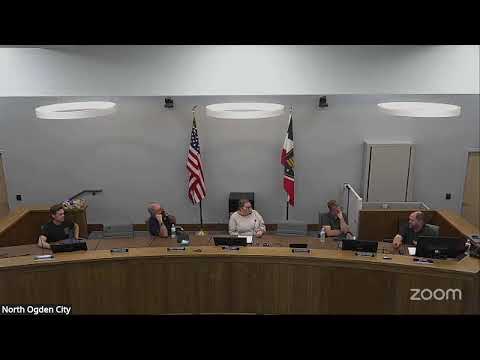
The North Ogden City Planning Commission on June 4 received a staff training and draft outline of a state-required water use and preservation element that cities must add to their general plans by the end of 2025 under recent state legislation.
Scott Hess and Ryan Nunn presented the item and asked the commission for initial feedback on a short draft section the city staff plans to refine with the Division of Water Resources, secondary-water providers and culinary-water operators. "It's likely we will cancel the July second planning commission meeting," Hess told the commission, noting schedule constraints around community events and additional hearings needed on the draft.
The draft, which staff described as a short, five-page element, lays out four required topics: an analysis of how permitted development affects water demand and infrastructure; methods to reduce per-capita consumption in future development; methods to reduce per-capita consumption in existing development; and opportunities for the municipality to modify its own operations to reduce waste. Hess summarized the purpose language included in the draft: "Water is a critical resource for the health, economy and sustainability of North Ogden," and said the plan will try to align local land-use practice with state and regional goals.
Why it matters: Senate Bill 110 (as discussed in the training) directs first- through fourth-class Utah cities and all counties to adopt a water-use element in their general plans; staff said the statutory deadline is the end of 2025. The commission and staff discussed how that requirement interacts with other recent state planning mandates and with local water providers and said the new element is intended to be flexible rather than to mandate specific outcomes for every community.
Key technical points and local context
- Providers and consultation: Staff advised the commission to consult both culinary and secondary water providers. Commissioners were told North Ogden receives secondary water primarily from Pineview Water Systems and Mountain View Irrigation (which serves the northern quarter of the city). Staff noted the city should meet with the Division of Water Resources, Pineview and Mountain View as the draft is finalized.
- Storage and capacity: City staff said a recently completed 2,000,000-gallon tank improved the city's storage and pushed the estimated need for another major tank investment out to about 2040 (with further planning to 2054); staff said the tank put the city in compliance with state storage capacity requirements for fire and culinary needs.
- Metering and leak detection: The commission watched a short local news segment showing the city's cellular-enabled water meters, which staff said provide near-daily usage and leak alarms. Staff and commissioners said the meters make it possible to spot continuous leaks quickly and reduce wasted water and bills for customers.
- Secondary-water constraints and costs: Presenters and commissioners discussed that secondary-water systems are often privately managed and tied to water shares. Staff said that in parts of the city Mountain View has begun requiring builders or homeowners to bring an actual water share; on the open market a single share was described in the discussion as costing roughly $15,000 to $20,000. Commissioners and staff raised equity and economic-development concerns tied to that cost.
- Enforcement and staffing limits: Staff repeatedly stressed the city lacks capacity to act as a "water police" for secondary-water usage if it participates in some secondary-water metering or enforcement programs. The draft element includes many conservation policies the city can recommend to secondary suppliers, but staff said the city does not intend to take over operation of Pineview or Mountain View irrigation systems because doing so would create major staffing and liability obligations.
Policy tools discussed
Staff and commissioners reviewed a range of policy tools that could appear in the element or follow from it: low-water landscaping standards (especially for multifamily and institutional projects), incentives or rebates for retrofitting irrigation and fixtures, possible water budgets or allotments for municipal/public sites, programmatic elimination of nonessential turf in parks and park strips, promoting efficient irrigation (drip systems, smart controllers and rain sensors) and better public education and sample plant lists to help homeowners adopt low-water yards.
Commissioners emphasized outreach and demonstration projects as critical: one commissioner suggested the city highlight one or more local yards or cul-de-sacs using drought-tolerant landscaping as exemplars, and staff suggested compiling a local plant list or contracting a low-cost landscape-architecture template for residents and builders.
Other technical items noted
- The draft mentions opportunities to study and better understand local groundwater and spring resources; staff identified Rice Creek, local springs and nine city wells as important but not fully quantified assets.
- Staff said the state requires progressive metering of secondary connections (timeline discussed in the training around grants and metering deadlines), and noted available state grant funding for secondary-water metering programs.
- Staff described how the city uses will-serve letters and development review to ensure culinary-water infrastructure can support new building; they said this functions as the city's concurrency control for water at present.
Next steps and public process
Staff said the draft is an initial "shell"; the city will continue to coordinate with the Division of Water Resources and secondary-water suppliers and will bring a completed draft back with a public hearing when ready. Hess asked the commission for feedback and suggested staff expects further meetings and a formal adoption process.
Administrative action at the meeting
The commission unanimously approved the May 7, 2025 meeting minutes on a voice vote. The approval was made by motion, seconded, and recorded as "all in favor: Aye." No other formal actions on ordinances or resolutions related to the water element were taken at the June 4 meeting.
Ending
Commissioners and staff identified several items for follow-up: coordinating a consultation with Pineview and Mountain View, adding illustrative guidance (plant lists and demonstration sites) for homeowners and multifamily developers, and refining the draft language before a public hearing and adoption. Staff also noted they expect to return the item for formal consideration and said they will notify the commission when the water element is scheduled for a hearing and vote.