Get Full Government Meeting Transcripts, Videos, & Alerts Forever!
Get email alerts on the Moderate Income Housing topic
No spam. Unsubscribe anytime.
Planning commission reviews 2025 moderate-income housing plan and recommends five strategies including impact-fee relief
Summary
Staff presented the state-required 2025 Moderate Income Housing Report, recommending five strategies (ADU support, allowing residential in commercial/mixed-use zones, PDD incentives with deed-restricted units, CRA/RDA set-asides, and waiving/reducing impact fees) and summarized recent local projects that include deed-restricted units.
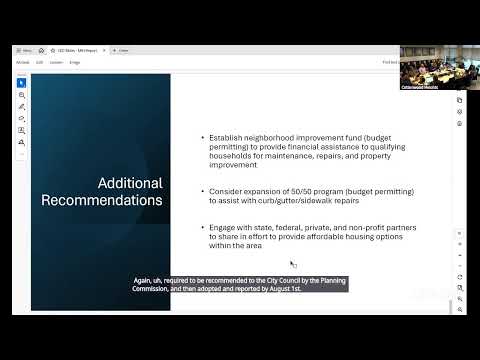
Cottonwood Heights planning staff presented the city’s 2025 Moderate Income Housing Report during the June 4 planning commission work session, summarizing local housing data, recent projects with deed-restricted units, and five recommended strategies the city will include in the state-mandated plan to be submitted by the August 1 deadline.
Staff said state law requires municipalities to adopt a housing plan every five years (and submit annual progress reports in intervening years). The statute sets a menu of state-defined strategies (26 options); cities must adopt at least three strategies and may adopt up to five to qualify for higher tiers of priority funding. Cottonwood Heights staff recommended adopting five strategies to preserve access to those funding opportunities.
Staff summarized local housing indicators: roughly half the city’s housing stock was built between about 1960 and 1980, single-family detached homes comprise approximately 80% of the housing stock, and the city’s area median income (AMI) used in the report is about $116,500. By staff calculations, an AMI household would have an affordable housing cost of just under $3,000 per month; 80% AMI equates to roughly $93,000 or about $2,300 per month in affordable housing costs. Staff emphasized that the largest affordability gaps exist at lower AMI bands (30–50% AMI) but said the city’s proposed strategies focus on moderate-income (80% AMI) options while recognizing other bands also have need.
Staff described the five recommended strategies: (1) continue ADU allowances and consider ordinance changes to make detached ADUs easier to build (staff noted detached ADU standards are currently restrictive, requiring larger setbacks and limiting heights, and that the city has issued few detached ADU permits); (2) allow residential density in commercial and mixed-use zones and codify mixed-use standards in nonresidential districts; (3) use PDD (planned development district) incentives to secure deed-restricted moderate-income units (staff noted two recent PDDs: IKO at Fort Union — ~200 units with 10% deed-restricted at 50% AMI — and the Wasatch Rock / Northern Gravel Pit entitlement with 600 entitled units and a 15% requirement, roughly 40 deed-restricted units at or below 80% AMI); (4) require a moderate-income housing set-aside in future community reinvestment area (CRA) / redevelopment projects (town center, gravel pit identified as potential future CRA/RDA areas) and consider using leftover EDA funds for affordable housing investments; and (5) develop a program to reduce or waive impact and development fees for deed-restricted moderate-income units.
On ADUs, staff explained internal ADUs (basement units, over-garage units, etc.) are permitted throughout the city with licensing and inspections, but detached ADUs are limited by size and setback rules that make them impractical on many lots. Staff suggested exploring pre-engineered plan sets and a card-file of approved designs to lower cost and complexity for homeowners who want to add ADUs.
Staff noted the city has an impact-fee schedule (transportation, stormwater historically noted) and said any program to waive or reduce fees would require careful study to comply with state impact-fee rules and to validate fee calculations before applying waivers. Staff recommended tracking progress annually and reporting implementation measures as required by state code.
Commissioners asked clarifying questions about whether certain development areas (for example, the gravel pit) would qualify for transit-oriented options and whether existing CRA/EDA funds could be reallocated; staff said some areas could qualify and that staff will return with more detail as projects progress. The report will be transmitted to city council as the commission’s recommendation for adoption and for submittal to the state by the August 1 statutory deadline.
Votes at a glance: At the end of the session commissioners moved and seconded to adjourn; the motion passed on an affirmative voice vote.