Get Full Government Meeting Transcripts, Videos, & Alerts Forever!
Get email alerts on the Police Training Facility Public Comments topic
No spam. Unsubscribe anytime.
Public commenters urge council to delay, reallocate funds and seek transparency on proposed police training facility
Summary
Multiple public speakers at the Dallas City Council meeting opposed the proposed Dallas Police Department training facility, citing rushed scheduling, insufficient funds, lack of site disclosure and calls to invest bond dollars in social services instead of expanded policing.
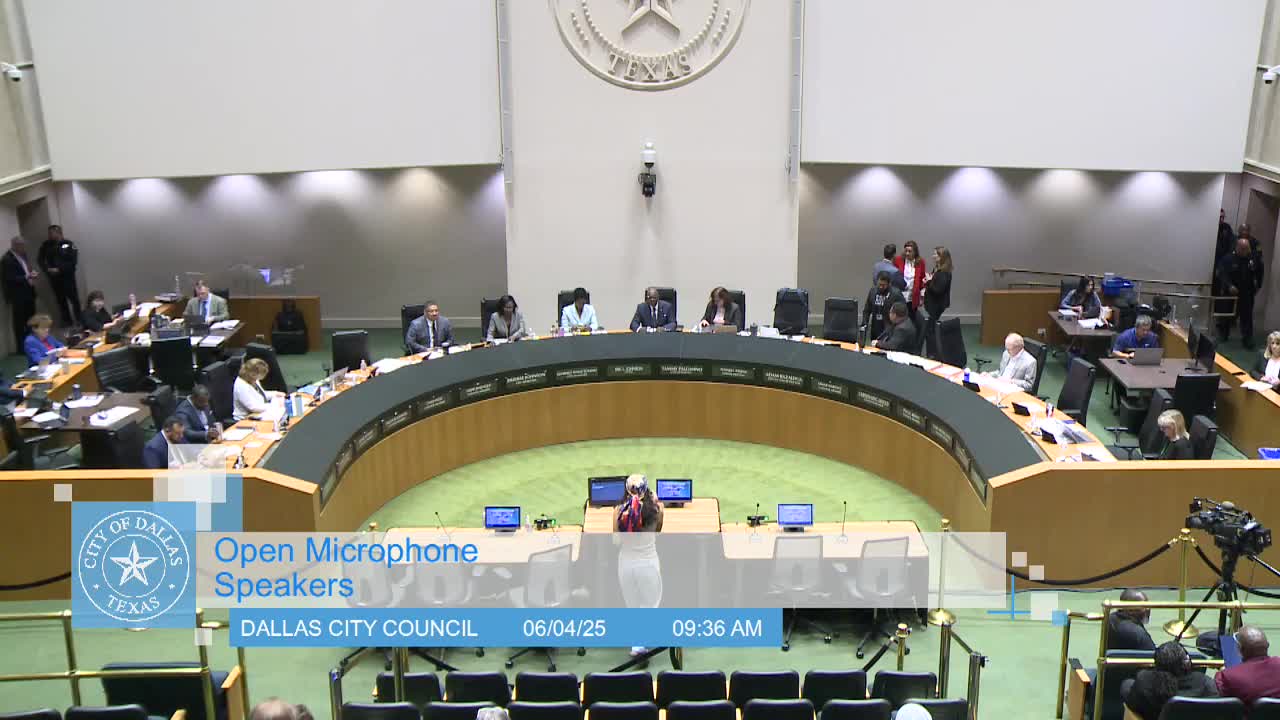
During the public‑comment period at the Dallas City Council meeting on June 4, several registered speakers urged the council to oppose or slow plans for a new Dallas Police Department training facility commonly called a "cop city" in public testimony.
Cece Encarnacion, director of community outreach for the Sarin Foundation, said contractors and subcontractors that profit from public subsidies should be vetted and urged the council not to fund companies that bypass environmental or zoning rules. Nora Sotto of District 4 told the council the project has been handled with "a lack of transparency, disregard for public opinion, and misappropriation of public funds," saying a presentation was released only 48 hours earlier and that funds raised were "not even one‑third of the amount needed." Tamara Linnae, a District 2 resident, questioned where the outdoor training components would be located (shooting range, tactical village, emergency vehicle course) and highlighted recent declines in violent crime rates; she urged investments in housing, mental health and job stability instead of a large training complex.
Lindsey Lindeman, a law student at UNT Dallas, said the proposed facility could accelerate militarized policing and convert bond language about public safety into a measure that supports surveillance and control; she said the police have "no constitutional obligation to protect" and that more training with military equipment is not a crime‑prevention strategy. By contrast, Miriam Sharma of Moms Demand Action, a gun‑violence prevention volunteer, testified in favor of gun safety work and urged residents to participate in National Gun Violence Awareness Day.
Nut graf: Testimony was mixed but skewed toward opposition; speakers raised procedural concerns (short notice for presentations and unspecified location for major components), budgetary concerns (project funding shortfalls and diversion of bond money) and policy objections (militarization, surveillance and prioritization of policing over social services). Several speakers urged the council instead to use bond and city funds for housing, infrastructure, libraries and community‑based violence intervention.
Ending: The city council did not take formal action on the facility during the meeting; public commenters requested additional public hearings, clearer disclosure of site plans and detailed funding breakdowns before any financial commitments are finalized.