Get Full Government Meeting Transcripts, Videos, & Alerts Forever!
Get email alerts on the Fleet Management topic
No spam. Unsubscribe anytime.
City fleet reports higher preventive‑maintenance compliance, expands EV charging and tests off‑grid solar canopies
Summary
Equipment and Fleet Management reported improved KPIs, ongoing electric vehicle deployments, new level‑3 chargers and mobile off‑grid solar canopies; council asked for progress updates on charger installations and deployment timelines.
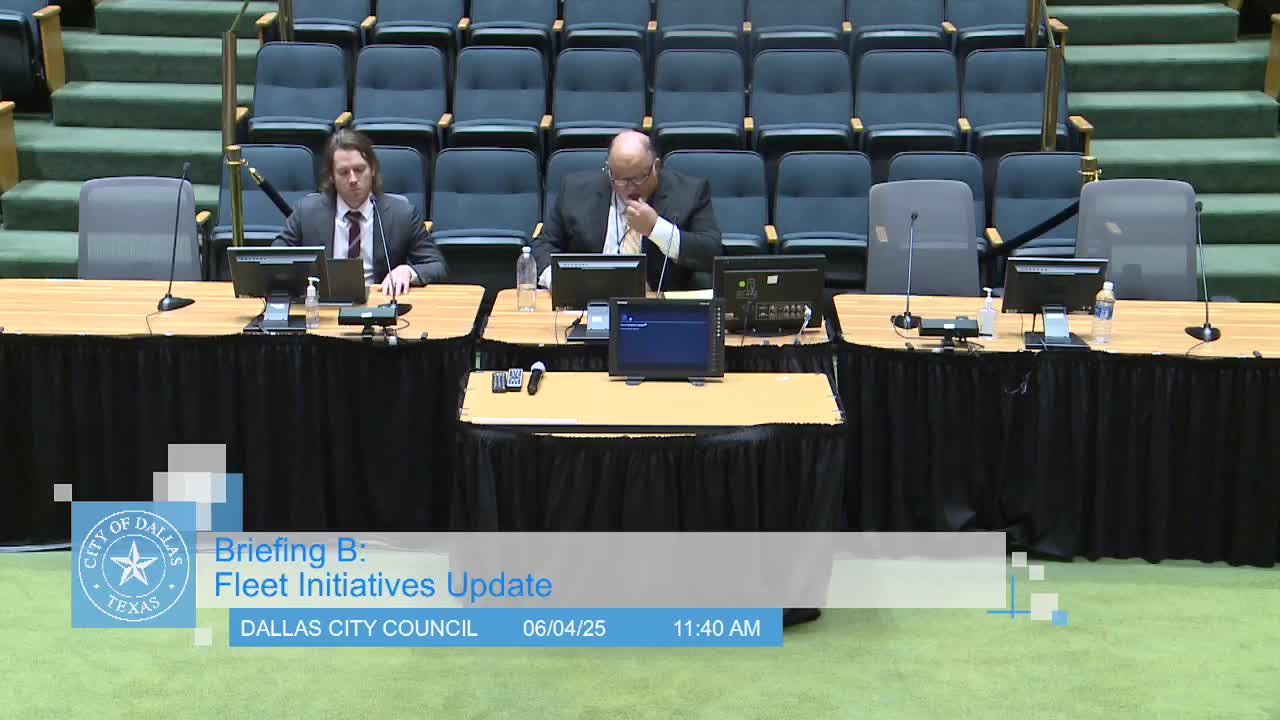
The City of Dallas Equipment and Fleet Management team briefed the council June 4 on fleet performance, workforce development and progress toward vehicle electrification.
Director Vincent Olson and Assistant Director Matthew Amend reported the department manages about 5,700 fleet assets across five service centers, with roughly 190 mechanical staff and five full‑service fuel islands. Key performance indicators for the current year included an estimated preventive‑maintenance (PM) compliance rate near 82% and fleet availability averaging about 83–84% across departments. The department noted an increase in parts inventory, a centralized hub‑and‑spoke approach for parts distribution and rising employee training and certification: 8 technicians from Dallas College recently joined, and ASE‑certified technicians received doubled incentive pay.
On fuels and electrification, staff said the city manages about 6.8 million gallons of fuel annually and is integrating EV kilowatt‑hour usage into fuel accounting. The motor pool at City Hall has been fully electrified under an existing Ford contract and houses 12 level‑2 charging pedestals. The department has installed level‑3 chargers at central and southeast depots and is deploying larger charging banks; Olson said two level‑3 depots are operational and staff are collecting usage data.
The briefing highlighted pilot “off‑grid” solar charging canopies at Hensley Field and the central service center; the canopies include solar arrays with battery storage and tilt/pan capability. Olson said those portable canopies allowed about 160 miles of travel on off‑grid solar in initial tests and can be redeployed if a site changes.
Councilmembers asked about timelines and barriers. Councilmember Jerome Stewart asked why some level‑2 and level‑3 installations remained shown as pending; staff said most level‑3 chargers that staff showed were installed and serving vehicles, but several other planned sites remain pending because of Encore installation timelines, supply‑chain constraints (transformers and conduit) and, in one case, unexpected underground conditions discovered during trenching at a depot. Assistant City Manager Donzel Gibson said the city has pushed Encore for delivery and that timelines largely depend on supplier lead times.
Nut graf: Fleet staff characterized the program as a mix of near‑term operational gains—higher PM compliance, expanded parts and technician training—and medium‑term capital changes tied to electrification: chargers, battery and software integration and workforce retraining to support electric and heavy equipment. The department will continue to brief council committees on charging deployment and EV policy details.
Ending: Olson and Amend said the department will continue to deploy charging infrastructure, expand training partnerships with Dallas College and provide additional committee briefings on level‑2/3 charging schedule and CCAP alignment.