Get Full Government Meeting Transcripts, Videos, & Alerts Forever!
Get email alerts on the Early Learning topic
No spam. Unsubscribe anytime.
Early‑learning changes: ECAP delays, rate timing pushed and mixed program cuts and investments
Summary
DCYF outlined changes to early‑learning policy and funding: delays to Fair Start rate increases, reduced ECAP slots and eligibility changes, plus both cuts and targeted facility and pilot investments.
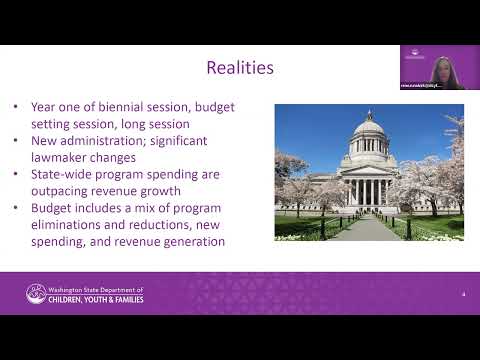
DCYF told webinar participants on May 14 that the legislative conference budget delays several early‑learning policy and rate changes planned under prior law, reduces some slots and grants, and provides targeted capital and pilot investments.
The changes matter to early‑learning providers and families because the timing and scope of rate increases and program entitlements determine provider revenue and family access to subsidized child care. Lisonbee Kreutzinger and Renee Newkirk emphasized that the department will provide implementation guidance after final gubernatorial action.
Key policy and funding moves cited by DCYF include: the delay by one year of a scheduled Fair Start for Kids center‑based rate increase that would have set rates at the 80th percentile of the most recent market rate survey (the department said the delay feels like a cut for many centers even though funding remains in the biennium); full funding of the collective bargaining agreement with family child‑care providers; a postponement of statewide ECAP entitlement until the 2030–31 school year; an increase in ECAP school‑day rates of 5% beginning July 1, 2025, but a reduction of 3,000 ECAP part‑day slots in the same fiscal year; and a small slot increase (250 school‑day slots) effective in fiscal year 2027.
DCYF listed a series of program reductions and eliminations: center‑based trauma‑informed care enhancement was eliminated for centers (retained for family child‑care), early ECAP program funding was eliminated, Working Connections seasonal child care line was removed from stand‑alone funding (the department said seasonal care remains available through forecast processes), and several grant lines (equity grants, complex needs fund, technical assistance funds and mental‑health consultation funding) were reduced, with some differences between center‑based and family‑child‑care allocations because family‑child‑care is covered under a bargaining agreement.
New investments noted by DCYF include $51 million at the Department of Commerce for early‑learning facilities (with $9 million for minor renovations and $3 million for emergency grants), a $2 million one‑time grant for Washington Communities for Children, and a $300,000 child‑care mental health pilot in Spokane.
Ending: Agency leaders said they will publish more detailed implementation guidance and meet with ECAP directors, providers and partners to explain schedule, eligibility and contract changes once the governor acts.