Get Full Government Meeting Transcripts, Videos, & Alerts Forever!
Get email alerts on the Child Welfare topic
No spam. Unsubscribe anytime.
DCYF to cut, retool prevention and child‑welfare programs while preserving some statutory services
Summary
DCYF said the Legislature reduced or eliminated several prevention and child‑welfare programs, assumed underspend in multiple lines, and funded select new placements and staff; statutory obligations such as Family Reconciliation Services remain in law even where funding is reduced.
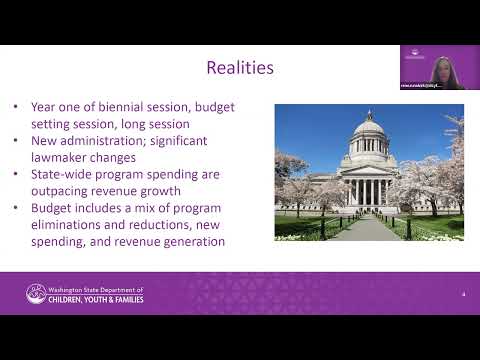
The Department of Children, Youth and Families told a May 14 webinar audience that the Legislature’s conference budget includes a series of reductions, program eliminations and a few targeted investments in prevention and child welfare.
The changes matter for families, caregivers and providers because DCYF said some reductions will affect contracts and client access while other reductions are tied to assumed underspend and may not immediately change current service levels.
Agency officials listed specific program changes. Renee Newkirk, DCYF chief financial officer, said the department will see reductions linked to projected underspend in multiple lines; she identified the foster care assessment contract (FCAP) with Harborview as a reduced contract where the department "does anticipate there to be an impact." DCYF said some reductions were categorized as underspend and thus are expected by the Legislature to occur without direct program cuts, but implementation choices remain pending.
Program eliminations and reductions named in the webinar included: elimination of the Intercept program (funded only through FY26 and not implemented), elimination of a Safe Care contract in Grays Harbor (no provider in place), elimination of a crisis family intervention contract (a short‑term counseling component of Family Reconciliation Services, or FRS), elimination of one foster care respite contract in a single region (DCYF said case aids remain available under caregiver supports), and elimination of planned CSEC receiving center funding where implementation funds were insufficient.
DCYF said some program reductions will have direct client impacts. The agency flagged a $3,000,000 reduction to the home visiting program and said the foster care assessment program contract reduction will have measurable impacts. At the same time, DCYF noted new investments: 10 additional emergent placement (EPS) beds tied to the DS settlement agreement, funding for critical incident review staff, a $50,000 proviso to convene a foster care rights work group, continued funding for a rising‑strong model in Spokane, three Positive Indian Parenting sites, adolescent transition living placements and new staff to support CSEC and missing tribal youth.
On Family Reconciliation Services, Lisonbee Kreutzinger said passage of HB 1509 (codifying community‑based pilots for FRS) did not change DCYF’s statutory obligation to provide FRS; Renee Newkirk said the department will continue to provide FRS but must do so within a reduced child‑welfare budget and that implementation details were still being worked out.
Ending: DCYF told attendees it will move into implementation planning and notified impacted employees where positions were eliminated; the department asked for stakeholder patience while it determines contract and service adjustments.