Get Full Government Meeting Transcripts, Videos, & Alerts Forever!
Get email alerts on the Budget topic
No spam. Unsubscribe anytime.
DCYF: Legislature passes budget with cuts, new investments as state faces multibillion-dollar shortfall
Summary
The Department of Children, Youth and Families briefed partners May 14 on the conference budget passed by the Legislature, describing a mix of program reductions, eliminations and targeted investments while the governor considers final signature and vetoes.
The Department of Children, Youth and Families (DCYF) told partners on May 14 that the state budget passed by the Legislature assumes large revenue changes and includes both cuts to services and new targeted investments as the governor considers final action.
The update matters because the budget sets Washington’s operating priorities for the next two fiscal years and begins July 1; DCYF programs serving children, youth and families will be reshaped by those choices. "The state is currently faced with a $15,000,000,000 budget deficit over the next 4 years," Renee Newkirk, DCYF chief financial officer, told webinar attendees.
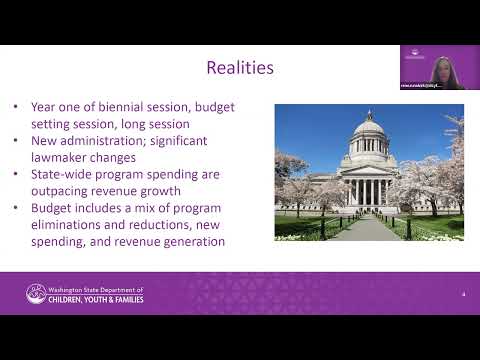
Agency leaders said the Legislature took a multi‑pronged approach to balance the state books: reductions and eliminations of programs, assumptions of underspend in several line items, new revenue adjustments and select new spending. Lisonbee Kreutzinger, DCYF director of public affairs, noted this was a first biennial session with a new governor and many new lawmakers, which changed the dynamic of negotiations.
Renee Newkirk outlined the budget math the Legislature used: the conference budget assumes roughly $8.7 billion in additional revenue adjustments over the next four years while also reducing or eliminating some DCYF programs and assuming underspend in other lines. Agency staff stressed that the presentation reflected the conference budget as of May 14 and that the governor’s final signatures or vetoes could change funding before implementation.
DCYF said some reductions are expected to be handled through "assumed underspend"—legislative adjustments based on expected lower utilization—while other changes will require active implementation decisions by the department and could affect clients and provider contracts. Agency leaders warned that they had not completed implementation planning and that more details and a second version of the briefing would follow after final budget action.
The webinar also flagged an expected additional risk from possible federal funding reductions, since federal fiscal and state fiscal years do not align. Newkirk said DCYF is monitoring federal budgets but cannot yet quantify possible additional cuts. The department will publish updated materials after the governor acts.
Ending: DCYF asked stakeholders for patience while it completes implementation plans and communications; the agency said it will follow up with more detailed guidance once the governor signs or vetoes the remaining measures and as implementation decisions are finalized.