Get Full Government Meeting Transcripts, Videos, & Alerts Forever!
Get email alerts on the Property Maintenance topic
No spam. Unsubscribe anytime.
York County supervisors debate new "overgrowth" ordinance; staff told to couch rules in public-safety terms
Summary
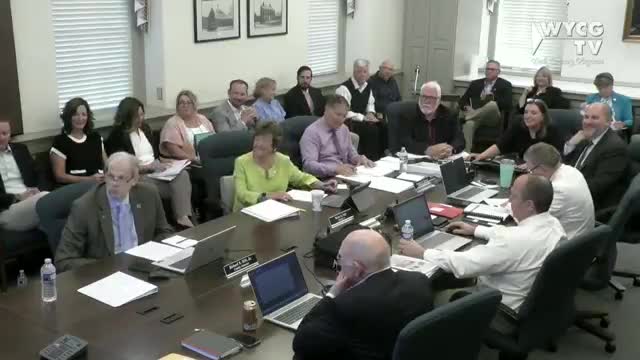
York County supervisors on June 3 reopened debate on proposed amendments that would add a defined "overgrowth" category to existing property-maintenance rules, covering overgrown shrubs, trees, noxious weeds and invasive vines.
York County supervisors on June 3 reopened debate on proposed amendments that would add a defined "overgrowth" category to existing property-maintenance rules, covering overgrown shrubs, trees, noxious weeds and invasive vines.
The discussion focused on when county action would be justified and how enforcement would work. Planning staffer Caitlin said the draft ties removal authority to narrow safety-related conditions and to an enforcement timeline modeled on the county's grass ordinance: "We'd provide a written notice of violation annually running 7 days to correct," she told the board, and after a single notice a contractor could abate repeated violations in the same year and place a lien for costs.
The board and staff said the proposal is complaint-driven and not intended as a general aesthetics code. Caitlin said grounds for county action in the draft include vegetation that obscures address numerals or mailboxes, vegetation that obstructs pedestrian or vehicular traffic or that prevents emergency access to windows, doors or paths, vegetation physically growing into and damaging a structure, and other conditions that would impede ingress, egress or emergency response.
Why it matters: supervisors repeatedly framed the proposal as a public-safety measure rather than an aesthetic regulation, and several members warned the county must avoid overreach on private-property maintenance. The board asked staff to return with language that clearly ties enforcement to safety concerns and to present the item again at the next public hearing.
Most contentious points
- Notice period and process: staff said the 7-day correction period and one written notice per year were copied from the county's grass ordinance. Board members argued 7 days can unfairly catch people away on vacation and suggested a longer initial period for non-urgent overgrowth; one supervisor proposed 30 days for overgrowth because it accumulates slowly. Staff noted zoning officers typically try to work with property owners before abatement and that the code's current structure gives enforcement discretion.
- Complaint-driven enforcement: Planning staff and several supervisors emphasized the ordinance would operate on complaints rather than proactive inspections. A supervisor said repeated neighbor complaints or evidence of infestation or physical danger would prompt county action, while other members cautioned that complaint-driven rules can be weaponized in neighbor disputes.
- Interaction with unsafe-buildings and demolition processes: board members asked how overgrowth enforcement would relate to building-code actions for dilapidated structures. Staff said building officials already have separate authority to condemn or abate unsafe buildings; the proposed overgrowth language would not itself create a demolition process but could surface properties needing building-code review.
- Vulnerable residents and assistance: supervisors raised that some property owners cannot physically or financially maintain yards. Staff said the county coordinates a multi-agency team—including social services, fire/life safety and code enforcement—to assist hoarding or incapacity cases and suggested partnerships (church networks, housing office referrals) to help with abatement when owners cannot pay.
Quantitative and procedural details cited
- The 7-day correction period and single annual written notice are taken from the county's grass enforcement practice. - Zoning staff said the county issues about 100 tall-grass violations per year and contracts to mow roughly 16 properties annually; staff estimated the number of overgrowth cases would be smaller than grass complaints. - Planning staff referred to an existing code section (20-35) requiring visible address numerals for fire/life safety; the overgrowth draft would use visible addresses as one trigger for enforcement.
Board direction and next steps
Supervisors did not vote on the ordinance June 3. They asked staff to revise the draft to emphasize public-safety triggers (access for emergency responders, obscured address numbers, blocked ingress/egress) and to return the item as a continued public hearing on June 17 for further public comment and potential action.
Ending
Staff warned adding specific process benchmarks beyond those already used could create legal defenses that make enforcement harder; supervisors asked for draft language that leaves room for staff discretion while clearly couching the ordinance as a public-safety tool rather than an aesthetics code.