Get Full Government Meeting Transcripts, Videos, & Alerts Forever!
Get email alerts on the County Budget topic
No spam. Unsubscribe anytime.
Benton County budget committee approves 2025–27 budget, tax rates and a package of amendments
Summary
Benton County’s budget committee voted Friday to approve the proposed 2025–27 county budget and set both the permanent and local‑option tax rates, and it adopted a bundle of amendments that shift contingency and transfer lines to protect programs such as the sheriff’s work crew and restore a management deferred‑compensation contribution.
Benton County’s budget committee voted Friday to approve the proposed 2025–27 county budget and to set permanent and local-option tax rates, and it adopted several follow-up amendments that shift existing reserves and contingency money rather than raising new taxes.
The committee approved the budget as presented by county staff and set the permanent property tax rate used to support the county’s operations. Members later approved an amendment that adds $847,000 to the special grant fund to carry forward and expand the state deflection program allocations. The committee also approved several internal reallocations to preserve the sheriff’s work‑crew program, restore a management deferred‑compensation contribution, and create a nominal $1 line for future jail replacement planning.
Why it matters: the decisions fix the county’s fiscal direction for the next biennium and create designated funding lines and internal transfers that staff and the board of commissioners can use during final adoption. Committee members and staff emphasized a mix of maintaining reserves while protecting programs that county officials and community partners called essential, such as court facilities, emergency operations, community grants and the sheriff’s work crew.
Most important actions and outcomes
- The committee moved and approved the permanent tax rate as presented in the staff packet. A separate motion approved the local option levy rate. Recorded roll-call vote tallies were not read aloud by name; all recorded votes on those motions were unanimous among committee members present.
- The committee approved the proposed 2025–27 budget as presented by staff (the original staff motion referenced $539,427,492). Committee members then approved amendments that increase the budget only for the deflection program and otherwise accomplish internal reallocations of contingency/transfer lines; the deflection grant increase was stated in the meeting as $847,000 and was adopted.
- Amendments adopted during deliberations included: (a) establishing a $1 general‑fund line item to begin saving for a future correctional facility, (b) moving the fair manager position budget from the general fund into the fair fund and using the resulting general‑fund savings to fund the sheriff’s work crew while returning the fair fund contingency to cover the position cost, (c) restoring the management/confidential deferred‑compensation contribution from 1.5% back to 3.0% by reallocating contingency across funds and (d) restoring a lower vacancy factor for the county’s NAEP program by reallocating contingency funds.
What staff presented and key program detail
County administration and finance staff framed the meeting as the final, non‑departmental wrap‑up after 15 departmental presentations. Staff explained major fund groups and the sources of county revenue, noting the large shares of capital and grant funding: general fund operating transfers and local option levy collections; the county school fund (a statutory pass‑through); federal American Rescue Plan Act (ARPA) dollars and several special and trust funds.
Staff described several multi‑year capital projects already funded or in reimbursement, including the new Benton County Courthouse and the Benton County Emergency Operations Center. Staff said the courthouse project is fully funded through a mix of tax‑exempt debt, state judicial department reimbursement and project earnings; interest earnings on project accounts were identified as a source that could be applied one time to lower near‑term general‑fund debt service.
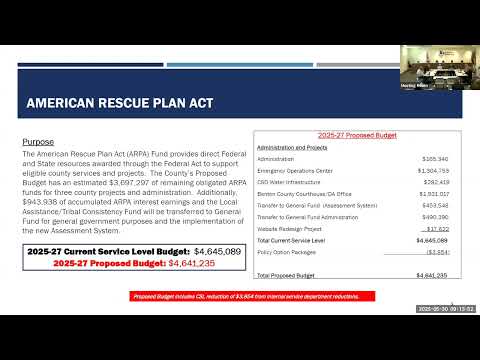
Staff summarized ARPA spending and deadlines: the county’s original ARPA allocation (received in 2021) was described and staff said remaining ARPA dollars must be spent by 12/31/2026. Staff identified ARPA commitments for the emergency operations center, courthouse‑related needs and transfers toward the general fund for planned information‑technology work, among other line items.
On economic development staff described ongoing contract discussions with the City of Corvallis for jointly funded positions and noted a proposed contract change that would alter which side pays which salary and create a single contract/MOU rather than multiple money exchanges. The committee was advised staff would confirm whether the city has budgeted for the revised contract and that commissioners could delay any final budget action on that line if they preferred.
Community grants, lottery funds and capital projects
Staff proposed continuing a set‑aside for community grants and recommended moving those discretionary community development funds into a more transparent, application‑based process administered by the county with board oversight. The budget keeps funding for the Benton Historical Society from lottery monies at the current level.
Capital projects were reported at a substantially larger total project cost, but staff stressed next‑biennium spending generally represents remaining project balances and reimbursements rather than new construction commitments. The Monroe Health Center replacement was left in contingency pending completion of outstanding federal grant and congressional funding requests; staff said an existing federal grant of roughly $1 million is included in the community health center budget but not fully locked in.
Public comment and issues raised
A county resident who identified himself during the hearing raised concerns about the county’s growing building footprint, vacancy‑factor accounting used to balance budgets, and proposed internal fleet rate increases he said would move large maintenance costs onto department budgets. The committee acknowledged those concerns and discussed options to preserve services while rebuilding unrestricted reserves toward the board’s stated target level.
What the votes and amendments mean for operations
- The committee’s adopted amendments preserve the sheriff’s work crew by shifting an internal personnel cost from the general fund into the fair fund and then using the freed general‑fund dollars to pay the sheriff’s office for the work‑crew program. Staff said this will not increase the county’s overall budget but does reallocate where the position is budgeted.
- The committee restored the management/confidential deferred‑compensation contribution to 3% by moving contingency across several funds and increasing general‑fund contingency by the small net amount left over after the package of reallocations.
- The committee also added $847,000 in the special grant fund for the state deflection program (carryover plus anticipated allocations) and approved language to hold a small, symbolic $1 appropriation to seed future jail‑replacement planning.
Next steps and final adoption
The County Administrator and finance staff will implement the committee’s approved transfers and amendments in the version of the budget that the Board of Commissioners will consider for final adoption. Staff said some contract changes (notably the proposed Corvallis economic‑development contract change) can be finalized after today’s committee approval if the board prefers to adopt the budget now and approve contract language later. The budget committee noted the board retains the authority to adjust the budget at adoption within legal thresholds.
Ending note: committee members and staff repeatedly framed the package as a mix of one‑time adjustments and structural choices intended to preserve key services while rebuilding reserves. Several members said they want an ongoing facilities plan to guide further decisions about county buildings and to avoid making choices that would remove options before a comprehensive plan is in place.