Get Full Government Meeting Transcripts, Videos, & Alerts Forever!
Get email alerts on the Procurement Spmo topic
No spam. Unsubscribe anytime.
PUC approves GPA strategic program management office contract with $10.5M cap and added safeguards
Summary
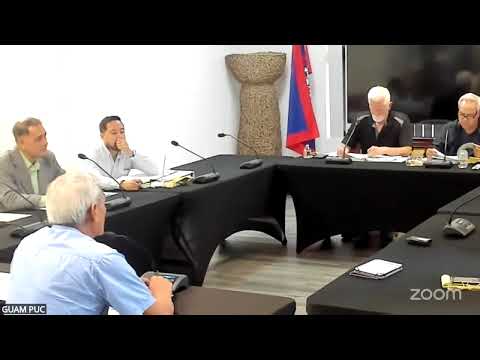
The Guam Public Utilities Commission on May 20 unanimously approved the Guam Power Authority’s amended petition to procure a strategic program management office (SPMO) to support upcoming GPA projects at an estimated aggregate cost of $10,500,000, imposing new contractual safeguards and requiring PUC approval before the cap can be exceeded.
The Guam Public Utilities Commission on May 20 unanimously approved the Guam Power Authority’s amended petition to procure a strategic program management office (SPMO) to support GPA’s upcoming capital projects, approving an estimated aggregate cost of $10,500,000 and imposing new contractual safeguards and oversight conditions.
The vote follows PUC legal counsel Anthony’s updated report and proposed order finding the SPMO procurement prudent and necessary after GPA added managerial and contractual controls addressing prior cost-overrun concerns tied to earlier PMO work.
Counsel Anthony told commissioners he initially recommended against approval when GPA’s original filing tied the SPMO price to a 15% assumption of roughly $70,100,000 in projected project costs and left the arrangement as an indefinite-quantity contract. After discussions with GPA and an amended petition, Anthony said he found the $10,500,000 estimate reasonable given the additional safeguards GPA pledged to include.
Those safeguards described in the amended petition and the PUC order include: the use of task orders negotiated individually for scope, hours, schedule, deliverables and cost; public project reports and dashboards shared with GPA management, the Commission and CCU; contractor invoices that include hourly billing tied to an agreed schedule; imposition of a dollar ceiling on SPMO services for each project that the contractor may not exceed without prior GPA approval; weekly oversight meetings; and audits of federally funded projects by a U.S. Department of Energy technical program officer, limited to federally funded work.
Anthony also said the SPMO contractors would report to GPA’s Assistant General Manager for Engineering and Technical Services, increasing direct supervision. The order approved by the commission requires GPA to obtain prior PUC approval before aggregate SPMO costs exceed $10,500,000.
GPA representatives, including John, said most anticipated SPMO work will be supported by grant funding tied to specific projects — they cited federal grants such as DOD and FEMA programs — and that the SPMO is intended to provide temporary staff capacity while GPA recruits and trains in-house engineers. John described efforts to train civil-engineering graduates for electrical and mechanical roles (including preparing staff to take the EIT exam) and said GPA expects to scale back SPMO use as project work completes.
Commissioners pressed GPA on contingency limits and cost control. The PUC’s order does not automatically allow a standard 20% contingency to be applied without returning to the commission; the order requires prior approval if aggregate SPMO costs exceed the $10,500,000 estimate. That restriction was singled out by counsel and commissioners as a response to the agency’s prior PMO contract history.
Commissioner Mike moved to grant the amended petition as reflected in the proposed order; the motion was seconded and carried unanimously.
The approval authorizes the procurement under the terms set out in the PUC order and retains a requirement for GPA to come back for PUC approval before aggregate SPMO expenditures surpass $10,500,000. The commission did not approve any increase to that cap as part of this vote.
Further administrative follow-up required by the order includes implementation of the listed reporting and oversight measures and periodic updates to the PUC on task order issuance and expenditures.