Get Full Government Meeting Transcripts, Videos, & Alerts Forever!
Get email alerts on the Community Climate Programs topic
No spam. Unsubscribe anytime.
Fairfax outlines community climate programs: Charge Up, Sustain Fairfax, home retrofits and business incentives
Summary
County climate staff briefed supervisors on multiple community programs supporting greenhouse‑gas reductions and resilience, including Charge Up Fairfax for EV charging at community associations, the Sustain Fairfax public challenge, group solar purchasing signups and progress toward the 100,000‑home retrofit goal.
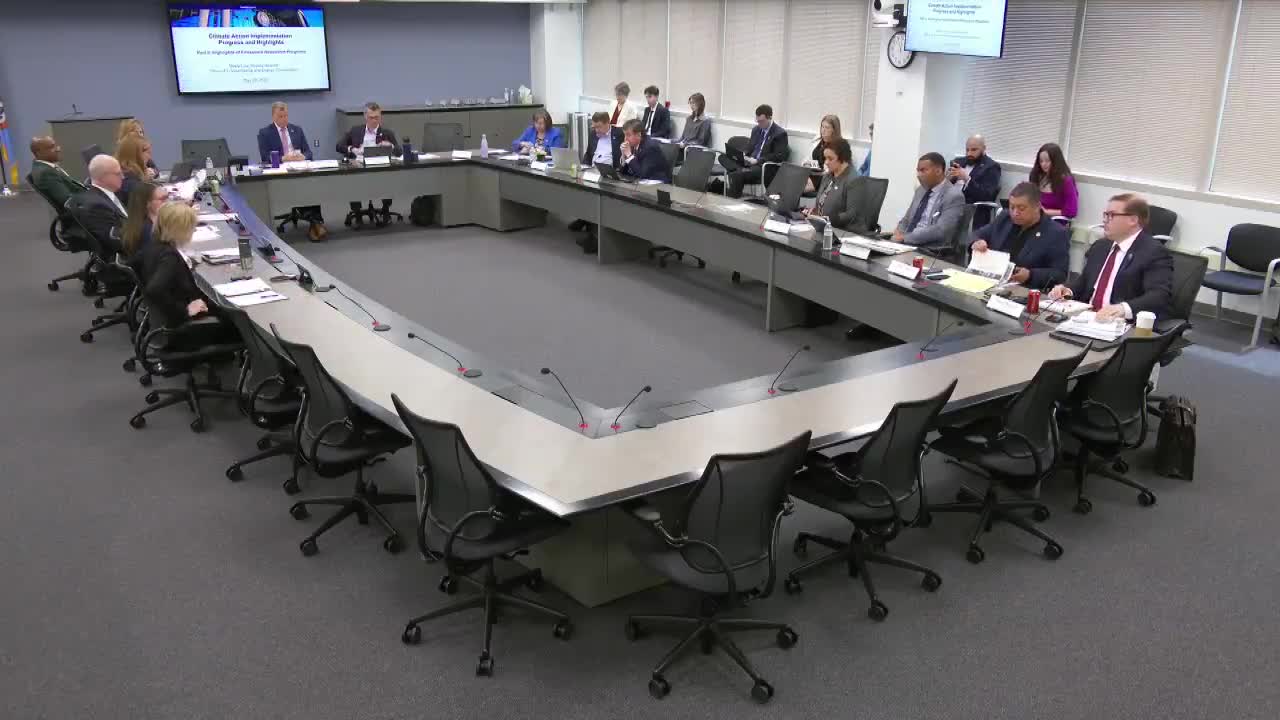
Neely Law, Deputy Director of the Office of Environmental and Energy Coordination (OEEC), presented the second half of the county’s climate‑action briefing on May 20, describing community programs linked to the Communitywide Climate and Energy Action Plan (CCAP) and other county priorities.
Programs and metrics: Law said OEEC moved the Charge Up Fairfax program from pilot to a full program in 2024; staff engaged with 20 communities during the pilot and accepted 14 new communities in 2024 that sought assistance with community association EV charging. Rama Mitri, OEEC’s program manager for Charge Up (introduced in the presentation), was cited as leading new 2025 efforts to expand partnerships and eligibility.
Public awareness and residential support: the office launched the Sustain Fairfax campaign in 2024 and the Sustain Fairfax Challenge in February 2025 to encourage residents to track actions and learn steps to reduce emissions. OEEC also reported progress on the county’s residential retrofit target: the county’s goal is to retrofit 100,000 housing units with energy efficiency measures by 2030; staff reported over 66,000 known participating households to date (largely via Dominion Energy programs) and said retrofit participation increased by about 14,000 since 2023.
Group solar and permitting numbers: Law reported two county‑promoted group solar purchasing programs that drew nearly 2,000 signups in 2024 and led to 135 home installations. County permitting and Land Development Services data support tracking of total installed solar capacity; supervisors noted the county appears on track to meet the county’s 2030 installed‑capacity target if current trends continue.
Incentives and nonprofit support: the Energy Conservation Assistance Program (ECAP) provides grants and incentives for community organizations, nonprofits and places of worship. OEEC said ECAP had approved roughly $155,000 in grants to support 28 energy projects by the end of 2024, leveraging more than $900,000 in upgrades. Examples included LED lighting upgrades at Rising Hope Mission Church and solar arrays at two congregations totaling about 160 kilowatts.
Business and trees: the Green Business Partners program had 51 member businesses and organizations as of 2024 (leaders, members and allies). OEEC emphasized peer‑to‑peer learning, recognition and partnerships with economic development and academic programs to help businesses adopt sustainable practices. Staff also reported 2,608 trees planted at schools and government sites in 2024 and said urban canopy efforts are being prioritized in the county’s hottest neighborhoods.
Upcoming priorities: OEEC listed 2025–26 priorities including launching a residential concierge service (soft launch mid‑2025, full launch in fall 2025) to give residents personalized technical assistance for retrofit and solar decisions; completing an EV readiness strategy by 2025 to identify gaps and ensure equitable charger access; and expanding cooling‑assistance programs (see Resilient Fairfax coverage). Supervisors asked for metrics and best practices around EV charger uptime and for support to amplify county social and program outreach.
Supervisors and staff recommended continued partnerships with community organizations, universities and business groups to expand program capacity and to help the county use public channels to increase resident participation in programs such as the Sustain Fairfax Challenge and group solar purchases.