Get Full Government Meeting Transcripts, Videos, & Alerts Forever!
Get email alerts on the Resilience And Adaptation topic
No spam. Unsubscribe anytime.
Fairfax expands Resilient Fairfax programs: AC Rescue becomes standing program; flood assistance and tree resilience advance
Summary
Allison Homer, Climate Planner with the Office of Environmental and Energy Coordination, reported that the county has turned the AC Rescue pilot — which installed 31 small air‑conditioning units at Harmony Place — into a standing program and that flood‑proofing reimbursements and tree‑resilience research are underway.
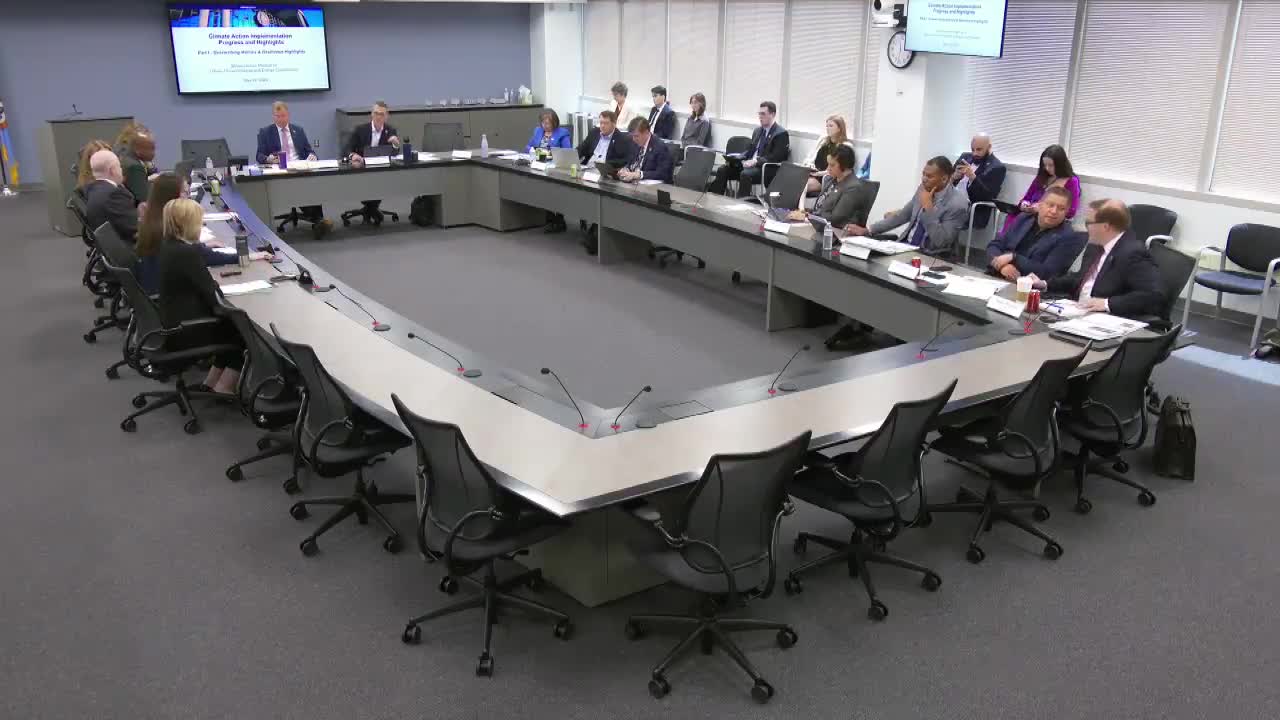
Allison Homer, Climate Planner and Resilient Fairfax program manager at the Office of Environmental and Energy Coordination (OEEC), updated the Environmental Committee on May 20 about resilience activities intended to protect residents from extreme heat, flooding and climate‑driven tree loss.
Homer highlighted the newly formalized AC Rescue program, which grew from a rapid response at Harmony Place Mobile Home Park. She said the pilot installed 31 small air‑conditioning units for residents with immediate need, then was transitioned into a standing program implemented through an existing home‑repair contract. "We were able to swiftly install 31 small AC units at Harmony Place and simultaneously connect the residents to other critical repairs and a range of social services," Homer said.
Why it matters: OEEC staff said an estimated 20,793 Fairfax County households (about 5%) lack air conditioning equipment at home; the presentation noted 153 small AC units had been provided since 2020 through county programs. Staff said AC Rescue is intended to fill gaps not covered by state‑restricted cooling assistance and to be implemented using an existing home‑repair contract and Resilient Fairfax funds.
Flood mitigation work: staff described the Flood Mitigation Assistance Program (FMAP), launched jointly by the county Department of Public Works and Environmental Services (DPWES) and the Northern Virginia Soil and Water Conservation District. The District told the committee it has received applications from 35 flood‑prone households and disbursed about $73,000 in partial reimbursements to date. The program reimburses residents for eligible flood‑proofing installations on a cost‑share basis (up to 50% of project costs), the presentation said.
Tree resilience: Homer described a Resilient Trees Initiative that compiled research on roughly 250 local tree species. Staff scored each species across more than 30 factors including resilience to wind, heat and flooding and adaptation benefits such as stormwater absorption and wind‑barrier ability. Homer told the committee that the research is intended to inform proposed amendments to the tree sections of the county’s Public Facilities Manual and that agency staff will conduct public engagement on the draft amendments.
Context and regional trends: the OEEC presentation pointed to climate trends — warmer temperatures, greater precipitation variability and more intense storms — and connected those trends to program work such as cooling centers, the AC Rescue pilot and flood‑proofing programs. Homer and other staff also noted an operational shift in tree planting guidance: Land Development Services changed the recommended planting window from September to October because Septembers are now often too warm for reliable sapling survivability.
Supervisors’ comments and requests: several supervisors praised the AC Rescue response, asked about the program’s referral and eligibility pathways, and urged staff to scale services. Homer said referrals will come from Department of Family Services rejections of cooling assistance, housing and community development referrals, mobile home outreach and Rebuilding Together projects already underway; Home‑repair contract amendments were signed to add AC Rescue to the scope and Rebuilding Together will implement the work.
Next steps: staff said FMAP and AC Rescue will continue to expand, OEEC will refine measurable goals for AC Rescue as the program scales, and the Resilient Trees research will inform forthcoming Public Facilities Manual amendments and public engagement.