Get Full Government Meeting Transcripts, Videos, & Alerts Forever!
Get email alerts on the Waste Management topic
No spam. Unsubscribe anytime.
Fairfax County updates ‘0 Waste’ plan as operations hit 29% diversion; audits show high contamination
Summary
Samantha Lee, 0 Waste Team Lead in the Department of Procurement and Material Management, reported that Fairfax County operations reached a 29% waste‑diversion rate in 2023 while the county pursues a 2030 goal of 90% diversion and a 25% reduction in waste from 2018 levels.
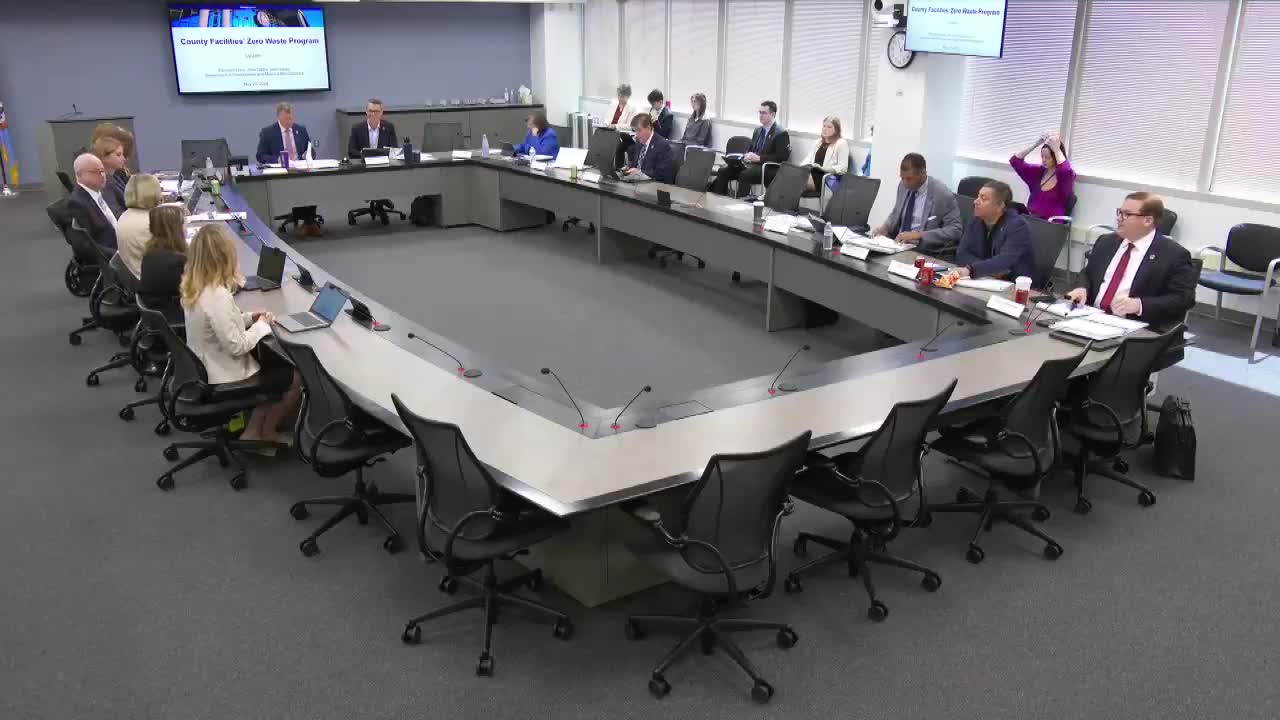
Samantha Lee, 0 Waste Team Lead in the Department of Procurement and Material Management (DPMM), told the Fairfax County Board of Supervisors’ Environmental Committee on May 20 that Fairfax County operations had achieved a 29% waste diversion rate in 2023 while the county continues to pursue an aspirational goal of diverting 90% of solid waste and reducing overall waste generation 25% from 2018 levels by 2030.
The 0 Waste plan, adopted by the Board in November 2021, established the county and Fairfax County Public Schools’ targets. "The 0 waste plan...establishes two key goals, reduce solid waste generation by 25% from 2018 levels and divert 90% of solid waste from being disposed of in the trash," Lee said. She described structures for implementation including a 0 Waste Core Team, a Champions Network launched in June 2023 and a department action‑plan requirement intended to track progress.
Why it matters: the county’s operational performance provides a baseline for larger community goals and indicates where county departments can make operational changes that also save money. Staff emphasized that progress to date includes measurable financial benefits; DPMM officials said internal reuse through the county surplus program rose from 25% in 2023 to almost 52% in 2024, and that the county achieved an estimated $188,000 in cost avoidance in the first two quarters of the fiscal year by reusing items instead of buying new ones.
Key facts and audit findings reported to supervisors included two week‑long waste audits conducted in 2023 across government centers, parks, fire stations, libraries, the detention center and several schools. Those audits found, for example, that about 20% of the government center trash compactor’s contents were recyclable material and one single‑stream compactor showed a 45% contamination rate. "In our single stream compactor, we found a 45% contamination rate," Lee said, noting the results point to an education and outreach need.
Departments are required to set a minimum of three achievable 0 Waste goals each calendar year; DPMM said 2025 action plans were due in March and many have been received but not all. Leanne Pender, director of Material Management, said the county has "received a number in the past couple of weeks, but we still have a handful of agencies we're working with to get those reports." Supervisors pressed staff to reach full participation so the county can capture all departmental ideas and efforts.
Program examples and funding: staff highlighted departmental innovations such as composting at several county facilities, vehicle services buying bulk fluids to reduce plastic container waste, battery recycling boxes distributed by DPWES, and Hidden Oaks Nature Center adding reusable foodware and on‑site composting for events. DPMM’s Logistics Center Surplus Program runs internal reuse auctions and was credited with the rise in reuse rates. Staff also said DPMM, working with the Office of Environmental and Energy Coordination (OEEC), has used plastic bag tax funding to support operational 0 Waste projects. The county’s free “party pack” program — three kits that serve roughly 100 attendees each — has been used at more than 73 county events and, staff estimated, has prevented more than 25,000 pieces of disposable foodware.
Open issues and next steps: supervisors questioned the details behind certain metrics and requested more transparency in calculations (Supervisor Alcorn asked for more detail about how "Gold 1" and "Gold 2" calculations are made). Several supervisors emphasized that contamination is largely an education problem and urged the county to simplify signage and outreach. Staff said the full waste audit report and department action plans are available to county staff on the 0 Waste SharePoint page and that they plan to publish additional materials publicly in the future. DPMM said it will continue outreach to get outstanding department action plans and to share more detailed methodology on request.
The presentation also noted an operational caveat: the payback estimates for prior ESCO (Energy Services Company) energy projects provided in the meeting packet assume current utility rates; staff said increasing energy prices would likely make those projects appear more cost‑effective over time.
The committee heard this briefing as part of a full agenda of three presentations. Supervisors asked staff to include Fairfax County Public Schools metrics in future updates so the board can see a combined government‑and‑school operational picture.