Get Full Government Meeting Transcripts, Videos, & Alerts Forever!
Get email alerts on the Language Access topic
No spam. Unsubscribe anytime.
Supervisors hear gaps in language-access implementation, file hearing; advocates seek $22.9M plan
Summary
The Budget and Appropriations Committee on May 21 heard updates on the implementation of the city’s amended Language Access Ordinance and filed the hearing after presentations from the Budget and Legislative Analyst and the Office of Civic Engagement and Immigrant Affairs and extensive public testimony.
SAN FRANCISCO — The Budget and Appropriations Committee on May 21 heard updates on the city’s implementation of recent amendments to the Language Access Ordinance (Ordinance No. 116-24) and filed the hearing after public testimony and presentations by the Budget and Legislative Analyst (BLA) and the Office of Civic Engagement and Immigrant Affairs (OSEA).
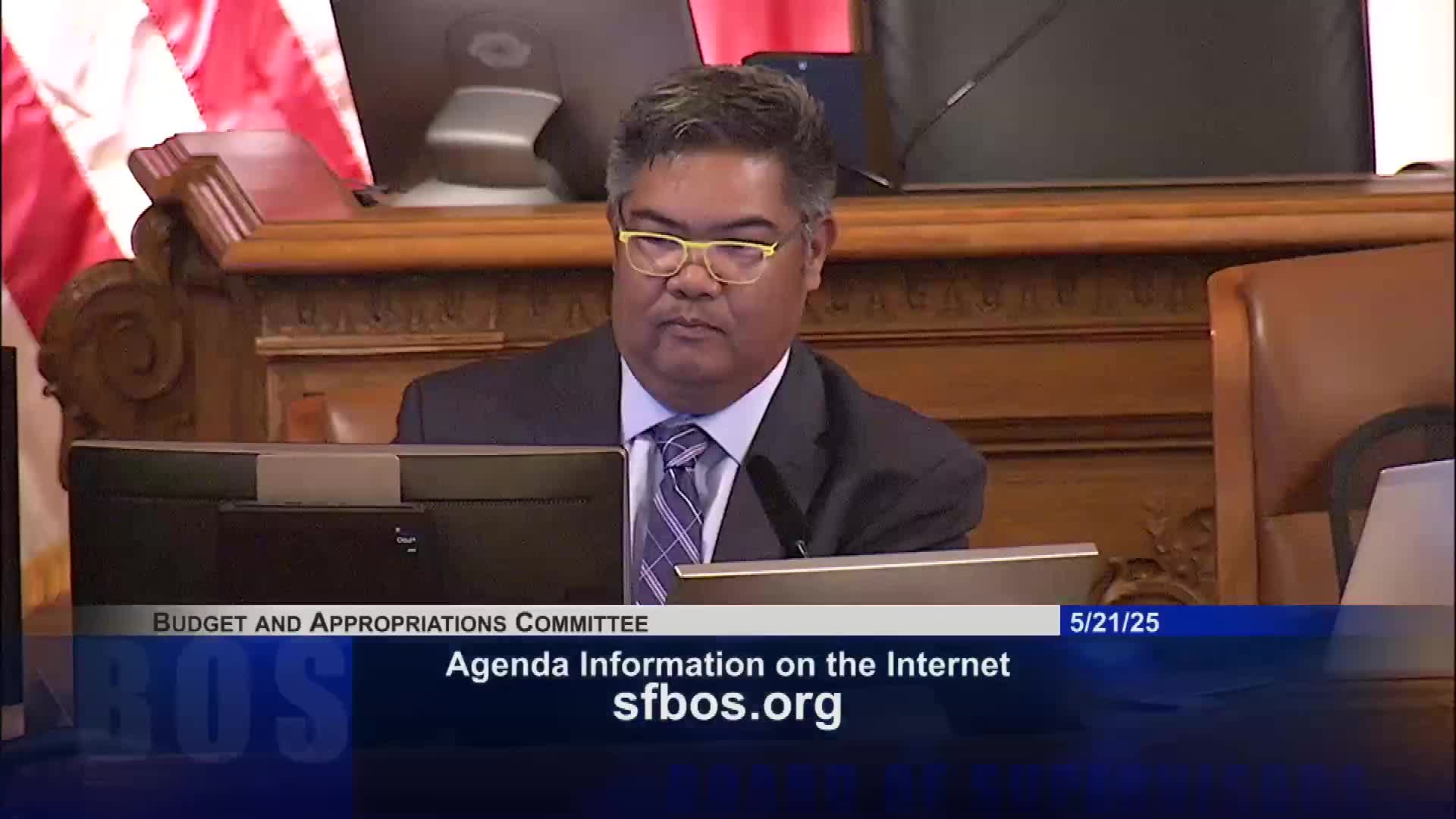
The hearing, called by Supervisor Shamone Walton and chaired by Supervisor Connie Chan, focused on whether city departments are meeting new requirements adopted in 2024 that expand translation, interpretation and emergency-language services and lower the threshold for designating required languages. After presentations and public comment, the committee voted to file the record. Supervisor Walton moved to file the hearing; Chair Chan seconded. The roll call vote was 4–0 (Engardio, Walton, Chen, Chan) in favor.
The BLA’s presentation to the committee estimated current, reported annual language-access spending at about $15.1 million for fiscal year 2022–23 and presented department‑by‑department estimates of the additional costs created by the 2024 amendments. Fred Russo of the BLA summarized the office’s figures: “for fiscal year 2022–23, the total reported was $15,100,000,” and the BLA estimates first‑year costs from the 2024 amendments at about $5,600,000 (comprised of $3,500,000 in one‑time costs and $2,100,000 in ongoing costs). Supervisor Walton and community advocates framed the BLA figure differently as part of a larger funding request: the committee heard proponents urge a $5,800,000 increase this year as part of a total $22,900,000 package to implement new language rights across departments.
OSEA Director Jorge Rodriguez and Language Access Policy Manager Anna DeCarolis described implementation steps and constraints within OSEA. OSEA reported it currently provides dedicated capacity in Chinese (Cantonese and Mandarin), Spanish and Filipino but does not yet have capacity in Vietnamese, a language the amended ordinance will likely certify beginning Jan. 1, 2026. DeCarolis said OSEA is developing a “Know Your Rights” brochure and plans expanded complaint reporting, but she also warned the office lacks resources to translate materials into all newly required languages or to convene subject‑matter experts for emergency‑response best practices.
Community groups represented by the Language Access Network (including Chinese for Affirmative Action and the African Advocacy Network) described everyday failures in service delivery and emergency response and urged the committee to fund implementation. Anisha Hingarani of Chinese for Affirmative Action said the issue is not theoretical: "Language access isn't just a service. It's about dignity, safety, and equal treatment," and network members recounted cases in which inadequate interpretation delayed or compromised care.
Key findings and figures presented or discussed at the hearing
- Current, self‑reported citywide language‑access expenditures (FY2022–23): $15,100,000 (BLA presentation to committee).
- BLA estimate of additional costs tied to 2024 amendments (first year): about $5,600,000 (one‑time $3,500,000; ongoing $2,100,000). The presentation highlighted $1,500,000 for additional document translation as a significant single line item.
- Advocate funding request: community organizations and several public commenters urged the committee to allocate $5,800,000 now as part of a $22,900,000 total investment citywide, and to preserve or provide $900,000 over two years to sustain the Language Access Network.
- Workforce and contracting data presented by the BLA and OSEA: 1,157 positions designated by the Department of Human Resources as having a “language special condition” (17% vacancy in 2022); 3,545 certified bilingual employees reported to DHR for FY2022–23; departments reported $2,200,000 for compensatory bilingual pay, while DHR payroll records showed $4,400,000 for the same category; the city has roughly $10,000,000 in multiyear contracts for language services (average vendor spending about $1,800,000 per year over five years).
- Reporting limitations: the BLA noted departments’ cost reports include a large “other / non‑categorized” category that accounts for nearly half of reported costs; the office recommended more detailed accounting and reconciliation between OSEA and DHR data.
Questions from supervisors and committee discussion
Supervisors asked about verification of department self‑reports, accuracy of translated materials, and emergency response protocols. Chair Chan asked OSEA whether it has engaged the Mayor’s Office on LAO resources; OSEA said it had not. Supervisor Cheyenne Chen showed examples of mistranslated signage in City Hall and planning‑department notices and pressed departments’ responsibility to review and budget for accurate materials. Supervisor Walton emphasized emergency services and first‑responder language access after several public testimonies described EMT crews and other first‑responder situations in which interpretation was not automatically used.
Recommendations discussed
The BLA recommended the Board consider new funding, require more specific reporting of language‑access expenditures, have OSEA and DHR reconcile discrepancies (for example, on compensatory pay), create guidance for departments on community‑focused approaches, study premium pay levels for bilingual staff, and consider a citywide registry of bilingual employees to allow cross‑department borrowing.
Public testimony and community priorities
More than a dozen community speakers and representatives from the Language Access Network described instances where limited English proficiency impeded access to health care, emergency services and benefits. Multiple speakers asked the committee to adopt the community funding request (a $5.8 million increase this year as part of a $22.9 million implementation plan) and to fund the Language Access Network at $900,000 over two years so community‑based organizations can continue to bridge communities and city departments.
What the committee did
After presentations and public comment, Supervisor Walton moved to file the hearing; Chair Connie Chan seconded. The committee recorded a 4–0 vote (Supervisors Engardio, Walton, Chen, Chan), and the motion to file passed.
What’s next
Filing the hearing makes the record available to the board and the public but does not appropriate funds or adopt policy. Several supervisors signaled intent to follow up during the budget process—particularly on first‑responder language access, reconciliation of departmental reporting, and DHR review of premium pay for bilingual staff—but no binding direction or budget allocations were adopted at today’s meeting.