Get Full Government Meeting Transcripts, Videos, & Alerts Forever!
Get email alerts on the Land Use Rezoning topic
No spam. Unsubscribe anytime.
Margate DRC presses developer on traffic, sequencing for Carolina Club Golf Course redevelopment
Summary
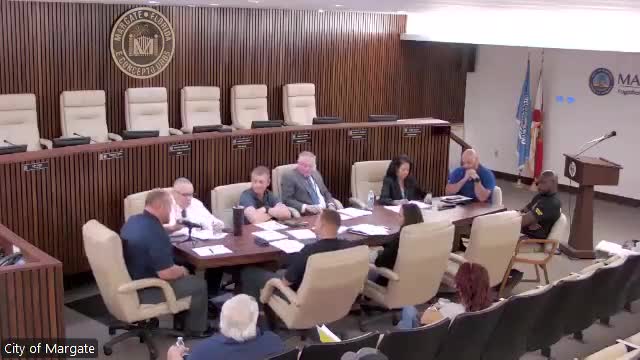
The City of Margate Development Review Committee met May 13 to review three linked applications to redevelop the Carolina Club Golf Course at 3011 Rock Island Road, including a land‑use plan amendment, rezoning and a development agreement.
The City of Margate Development Review Committee met May 13 to review three linked applications to redevelop the Carolina Club Golf Course at 3011 Rock Island Road, including a land‑use plan amendment, rezoning and a development agreement.
The committee’s discussion focused on traffic analysis and the sequencing of approvals: whether the rezoning and development agreement should be judged against a detailed site plan now or whether certain design details can be reserved for later, pod‑by‑pod site‑plan reviews.
The applications under review would convert the site, currently zoned S‑2 Open Space District, into a multi‑pod development with a commercial neighborhood‑serving retail pod, a townhome pod and a multifamily (apartment) pod. Applicant Matthew Scott, a zoning attorney who identified himself as representing the petitioner, said the project covers more than 65 acres and that “over half the project will be dedicated to lakes and open space and greenways, walking trails.” He said the team has submitted a land‑use amendment, rezoning application and development agreement and has been working with city staff for over a year.
Traffic analysis was the central issue. Chris Hagan, a transportation engineer with the applicant’s consultant, said the rezoning application includes a concept plan showing pod locations and access points but not the detailed striping, loading areas or traffic calming devices that typically appear at the site‑plan stage. “What's described in this comment…is too much detail that just isn't known at this stage,” Hagan said, adding the team can provide more detail on access locations and pod unit counts to inform an overall traffic study.
Lisa Bernstein, the city's outside traffic consultant, said she was “okay with…comparing the existing use to the proposed use” for the Broward County land‑use review but noted she could not determine impacts on surrounding roadways without additional information about internal site movements. Public Works Director Gio Batista warned the applicant that off‑site queuing and storage lanes could materially affect the project layout and economics and urged them to address those possibilities early.
City staff and the applicant also discussed vested‑rights documentation and how to treat the closed golf course in traffic and land‑use analyses. Andrew Penny, senior planner for development services, noted an “info only” comment asking the applicant to follow the process in section 40.343 for documenting vested rights if they intend to claim credits for previous uses. The applicant confirmed the golf course has been closed since February 2019 and said they would provide responses explaining how they treated the existing use in the land‑use amendment and how they will treat it for the rezoning traffic study.
Staff reminded the applicant that under city code the rezoning review must assume the maximum impact permitted under the proposed land‑use and zoning categories if a site plan is not available. Penny said the city’s concurrency review requires a finding that adequate public services are available and that, without a site plan, reviewers must typically analyze worst‑case impacts.
The Broward County Planning Council’s emphasis on affordable housing was raised. A staff member noted Broward County policy 2.16.2 prioritizes affordable housing and asked whether the applicant would provide affordable units or contributions to the county affordable housing fund. Matthew Scott said the county’s policy is a topic they will prepare for and that he would need to get back to staff on whether the developer would make such a commitment.
Several procedural and next‑step items were agreed: the applicant will confer with the city’s traffic consultant and provide more detailed pod counts and access configurations; the team will provide FDOT documentation related to a proposed connection to Sample Road; staff and the applicant will continue to revise the development agreement; and the DRC recommended the applicant resubmit after addressing comments before the matter proceeds to public hearing.
The meeting closed with the DRC reiterating adopted level‑of‑service standards for the city (arterials and collectors LOS D; local roads LOS C) and asking the applicant to reconcile its trip estimates with those standards as part of upcoming revisions and study work.
The DRC did not take a formal vote on the applications; staff will continue its technical review and work with the applicant on additional information requests and revisions.