Get Full Government Meeting Transcripts, Videos, & Alerts Forever!
Get email alerts on the Energy Storage Bess topic
No spam. Unsubscribe anytime.
Skagit commissioners hear closed‑record appeal of NextEra battery storage permit; decision set for June 17
Summary
The Skagit County Board of Commissioners heard a closed‑record appeal from Stewards of Skagit challenging the hearing examiner's approval of a special use permit for NextEra Energy's proposed 200 megawatt battery energy storage facility on Bayview Ridge. Commissioners will issue a public decision on June 17, 2025.
The Skagit County Board of Commissioners held a closed‑record appeal hearing June 2 on a challenge by Stewards of Skagit to the hearing examiner's December decision approving special use permit PL230408 for a NextEra Energy Resources battery energy storage (BESS) facility on Bayview Ridge.
The appeal, filed by the Stewards of Skagit, argued the examiner's decision rested on an incomplete or inaccurate record and on misrepresentations in the applicant's materials, and raised concerns about public notice, fire risk, emergency response and inconsistencies in parcel and design documentation. Planning staff and the applicant defended the review process and the prior SEPA mitigated determination of non‑significance (MDNS). The board said it will issue a public decision on Tuesday, June 17 at 11 a.m.
The appeal focused on two kinds of claims. First, procedural: the appellant said the record provided to the hearing examiner was incomplete, that four technical documents were submitted in abbreviated form, and that one of those documents never appeared in the public record before the examiner rendered a decision. "When the process fails, it undermines the integrity of the decision," Stewards of Skagit president Connie Scribe told the commissioners, saying the hearing examiner was asked to decide on more than 1,700 pages of record with limited time to review. Scribe also alleged that legal notices and posting dates were incorrect and that parcel numbers in the application did not match project maps.
Second, substantive public‑safety concerns: appellants and local residents urged the board to consider potential fire risk, emergency evacuation, insurance and contamination consequences. Resident Sandy Bourgeois, who said she lives about 1.5 miles from the site, told commissioners: "They may have made vague statements about noise being relatively quiet without proof of that.... A fire that still has potential to cause irreparable damage to my safety, home, property, and this valley, and it will only take one fire to do that." Other residents raised the prospect of evacuations and questioned whether local insurance would cover contamination or damages after a BESS fire.
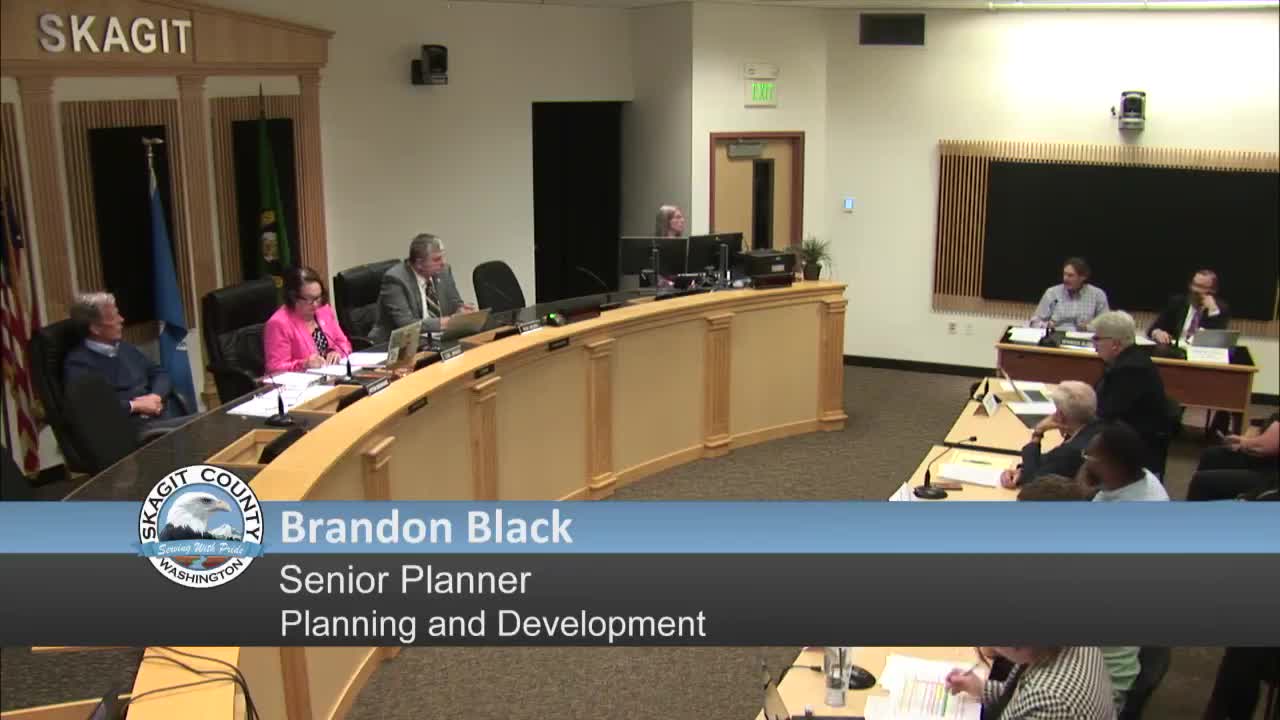
Planning staff defended the county's procedures and the record to the hearing examiner. "A complete record was provided to the hearing examiner and presented before the open record public hearing," Senior Planner Brandon Black told the board, and he said staff solicited technical review from the fire marshal, emergency management, building officials and other specialists. Black said staff provided abbreviated exhibits in the packet but supplied full versions to the hearing examiner during the open record hearing when requested; those full versions were entered into the record as exhibits 57, 58 and 59 (with the cultural resources report remaining confidential as Exhibit 8).
NextEra representatives told the commissioners the county's earlier SEPA MDNS addressed environmental impacts, including noise and fire potential, and urged deference to the hearing examiner's findings. Tim McMahon, attorney for NextEra, said the MDNS and the examiner's findings were the proper foundations for the special use permit and criticized the appeal for attempting to relitigate the SEPA determination. "The appellant fundamentally seeks to undermine the SUP decision by attacking the MDNS," McMahon said during his allotted time.
NextEra's fire safety engineer, Josh Adams, responded to safety claims with standards and industry data, telling the board that fatal incidents from battery energy storage systems in the United States have not been documented and that failure rates have fallen as deployments and standards have expanded. Adams cited national incident tracking by the Electric Power Research Institute and referenced specific design and testing standards that he said would apply to the project, including UL and NFPA standards and adoption of the 2021 Washington State Fire Code. "There are numerous layers of safety and safety testing and design systems that have to be implemented," Adams said.
Appellants contested parts of the record that describe the facility as a "remote location" with a 100‑foot setback, saying subsequent application versions changed setbacks to 35 feet and reduced other buffers, which they argued should have triggered a new review cycle. The appellant also pointed to items she said were not in the record at the time of the open record hearing, including a hazard mitigation analysis and a fire technical assistance report that referenced auxiliary generators.
Commission staff reiterated that the project site is zoned Bayview Ridge Heavy Industrial and said that zone is intended for heavy industrial uses. Staff and the applicant said that siting a BESS in an industrial zone is consistent with the county code and that additional technical review and permitting would occur at the development and building permit stages if the SUP is upheld.
No final board action was taken at the hearing. Chair Lisa Janicki told attendees the board will consider the written and oral arguments and render a decision in a public session on June 17 at 11:00 a.m. Janicki also reminded participants that because the matter is quasi‑judicial, board members should not be contacted about the case before the decision.
The hearing record the board will review includes the hearing examiner's decision, the SEPA MDNS, the exhibits and the briefs filed by the appellant and the applicant. The board's public decision is scheduled for June 17.
The hearing drew multiple local residents and organizational representatives who had been parties of record at the open record hearing; those residents emphasized the potential human‑health, environmental and emergency management consequences if a fire or other serious incident occurred at a large BESS facility.
The board concluded the hearing and reminded parties that procedural limits for closed‑record appeals restrict new evidence; the commissioners will base their decision on the record that was before the hearing examiner and the materials submitted for the appeal.