Get Full Government Meeting Transcripts, Videos, & Alerts Forever!
Get email alerts on the Critical Areas Ordinance topic
No spam. Unsubscribe anytime.
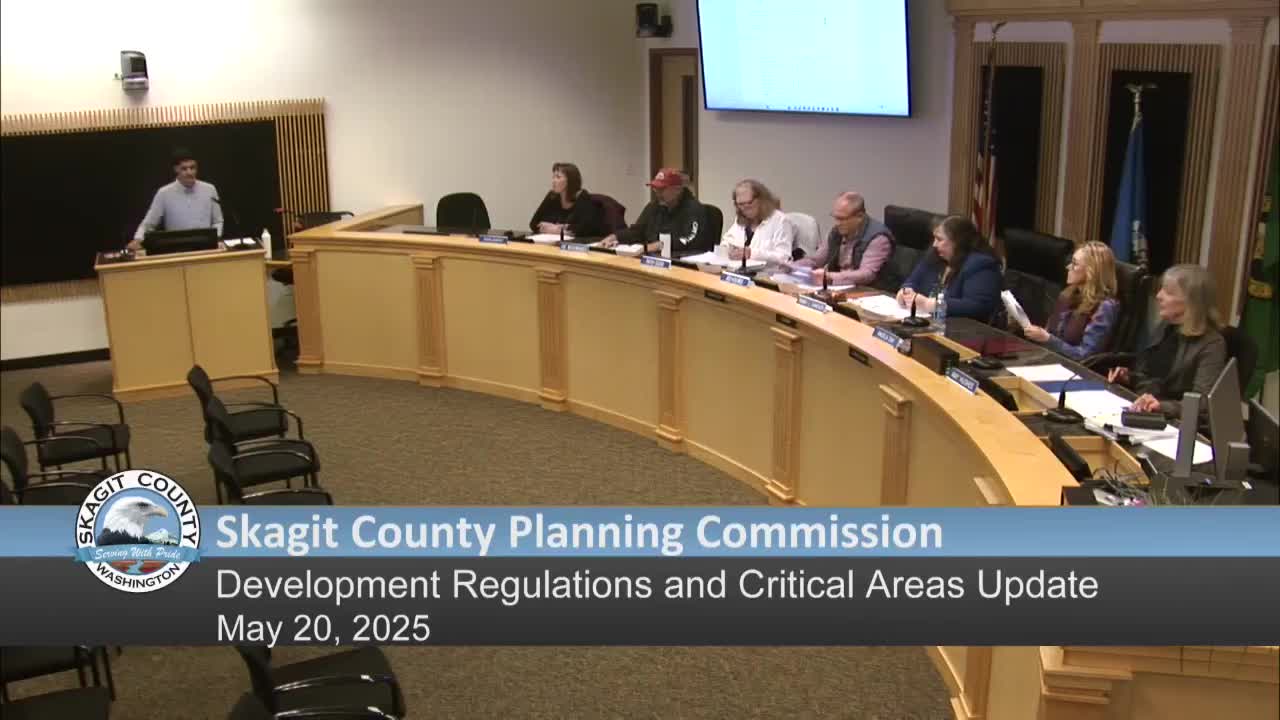
Planning Commission pauses critical areas ordinance deliberations after extensive staff briefings and public comments
Summary
Skagit County planners presented recommended updates to the critical areas ordinance (recommendations 1—17); commissioners requested more time and additional materials and voted to continue the discussion to a future meeting.
Skagit County planning staff on May 20 presented a package of recommended updates to the county—s critical areas ordinance (CAO), covering recommendations numbered 1 through 17. The Planning Commission accepted staff briefings but elected to postpone final deliberation and any recommendation on the critical areas ordinance to a later date in order to review draft code language and additional technical materials.
Staff overview and public-comment context: Robbie Eckroth and other department staff introduced the CAO briefing and identified Dan Nickel (consultant) and Andy Wargo (natural resource planner) as additional presenters. Eckroth summarized the public comment process and said the updates respond to written comments received during the review period.
Key staff points and areas of debate: Staff presented a series of targeted recommendations and clarifications for technical sections of the CAO: - Wetland mitigation (recommendation 1): Staff proposed clarifying mitigation priorities so that mitigation priorities for buffers are distinguished from direct wetland impacts. Dan Nickel and Andy Wargo explained the nuance: off-site mitigation (wetland banking) is often appropriate for large, direct wetland fills such as industrial sites and port projects where Army Corps and Ecology permits are required, while small residential buffer impacts are typically addressed by on-site mitigation because wetland credits are disproportionately expensive for minor buffer work. - Critical areas report scope (recommendation 2): Staff recommended against expanding the CAO review distance beyond the county—s 200-foot review area for fish and wildlife habitat conservation areas, noting that the county—s stormwater code addresses many water-quality effects beyond that distance. Several commissioners questioned wording in the staff response and requested removal of the word "downstream" to avoid implying an expanded review area. - Drainage and irrigation districts (recommendation 4 and related): Staff proposed clarifying definitions and regulatory treatment of managed ditches and drainage district channels so routine maintenance under state/federal permits would not inadvertently trigger local critical-areas review. Several commissioners supported clearer cross-references to other agencies and to the Drainage and Irrigation Consortium—s classification system (artificial ditches, managed without headwaters, managed with headwaters, natural streams). - Species of local importance (recommendation 7): Staff recommended adding forage fish and reviewing additions proposed by Skagit Audubon Society (white pelican, harlequin duck, brant, bufflehead, beaver), noting WDFW—s existing Priority Habitats and Species list already covers many species of concern. - Buffer enhancement and stream protection (recommendations 8, 12, 13, 15): Staff proposed clarifications to support habitat restoration projects without triggering additional review and to align wetland-buffer exceptions for very small Category IV wetlands with Department of Ecology guidance. The Department of Fish and Wildlife (WDFW) had recommended use of a site-potential-tree-height tool to set riparian buffer widths; staff noted technical and implementation challenges with that approach and said the county—s proposed buffer widths are intended to be consistent with the science while remaining administrable.
Points of friction and requests for more data: Commissioners repeatedly noted they wanted to see draft code text and supporting technical analyses before making recommendations to the Board. Specific concerns included: whether the 200-foot review distance should be revisited to incorporate cumulative downstream effects (staff recommended leaving the 200-foot standard and using the stormwater code for water-quality effects); WDFW suggestions to remove buffer averaging and to use site potential tree height as a buffer metric (staff said the tree-height approach produces variable results and could be difficult to implement locally); and proposed increases to riparian buffers (staff noted a proposed change to treat all Type F streams consistently, with many Type F streams moving from 100-foot to 150-foot buffers and Type N streams being treated at a 100-foot standard). Commissioners asked for county-specific analyses, comparison tables, and the WDFW site-potential-tree-height outputs applied to Skagit streams to better understand local effects.
Decision to continue: After extended discussion and multiple requests for additional technical materials, a commissioner moved to continue the critical areas discussion to a future meeting date recommended by staff. The commission agreed there was not enough time to complete deliberation on the CAO package and directed staff to schedule a follow-up meeting, provide draft code language and supporting technical materials (including the site-potential-tree-height analysis and any county-specific studies), and circulate those documents to commissioners in advance.
Why it matters: The CAO updates address wetlands, fish and wildlife habitat, buffer standards, agricultural ongoing-activity provisions and drainage-district maintenance. Changes could alter required buffers, mitigation sequencing, permitted routine maintenance for irrigation/drainage districts, and restoration-project permitting — all of which affect farmers, developers, conservation groups and shoreline/marine property owners.
Next steps: Staff will prepare revised code language and technical appendices and propose a follow-up Planning Commission meeting date. The department plans to present the revised materials to the Board of County Commissioners in late May (work session May 27) and to publish a second public comment period May 29—June 13 followed by a Board hearing on June 16.
Ending: Commissioners thanked staff for the depth of the materials and asked for specific Skagit-focused analyses to evaluate trade-offs between increased buffer widths and targeted on-site buffer enhancement.