Get Full Government Meeting Transcripts, Videos, & Alerts Forever!
Get email alerts on the Public Works Cip Reorg topic
No spam. Unsubscribe anytime.
Upland officials outline $76.5 million CIP, warn roads, water infrastructure face large funding and staffing gaps
Summary
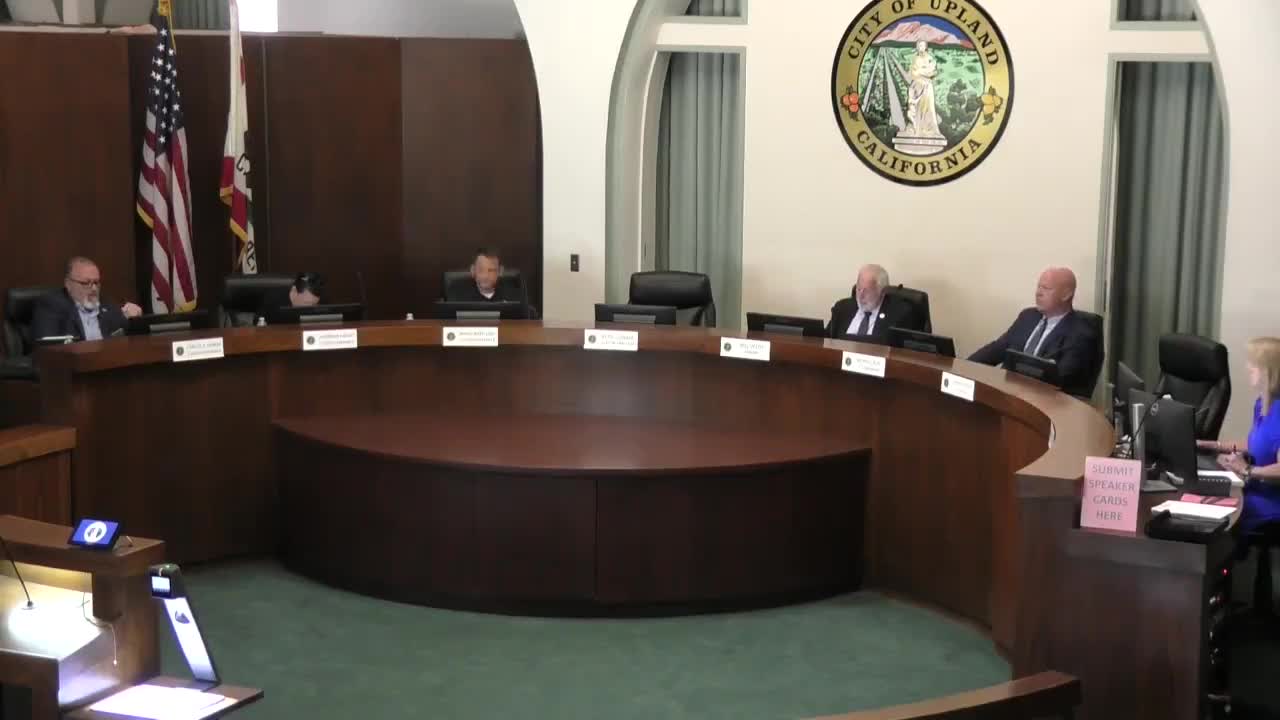
Upland Assistant City Manager Damien Arula told the City Council at a special workshop that the city’s infrastructure is aging and that its current staffing model cannot keep pace with the growing capital program.
Upland Assistant City Manager Damien Arula told the City Council at a special workshop that the city’s infrastructure is aging and that its current staffing model cannot keep pace with the growing capital program.
“our infrastructure is significantly aging and the need for reinvestment is urgent,” Arula said. He said a third‑party pavement assessment found a citywide Pavement Condition Index (PCI) of 57 and estimated a roughly $160,000,000 backlog to fully restore Upland’s 191 miles of roadway.
The presentation framed the problem as twofold: an annual funding shortfall for pavement preservation and a public‑works staffing gap that limits the city’s ability to design, bid and deliver projects. Arula said maintaining the current PCI of 57 would require about $15.4 million per year; improving the network to a commonly accepted target PCI of 70 would require about $26.23 million per year. He said current annual pavement funding for rehabilitation projects is about $6.38 million, producing an annual shortfall “of over $9,000,000 per year.”
Why it matters
Arula and staff warned that pavement deterioration accelerates if deferred, and that “what it costs to slurry seal today will jump to 8 times the cost or even 14 times the cost” when reconstruction becomes necessary. The council heard the larger fiscal picture alongside a proposed organizational change intended to increase the city’s capacity to deliver capital projects.
What’s in the CIP and key project examples
Staff said the CIP currently includes 134 projects totaling about $76.5 million across 21 funding sources. Major categories and selected projects noted in the presentation: - Streets and roads: 47 projects, about $33.7 million. Highlighted projects included Foothill Boulevard reconstruction (Benson to Euclid), Grove Avenue rehabilitation (Foothill to 15th), Fourteenth Street rehabilitation (Campus to Grove) and Mulberry Avenue reconstruction (Foothill to Pine). Arula said design and utility coordination are being planned to capture economies of scale. - Water: 43 projects totaling about $31.5 million, funded largely by a water bond. Noted items included a $2.1 million SCADA upgrade, a $3.1 million San Antonio Canyon Water Treatment Plant upgrade and a $3.9 million Foothill water‑main replacement tied to the Foothill Boulevard project. - Parks: Staff proposed about $4.5 million for parks in fiscal year 2025–26 (the slide noted the figure had been revised from an earlier $2.5 million). Projects mentioned included McCarthy Park ($716,000, funded by Quimby/QMB funds), Magnolia Park parking lot and playground work (approximately $725,000, Park DIF), Cabrillo Park protective netting (about $90,000, Quimby funds) and potential pickleball/tennis work at Memorial Park (Quimby funds). - Facilities and other: 14 facility projects totaling about $2.9 million, including a $240,000 ARPA project to reconfigure second‑floor police department administrative space, an animal‑shelter generator and $275,000 in SoCal Edison grant‑funded EV chargers for the Public Works yard. - Sewer: Staff listed nine sewer projects totaling about $2.6 million, including citywide sewer rehabilitation (additional $375,000 this year) and a Campus Avenue manhole installation ($374,000).
Funding sources and constraints
Arula and other staff described a mix of funding sources that include the gas tax, RMRA (Road Maintenance and Rehabilitation Account), Measure I, Quimby (park dedication) funds, Park DIF and water‑bond proceeds. Staff noted a “maintenance of effort” requirement tied to some programs that draws on the general fund each year; if the city falls short, those funds can be withheld. Arula said some funds are legally restricted (for example, Quimby developer park funds cannot be used for streets).
Staffing, benchmarking and the proposed reorganization
Arula said the Public Works Department’s staffing has not kept pace with the scale of projects. He reported that Upland’s utilities staffing (water, sewer, storm) is roughly 0.46 utility employees per 1,000 residents compared with a regional average of about 0.85; he translated that into an estimated shortfall of about 31 full‑time positions in utilities. For general public‑works operations (streets, parks, facilities, signage and urban forest) he reported Upland at roughly 0.51 employees per 1,000 residents versus a regional average near 1.35, yielding an estimated shortfall of about 67 positions. Combining the two, staff described a staffing deficit on the order of roughly 98 full‑time positions.
To address capacity constraints, staff proposed a reorganization built around three goals: strengthen leadership, improve project delivery and meet regulatory and service demands. Specific elements included creating two deputy‑director roles (one for Utilities and one for Public Works), an engineering/advanced planning manager in Utilities, a dedicated traffic engineer, a policy and legislative affairs manager to pursue external funding, a community information specialist and an operations customer‑service specialist. Arula said the deputy directors would be “working deputy directors” who also manage projects.
Fiscal impact and funding for the reorganization
Staff presented the following financial figures: a roughly $923,000 increase in salary and benefits across all funds for the proposed changes; and offsets achieved by frozen vacancies, position reallocations and eliminating consulting contracts. Staff said eliminating two contracts (GIS and traffic engineering) would save about $150,000 and that the net General Fund impact would be small. The presentation included two different net General Fund figures in slides and council discussion: staff said at one point the reorganization would result in a net General Fund reduction of about $19,500, and elsewhere a slide described a net General Fund savings of $169,500. The presentation did not reconcile those two specific slide figures during the meeting.
Council and public discussion
Council members and staff spent considerable time clarifying project timing, eligible funding sources and community engagement requirements. Arula stressed that proposed park projects funded with Quimby (development) fees would still require community workshops and subsequent council approvals. Council members asked about pilot options for pickleball (possible use of Pioneer Junior High courts), parking‑lot conditions in parks, the status of the Highway Safety Improvement Program (HSIP) grant (staff said HSIP funding of about $1.8 million, with a local match of roughly $206,000, is available for safety projects), and the age and need for the SCADA upgrade (staff said the existing system is roughly 20 years old).
Multiple council members urged new revenue measures to address long‑term needs. Council member Mauss praised the presentation as an “educational component” for the community; Mayor Valto and others said residents will need to weigh in on funding priorities. Arula said the city is exploring changes to development impact fees and other funding tools to capture money for large projects when appropriate.
What the council was asked to do
Staff requested that the council review the proposed reorganization and CIP alignment strategy and provide direction on how to proceed. No formal vote was recorded in the transcript. Arula closed the formal presentation by thanking staff and noting the item remained for council direction.
Ending
The workshop discussion moved from the presentation into extended council Q&A. The council did not adopt a reorganization ordinance or take a recorded vote during the session; staff said additional community engagement and follow‑up items (detailed project documentation, monthly CIP tracking and potential future funding proposals) would be brought forward for subsequent council consideration.