Get Full Government Meeting Transcripts, Videos, & Alerts Forever!
Get email alerts on the Capital Improvement Program topic
No spam. Unsubscribe anytime.
Eau Claire council reviews $265 million CIP; public safety training, parking deck and PFAS work rise to top
Summary
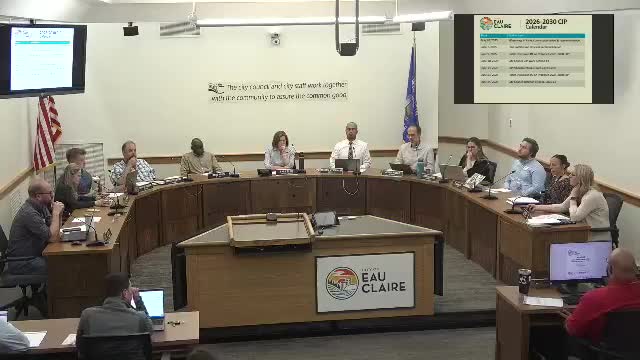
Eau Claire City Council members spent a work session on May 27 reviewing a proposed five‑year capital improvement program (CIP) totaling about $265 million, discussing priorities and funding options for several large planned projects, including a downtown parking structure, a regional public safety training facility, PFAS response work, and sewer plant upgrades.
Eau Claire City Council members spent a work session on May 27 reviewing a proposed five‑year capital improvement program (CIP) totaling about $265 million, discussing priorities and funding options for several large planned projects, including a downtown parking structure, a regional public safety training facility, PFAS response work, and sewer plant upgrades.
The CIP matters because several of the largest items would be funded by issuing general obligation debt and because their timing affects downtown businesses and other projects. “This year’s CIP is a little higher than usual because we have four larger projects plus a major sewer project,” said Kitsy Winters, a city director leading the presentation. Staff said roughly 53.5% of the plan is anticipated to be funded by long‑term debt, about 28% from enterprise funds and the remainder from grants, operating monies and one‑time fund balance.
Key items discussed
- Public safety training facility and driving track: Council and staff discussed expanding an existing training site at the former landfill into a regional facility that would include classroom space and a driving track. Police Chief Matt Lucas said the planned facility would support scenario‑based training (de‑escalation, crisis communications, less‑lethal options) and could be used by local and neighboring agencies. Council heard the design would aim to make the site usable by fire, transit and other departments and that grant opportunities remain to offset construction costs. Staff said prior DNR site work showed the location is buildable, allowing design work to proceed sooner than expected.
- Downtown parking structure (Gibson Ramp replacement): Staff described a plan to demolish the existing Gibson parking ramp and replace it with a smaller, two‑level deck sized to better match projected demand. The proposed design aims to avoid an elevator (reducing cost and maintenance) and produce roughly 200–240 stalls instead of the current ~400. Leah (city staff) told the council the timing of demolition was coordinated with hotel and convention‑center renovation schedules to avoid overlapping closures and minimize economic disruption.
- PFAS treatment and water system work: Winters said PFAS work remains a major capital item (staff cited a multi‑million‑dollar treatment project), and that potential settlement funds from litigation will be evaluated with auditors and the city’s external counsel to determine allowable uses and how those funds could offset planned borrowing.
- Sewer plant/headworks: Engineering staff described consolidating several planned headworks and UV/filtration projects into a single larger replacement estimated at roughly $22.5 million, based on a 2024 sewer study.
- Fire Station No. 2 replacement or remodel: Council discussed a planned $8 million allocation for Fire Station No. 2 with staff and Chief (Fire) noting the current facility is long past its expected life (original construction in 1941), has limited living quarters and is not ADA compliant. Estimates for a full new station were discussed in a broader range (staff noted $10–14 million depending on scope) and members indicated grant pursuit will be critical.
- Redevelopment authority (RDA) land acquisition: The CIP includes a $1 million placeholder to enable the RDA to acquire blighted properties for redevelopment into housing. Staff said council would retain review and approval of district boundaries and projects; the $1 million was drafted around a particular site but could be deployed elsewhere by council/RDA action.
Funding and timing
Winters asked council to view the CIP as similar to household balance‑sheet management: maintain reserves while using debt strategically for long‑lived assets. Staff said they had reduced the amount of general‑fund cash used compared with prior drafts and continue to pursue grants and partner funding. Council and staff agreed to additional public outreach and two more internal sessions before final adoption.
What’s next
The council scheduled public discussion dates and follow‑up work sessions in June; the council will consider formal adoption later in the month. Staff said they will return with more detailed cost estimates, grant‑matching scenarios and clearer phasing for downtown projects that may affect businesses.
Ending
Councilmembers asked several follow‑up questions about specific items — including elevator costs for the ramp, brush‑site scale options, and how PFAS settlement dollars might be used — and staff committed to providing supplemental materials in advance of the next hearings.