Get Full Government Meeting Transcripts, Videos, & Alerts Forever!
Get email alerts on the Teacher Recruitment topic
No spam. Unsubscribe anytime.
Committee reviews teacher recruitment and retention programs: loan forgiveness, apprenticeships, micro‑credentials and certification pathways
Summary
Legislative staff and state education officials briefed the committee on statutory recruitment tools and recent pilots — including apprenticeship grants, micro‑credentials, and the national‑board stipend — and discussed which incentives have shown uptake and where more data is needed.
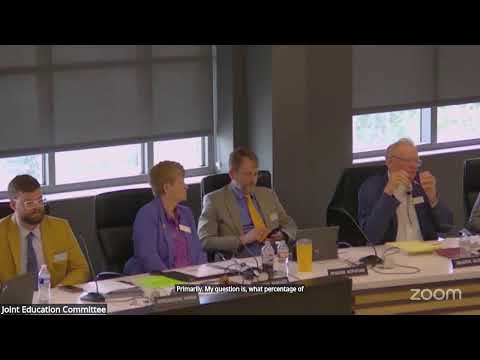
Legislative staff, the Wyoming Department of Education and the Professional Teaching Standards Board briefed the Joint Education Committee on the state’s efforts to recruit and retain K‑12 teachers, including current statutes, recent pilot efforts (teacher apprenticeships and microcredentials) and funding history for earlier loan‑repayment initiatives.
Tanya Heitrick (LSO) opened the committee briefing with a memo titled “K‑12 public school teacher recruitment and retention.” She noted prior programs in statute, including two loan‑repayment programs (teacher shortage and adjunct professor programs) that have since sunsetted or stopped taking new applicants, and described program eligibility and service obligations as outlined in statute.
Why this matters: Wyoming faces hard‑to‑fill subject areas and rural staffing pressures. Committee members asked for data on program participation and whether particular incentives correlate with improved recruitment or student outcomes.
Key program and finance points - Teacher shortage loan‑repayment program: LSO summary said the program (enacted earlier) had appropriations and partial expenditures; participation was limited. An LSO analyst cited an earlier Community College Commission report (2013) showing 93 participants with 34 completing the teacher service obligation; the program’s appropriation partially reverted. LSO said eligibility required Wyoming residency or high‑school graduation in Wyoming and study toward specified endorsements (special education, math, science, world language or reading/ESL endorsements). (T. Heitrick; M. Wilmar) - Adjunct professor program: enacted to support dual‑enrollment instructors; smaller appropriation with most funds expended or encumbered; reported participation was modest. (M. Wilmar) - National Board Certification stipend: the statute authorizes state payments to districts for national board certified teachers and a $4,000 annual stipend; the program has paid roughly $28.5 million over 19 years. An LSO analyst said the state no longer funds application costs (historical private partnership ended) and that after 2021 payments were limited to 15 years per teacher. (M. Wilmar) - Extra compensation statute (21‑13‑324): districts may pay extra compensation for certain hard‑to‑staff positions or as incentives; 11 districts sought reimbursement for extra compensation in the most recent school year LSO examined. (T. Heitrick; M. Wilmar)
Newer initiatives and state efforts - Teacher apprenticeship program (pilot): WDE described an apprenticeship model that recognizes work‑based experience and can be funded through workforce grants. Three districts piloted the apprenticeship; feedback led districts to apply directly to Workforce Services rather than having WDE be the grantee. WDE said it will continue to support districts that pursue the grant through Workforce Services. (D. Schoener; N. Tijeski) - Micro‑credentials: WDE and the Professional Teaching Standards Board (PTSB) reported a computer‑science micro‑credential pilot and quality assurance work with other states on micro‑credential standards; PTSB said micro‑credential “stacks” can be used to add endorsements once quality standards are met. (Brandon O’Connor, PTSB; Nathan Tijeski) - Recalibration and professional supports: WDE staff described the Retention and Recruitment Task Force and other initiatives (principal leadership academy, Innovator Network for teacher‑led professional development, superintendent’s tour of exemplary practices) aimed at leadership development and targeted professional learning to improve working conditions.
Certification pathways and permits Brandon O’Connor (Professional Teaching Standards Board) outlined multiple routes to licensure: the traditional university preparation route, approved alternate‑route programs, apprenticeship pathways and several permit types (career‑industry permits, substitute permits, provisional/exception authorizations). He described a new statutory path (from 2024 legislation) allowing certain accredited alternative programs to lead to a standard license after two successful district‑evaluated years; PTSB reported limited early use of that provision so far.
Questions and data requests from committee members Members asked for more evidence linking incentives to recruitment and student outcomes; LSO and WDE offered to collect additional data and to provide PTSB and external analysis (WDE noted national research indicates positive outcomes for classrooms with national board certified teachers and said it would share supporting studies). Members also asked WDE for a recalculated graduation‑rate view that excludes students who transfer to homeschool or ESA programs per federal guidance; WDE agreed to share comparative calculations.
Public testimony highlights - The Wyoming Education Association (WEA) president, Kim Amen, testified as a former classroom teacher and urged investments in staff‑support, smaller class sizes, counselors and behavioral interventionists as retention measures; Amen also urged careful design of any “teacher bill of rights” to avoid unintended consequences such as punitive, expulsion‑first policies. - Representatives of BOCES and youth‑service providers told the committee that residential and BOCES placements serve high‑needs students and that many students in those programs have mental‑health diagnoses or adverse childhood‑experience histories; speakers said community partners and BOCES play a role in stabilizing students who cannot be safely or effectively served in typical classrooms.
Ending note: next steps LSO, WDE and PTSB agreed to provide follow‑up materials (detailed program participation and finance figures, research on national board certification outcomes, apprenticeship/grant details and comparative graduation‑rate calculations) to help the committee evaluate incentive design and potential scaling of pilots.