Get Full Government Meeting Transcripts, Videos, & Alerts Forever!
Get email alerts on the Transit Safety Cleaning Outreach topic
No spam. Unsubscribe anytime.
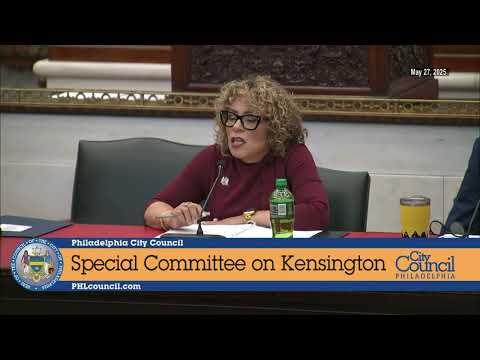
SEPTA details stepped-up policing, cleaning and outreach as Kensington hearing focuses on opioid-era transit impacts
Summary
At a Philadelphia City Council special committee on Kensington hearing, SEPTA Transit Police Chief Chuck Lawson and David Williams, SEPTA senior director of custodial services, described a set of policing, cleaning and outreach actions the authority has taken in response to the opioid crisis and urged continued funding and interagency coordination.
At a Philadelphia City Council special committee on Kensington hearing, SEPTA Transit Police Chief Chuck Lawson and David Williams, SEPTA senior director of custodial services, described a set of policing, cleaning and outreach actions the authority has taken in response to the opioid crisis and urged continued funding and interagency coordination.
The testimony matters because transit riders, employees and adjacent businesses have said stations in the Kensington corridor have become frontline sites for substance use and related disorder; SEPTA officials said the authority’s recent investments have led to measurable declines in serious crime but also are straining the agency’s budget and operations.
Chief Lawson told the committee that "SEPTA has committed to an increased presence of police, cleaning, and outreach resources through the Kensington Corridor." He said the SEPTA Transit Police Department "recorded the largest 1 year decrease in serious crime in the department's 43 year history," noting a 33% drop across serious-crime categories and a 42% reduction in robberies compared with the year prior.
Lawson said the department has grown its uniformed ranks to 248 officers and expects additional hires to reach its new budgeted headcount. "There are more transit police officers spending more time enforcing more laws and safety rules in Kensington than ever before in the history of our department," he said, and he emphasized enforcement of system rules, citing a record of more than 47,000 code-of-conduct removals last year.
David Williams described operational changes behind SEPTA’s cleaning push, including new "pit crews" that perform mid‑route cleaning on Broad Street and Market–Frankford cars and a reorganization that placed cleaning under a newly created deputy chief operating officer for cleaning. "The truck is like a unit on wheels," Williams said of the mobile cleaning units he proposed and described their benefits for faster, higher‑quality station and car cleaning.
SEPTA officials gave several quantitative examples: they said the authority has more than doubled spending on safety, security and cleaning priorities over three fiscal years; that the four Kensington stations each saw better than 20% declines in serious crime in 2024 (a combined 34% corridor decline, with Tioga down 58%); that quality‑of‑life enforcement rose 217%; and that SEPTA budgeted $10 million in fiscal 2026 to install more than 100 full‑length fare gates at nine additional stations after a successful pilot.
Committee members pressed SEPTA on outreach and program oversight. Lawson described the SCOPE program as a "holistic approach focused on partnerships with social service agencies and health navigators," but said SCOPE "is currently in a period of transition." He testified that SEPTA paused several outreach contracts in February to strengthen oversight and contracting practices and that a new third‑party outreach contract is expected to be back in the field effective July 1. "We paused those contracts to investigate some issues that we were having with that contract ... so that we could work through how to build a better, stronger contract with our partners," he said.
Members repeatedly asked for clearer metrics and for common measurement standards across agencies. Lawson recommended citywide alignment on how outreach engagements are defined and measured so contractors can be held to consistent performance standards: "We all gotta get on the same page about how we're measuring engagements, what is an engagement, how are we measuring it," he said. Councilmembers also asked for headcount data by patrol district and for language-access and accessibility details for SEPTA’s customer reporting tools; Williams confirmed the transit watch app supports multiple languages and a text option.
Several council members pressed SEPTA on the balance between enforcement and services. Some members supported stronger enforcement measures on SEPTA to reduce what they described as comfort for people using the system for unsafe activity, while others highlighted that enforcement must be paired with reliable outreach and housing options to avoid moving people from transit into equally unsafe settings. Lawson said the authority deploys a combined strategy of enforcement, cleaning and social‑service referrals and that some elements of the response — notably sustained staffing and specialized cleaning equipment — require additional funding.
The committee asked SEPTA to provide follow‑up materials, including: (1) exact officer staffing numbers by patrol district (specifically the District 4 footprint between Huntingdon and Tioga), (2) details of the new outreach contract and supervision plan for SCOPE, (3) performance metrics SEPTA uses for outreach engagements, and (4) the agency’s plan and timetable for the $10 million fare‑gate expansion and related revenue and ridership impacts.
SEPTA officials asked for intergovernmental cooperation, saying the solution will require collaboration among Amtrak, Conrail, SEPTA, Philadelphia city departments, state agencies and federal partners. The committee closed the panel with a request that SEPTA return with the requested data and with plans for continuing community engagement in Kensington.