Get Full Government Meeting Transcripts, Videos, & Alerts Forever!
Get email alerts on the Local Government topic
No spam. Unsubscribe anytime.
Santa Cruz supervisors renew sheriff military-equipment policy and approve budget, zoning and public-safety items after heated public comment
Summary
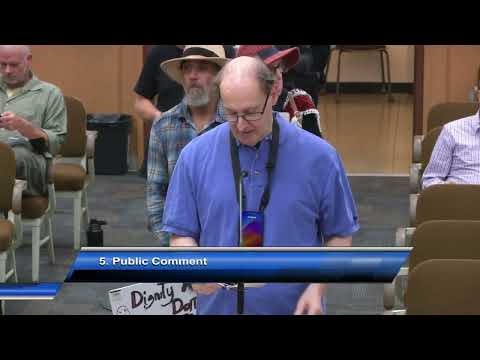
Santa Cruz County supervisors on May 20 unanimously approved the sheriff’s annual military‑equipment report under AB 481 and a package of budget, code and public‑safety measures after hours of public comment that included calls for more notice about the sheriff’s public meeting and demands to slow permitting of grid‑scale battery projects.
Santa Cruz County supervisors on May 20 unanimously approved a series of administrative and policy measures including the annual renewal of the Santa Cruz County Sheriff’s Office military equipment policy under Assembly Bill 481, budgets for Zone 5 flood control capital projects, a local Mills Act program for historic preservation, an issuance of tax‑and‑revenue anticipation notes and multiple code and public‑safety amendments. The meeting drew extended public comment on lithium‑ion battery storage proposals, mental‑health and housing program funding and the adequacy of public notice for the sheriff’s AB 481 report.
The board voted across the agenda in a string of unanimous roll calls after presentations from county staff and agency directors. The most contested public discussion of the morning centered on the sheriff’s report on equipment listed under AB 481, the state law governing acquisition, public reporting and community hearings for “military equipment.” The sheriff’s office presented its 2024 annual report and requested that the county re-adopt its ordinance and findings; the board voted to approve the sheriff’s requested actions after public commenters and civil‑liberties groups asked for additional outreach and a postponement.
Why it matters: The AB 481 process is intended to give the public a yearly, statutory opportunity to review what items — from drones and armored vehicles to distraction devices or precision rifles — a local law‑enforcement agency has and how it used them in public. Public concerns at the May 20 hearing focused on the transparency and publicity of a May 8 public meeting the sheriff’s office held; activists urged a delay so more residents could review the annual report. County staff and sheriff’s representatives said the department will expand reporting and public notification in future cycles and that certain reporting practices (for example, adding AR‑15 deployments to the inventory) will change going forward.
Quotes and public comments
- “Please do not vote on this proposal today,” Peter Gelblum of the Santa Cruz County chapter of the ACLU of Northern California told supervisors during the AB 481 hearing, urging continuation so the required “well‑publicized” meeting could be held in a manner he said the county had not met. He told the board: “A B 4 81 specifically … requires at least one well‑publicized and conveniently located community engagement meeting to discuss the report.”
- Lieutenant Dee Baldwin, the sheriff’s AB 481 coordinator, said the office made two substantive changes in response to public concerns: an expanded inventory and a new capture process for certain weapon deployments. “Next year’s annual report will have the items listed. And then we’ve also now set up the framework to capture those deployments in public,” Baldwin said, adding: “So starting June 1, we’ll be capturing anytime that AR‑15 is deployed into public as a use of force for public review next year.”
Votes at a glance
- Sheriff’s Office AB 481 annual report and re‑adoption of the county military‑equipment ordinance — approved unanimously (Martinez, Koenig, Cummings, DeSerpa, Hernandez: all Aye).
- Zone 5 Flood Control 2025–26 operations and expansion/construction budgets (includes proposed $4.2 million capital allocation, and a requested $500,000 one‑time general‑fund contribution for a Leona Creek culvert lining) — approved unanimously (Cummings, DeSerpa, Hernandez, Martinez, Koenig: all Aye).
- Mills Act historic‑preservation program (opt‑in tax incentive for private owners of eligible historic properties; staff proposed a 20‑contract cap and outline of assessor valuation changes) — board approved concept and directed next steps; motion passed unanimously (Koenig, Martinez, Cummings, DeSerpa, Hernandez: all Aye). The assessor estimated a realistic ongoing general‑fund revenue loss of roughly $22,880/year at full enrollment (20 properties) and a maximum theoretical loss of about $65,520/year; upfront assessor programming costs were estimated at about $10,000.
- Tax and revenue anticipation note (TRAN) issuance, not to exceed $42 million, to smooth county cash flow — approved unanimously (Koenig, Martinez, Cummings, DeSerpa, Hernandez: all Aye).
- Mosquito and vector control benefit assessment rate reports (CSA 53 and north/south subareas) — board opened and closed the required public hearing and confirmed the reports (Koenig, Martinez, Cummings, DeSerpa, Hernandez: all Aye). Staff said the three assessments together are expected to generate about $1.7 million for 2025–26, though the program continues to rely on reserve funds for full operations.
- Code update and zoning correction package (miscellaneous amendments to county code and local coastal program; included one parcel rezoning to match historic allowed use) — approved (DeCerpa, Cummings, Martinez, Koenig, Hernandez: all Aye).
- Ordinance change allowing CAL FIRE to administer certain backyard burn permits and related amendments — approved (Cummings, Koenig, Martinez, DeCerpa, Hernandez: all Aye).
- Adoption of proposed fire hazard severity zone ordinance (designating very‑high/high/moderate wildfire hazard areas in the county’s local responsibility area) — board approved concept and scheduled a second reading (DeCerpa, Cummings, Martinez, Koenig, Hernandez: all Aye). County staff emphasized the maps will trigger building‑code (7A) and defensible‑space requirements in locally designated very‑high and high areas.
- Measure Q (parks/environment ballot measure) implementation timeline adjustment — staff asked the board to move the Vision Plan target date from July to October to permit more stakeholder and public engagement; board directed staff to add a community meeting within the Third District and otherwise approved the schedule change (Koenig, Martinez, Cummings, DeSerpa, Hernandez: all Aye).
- Illegal dumping fine increase (amend county code to raise fines; recommended first offense $2,500, second $5,000, subsequent $10,000) — board approved concept and asked staff to report back on how other counties apply similar fines; motion passed unanimously. County staff noted recent investments in camera surveillance at dumping hot spots, an active code‑compliance investigator and partnerships with sheriff’s investigators; the county reported it removed roughly 855 tons of illegally dumped material in 2024 and spent an estimated $457,000 on cleanups in FY 2024–25.
Other notable actions and reports
- Strategic planning and “health‑in‑all‑policies” report: staff described a proposed Health in All Policies (HiAP) approach and possible community indicators to track countywide outcomes (health access, mental‑health days, housing point‑in‑time count, job quality, transportation alternatives, EV infrastructure and greenhouse‑gas emissions). The board directed staff to continue integrating HiAP questions into the strategic plan refresh and suggested pursuing pilot projects and outside funding where feasible.
- Pride recognition: supervisors received a presentation recognizing 50 years of Santa Cruz Pride and the county’s historic role in LGBTQ+ advocacy.
What the board asked staff to do next
- Sheriff AB 481: expand public notification for the annual meeting and file more granular deployment reporting (the sheriff’s office also told the board it will include AR‑15 deployments in next year’s captured inventory).
- Illegal dumping: county staff will coordinate with neighboring counties (Monterey, San Benito, Santa Clara) to study fine enforcement patterns and return to the board with findings no later than September to inform implementation.
- Measure Q: staff will proceed with a more deliberate outreach schedule and add a community meeting in District 3 as directed.
Context and clarifying details
- AB 481 / military equipment: County staff said the sheriff’s office received no formal complaints in the 2024 reporting year related to listed equipment; internal audits continue monthly and some items have been removed from the inventory after review. The sheriff’s office also said it will record and publish AR‑15 deployments beginning June 1 and include them in next year’s report.
- Zone 5 flood district: staff proposed to allocate roughly $4.2 million in capital projects for priority culvert and storm‑drain improvements (including Pipe lining in Leona Creek under Capitola Road) and to use an existing capital reserve (starting fund balance noted around $3.9 million). The budget proposal included a discretionary $500,000 general‑fund request to finish the Leona Creek lining.
- Mills Act: Assessor’s office explained Mills Act valuation methodology (a specialized income approach) and estimated the county’s potential annual tax revenue impact at about $22,880 (realistic case) to $65,520 (upper bound) if 20 properties enroll; assessor implementation requires changes to assessor software and an estimated $10,000 in up‑front programming costs.
- Illegal dumping/litter: staff reported roughly 855 tons of illegally dumped material removed in 2024 and projected county spending of about $457,000 on illegal‑dumping response during FY 2024–25; litter‑abatement spending across county programs in the same year was reported near $865,000.
What the public asked for
- Stronger notice and additional public meetings around sheriff AB 481 reporting, with multiple residents and civil‑liberties groups urging the board to continue the item and provide larger, well‑publicized in‑person outreach opportunities.
- A moratorium or stronger review and county oversight for large lithium‑ion battery storage projects: numerous members of the public urged the board to slow project approvals, convene technical and fire‑safety experts and consider a moratorium until state codes and standards settle.
Next steps and timeline
County staff will return with follow‑up materials by late summer and fall: a report on illegal‑dumping enforcement practices in neighboring counties (requested by the board), further options for HiAP integration and community indicators (as part of the strategic‑plan refresh), and the Mills Act application materials and contract template for launch next year.
Ending note
Supervisors said they expect continuing community concern about both the disclosure and use of military equipment and the pace of permitting for new technologies such as grid‑scale batteries. Staff emphasized their intent to expand outreach and take additional administrative steps meant to increase transparency before next year’s reporting cycle.