Get Full Government Meeting Transcripts, Videos, & Alerts Forever!
Get email alerts on the Clean Tech Economic Development topic
No spam. Unsubscribe anytime.
Greater Sacramento Economic Council outlines clean‑tech pipeline tied to air‑quality goals
Summary
The Greater Sacramento Economic Council told the Sacramento Metropolitan Air Quality Management District board on May 22 that nearly a third of its active business pipeline is in clean‑tech and mobility, highlighting local hydrogen, battery and circular‑economy projects that intersect with regional air‑quality priorities.
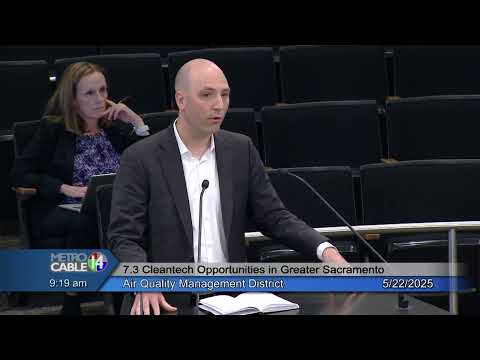
Trolls Adrian, executive vice president of the Greater Sacramento Economic Council, told the Sacramento Metropolitan Air Quality Management District (AQMD) board on May 22 that the region’s economic‑development pipeline includes 108 active projects, of which 33 are in clean‑tech and mobility.
Why it matters: Adrian and AQMD staff framed the region’s clean‑tech activity as directly linked to the agency’s air‑quality work — from hydrogen fueling and biomass‑to‑hydrogen facilities to battery‑related manufacturing and circular‑economy projects — and said continued coordination is needed to translate those projects into emissions reductions and jobs.
Adrian said the council’s May 1 pipeline count showed “somewhere between a quarter and a third” of its 108 active projects are clean tech, and that the sector is the top driver of inbound economic activity. He described the region’s strengths as a large labor pool, high STEM degree attainment and proximity to Bay Area research and Nevada production capacity. “We really are becoming this hub, an ecosystem of, integration of these economic development projects that have a very direct link and benefit to air quality,” Adrian said.
AQMD program manager Paul Filley described several local projects that AQMD staff are tracking and supporting. Filley said ecomotive hydrogen will operate on Twin Cities Road near I‑5, converting agricultural biomass into hydrogen; another effort, Carbon 0, will produce biochar from agricultural waste for soil amendment and sequestration; and Sacramento Sewer’s biogas project converts waste into usable energy. “They’ll be taking biomass and converting it into hydrogen,” Filley said of the Twin Cities Road project.
Air Pollution Control Officer Dr. Ayala emphasized the agency’s role in linking economic development and air quality priorities. He told the board AQMD staff would return with overlays tying the council’s pipeline to specific projects the board may want to support, and he invited board members to visit operating sites and ribbon cuttings as projects come online.
Dr. Ayala also reported an agency milestone: AQMD has submitted documentation to the U.S. Environmental Protection Agency (EPA) showing the Sacramento Federal Nonattainment area has met the 2008 ozone standard, and EPA has reacted positively to the submission. “It’s just a matter of the administrative process,” he said, adding AQMD hopes to host the regional EPA administrator for a recognition event once the agency completes its final sign‑off.
Board members asked about federal policy and workforce connections. Vice Chair Maple asked whether changes at the federal level — including modifications to Inflation Reduction Act incentives — could slow investment. Adrian said federal incentives spurred an early pipeline spike but predicted medium‑ and long‑term industry demand will continue toward electrification; he added a pullback could strengthen the relative attractiveness of California because of ongoing state support.
Director Dickinson and others asked about educational partnerships. Adrian said GSAC routinely engages UC Davis, Sacramento State and local institutions on projects and noted UC Davis’s transportation research helped arrange international visits tied to clean‑tech recruitment.
Board members and staff discussed Metro Airpark as a regional cluster: Adrian said three of the council’s eight clean‑tech “locates” in the past two years occurred in Metro Airpark. AQMD staff noted other hydrogen infrastructure efforts in the area, including SACRT’s fleet conversion plans and Guardian Yards at Metro Airpark, and proposed follow‑up briefings and site tours when feasible.
No formal board action was taken at the May 22 meeting; the board did not reach quorum for action items and proceeded to receive the presentation. AQMD staff said some time‑sensitive items will require a future special meeting or online option.
The presenters, AQMD staff and board members were consistent in distinguishing discussion from decision: the council presented economic pipeline data and recruitment work; AQMD staff described the agency’s technical and permitting role and reported a pending EPA administrative step on ozone attainment; no ordinance, contract award or budget decision was made during this presentation.
Ending note: Speakers invited ongoing collaboration and site visits as projects progress, and AQMD said it would return with more detailed overlays linking specific projects in the pipeline to regulatory and permitting touchpoints the board oversees.