Get Full Government Meeting Transcripts, Videos, & Alerts Forever!
Get email alerts on the Development Code Amendments topic
No spam. Unsubscribe anytime.
Charlottesville planning commission hears staff plan for tiered development-code amendments, timelines for public hearings
Summary
City planning staff outlined a three-tier approach to fix technical errors, clarify ambiguities and pursue larger policy changes to the development code adopted in December 2023; commissioners pressed for more touch points with council and public engagement on complex items.
At a work session, Charlottesville planning staff presented a package of proposed development-code amendments organized into three tiers and outlined a schedule of reviews and public hearings aimed at updating the code adopted Dec. 18, 2023.
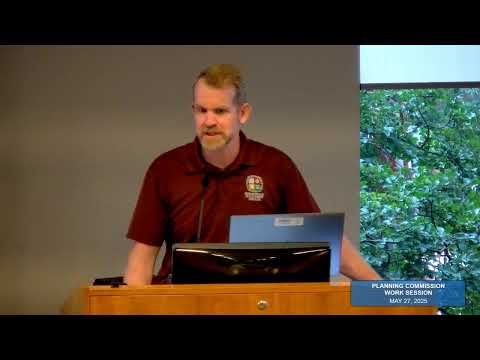
Matt, the development planning manager for Neighborhood Development Services (NDS), said the “three-tiered approach” is intended to separate minor edits from deeper policy changes so staff can advance technical fixes more quickly while reserving extensive community engagement for larger questions. “Our current development code was adopted on 12/18/2023,” Matt said, and “we plan to update tier 1 and tier 2 on an annual basis to ensure the code remains adaptable.”
Why it matters: The package responds both to drafting errors and to recent state law changes that affect local review processes; it also frames larger questions — building form, height measurement, fences, lighting for athletic fields, and a pathway for attached dwelling types in some residential districts — that could affect development patterns, permitting timelines and how residents interact with new projects.
Key points from staff
- Tier 1: technical corrections and compliance updates. Staff said these changes are chiefly copy edits, minor clarifications and amendments required by actions of the Virginia General Assembly. Matt told the commission that, "Under HB 2660, review deadlines for site plans, development plans, and subdivisions have been shortened ... that time frame has been shortened from 10 days to 5 days." He said most Tier 1 changes will proceed to a public hearing with the goal of adoption this fall.
- Tier 2: clarifications and fixes to resolve oversights. Examples include adjustments to the fee schedule; streamlining review for one- and two-unit construction so applicants can apply for building permits rather than full development review; and creating a dedicated application type for sublots and easement plats to improve tracking.
- Tier 3: deeper policy changes that require broad outreach and more time. Staff called Tier 3 items “big picture” matters that demand analysis and community engagement, including reexamining how height is measured (feet versus stories), the treatment of fences and walls, defining bonuses for existing structures, clarifying rules in the RNA (residential neighborhood) district, and active-frontage/parking-structure rules.
State-law changes and procedure
Staff flagged two state law items as drivers for code edits. According to staff, HB 2660 shortens review acceptance time frames; SB 974 shifts certain site-plan, development-plan and subdivision approval authority from the planning commission to administrative staff. Matt summarized that "Under SB 974, authority to review site plans, development plans, and subdivisions is shifting fully from planning commission to staff." He said the code will need multiple edits to align with those changes and that staff will reflect many of the state-driven updates in the department’s review manual as well.
Timeline and next steps
Staff described the next steps as: a staff/council work session (noted on staff slides for June 16), refinement from June through August, a planning commission public hearing targeted for Sept. 9, a city council public hearing targeted for Oct. 20, and a hoped-for adoption by Nov. 3; staff emphasized those dates are subject to change.
Commissioner feedback and themes
Commissioners broadly supported the tiered approach but pushed staff for more clarity and additional touch points before formal hearings. Commissioner Rory asked whether the city’s Standards and Design Manual (SADM) will be reviewed in coordination with the code, noting past discussions that tied the two documents together. Several commissioners urged staff to provide clearer schedules and to bring certain technically complex Tier 3 items earlier for detailed discussion rather than waiting until a public hearing.
The alternate-form proposal to allow attached dwellings in certain residential districts drew concentrated attention. Staff described an alternate-form path that would permit attached units in districts that currently have a 4-foot side separation requirement, while otherwise holding district regulations in place. Commissioners raised concerns about nonconformity impacts, building massing and how a final draft would affect lot coverage and block-scale outcomes; several asked to see a revised draft and recommended that the commission and staff schedule a focused work session on that item.
Other recurring subjects included active-frontage and garage/parking configuration rules, fence definitions and measurements (including how guardrails on elevated decks are treated), and the existing-structure bonus qualification date. Commissioners and staff discussed moving some items out of Tier 3 into Tier 2 where appropriate to speed noncontroversial fixes, while reserving extensive outreach for items that require broader public input.
Formal actions
The meeting concluded with a motion to adjourn that was moved and seconded and the chair declaring the meeting adjourned; no roll-call vote was recorded.
What comes next
Staff said they will incorporate the commission’s comments into revised materials, seek additional stakeholder input on complex Tier 3 topics, and return with drafts for the scheduled public hearings. Dates and specific phasing remain subject to change as staff refines the proposals and coordinates with city council.