Get Full Government Meeting Transcripts, Videos, & Alerts Forever!
Get email alerts on the Public Camping Implementation topic
No spam. Unsubscribe anytime.
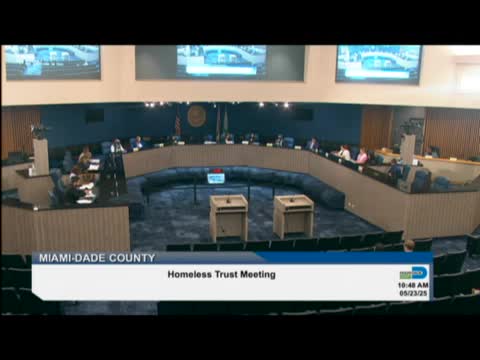
Trust updates members on implementation of Florida public‑camping law and outreach activity
Summary
Staff reported on actions after Florida's public‑camping ban (HB 1365), changes in outreach and sheltering capacity, a new homeless reporting tool and several housing projects in progress.
Staff updated the Miami‑Dade County Homeless Trust on implementation steps following Florida’s ban on public camping and sleeping (HB 1365) and described expanded outreach, reporting and housing placements.
The memo staff distributed summarizes January point‑in‑time decreases, lists mayoral memos issued after the law, and outlines operational responses. Staff said the Trust has scaled up outreach and short‑ and long‑term capacity, created a homeless reporting tool that has logged about 170 records (20–25 remain open), and recorded two formal complaints that staff said were mitigated in a timely manner.
Staff also reported continued client movement into a hotel‑to‑housing project operated under the New Hope Core model, ongoing capital improvements at an eight‑unit Wynwood acquisition (design is complete and permitting is underway) and progress on the Blue Village project. The Trust also reported a commitment tied to the county mental health center for some permanent housing developments.
Why it matters: HB 1365 changes how jurisdictions may address unsheltered camping and sleeping; the Trust’s operational changes, reporting tools and housing projects are the local responses to meet legal requirements while providing alternatives to unsheltered living.
Board discussion and next steps: staff presented the memo as an informational item and did not seek a vote. Board members asked clarifying questions about complaint handling and outreach; staff said they would not read the memo point‑by‑point but that it was available in the meeting packet.